The short version
- Hyde County, North Carolina, is conducting a six-month trial using Pivotal’s BlackFly electric aircraft to transport paramedics to emergency scenes in rural areas.
- The single-seat eVTOL allows one person to serve as both pilot and medic, reducing response times significantly compared to ground vehicles in difficult terrain.
- While major manufacturers focus on urban air taxis, this application highlights immediate utility for emergency services despite current limitations in range and payload.
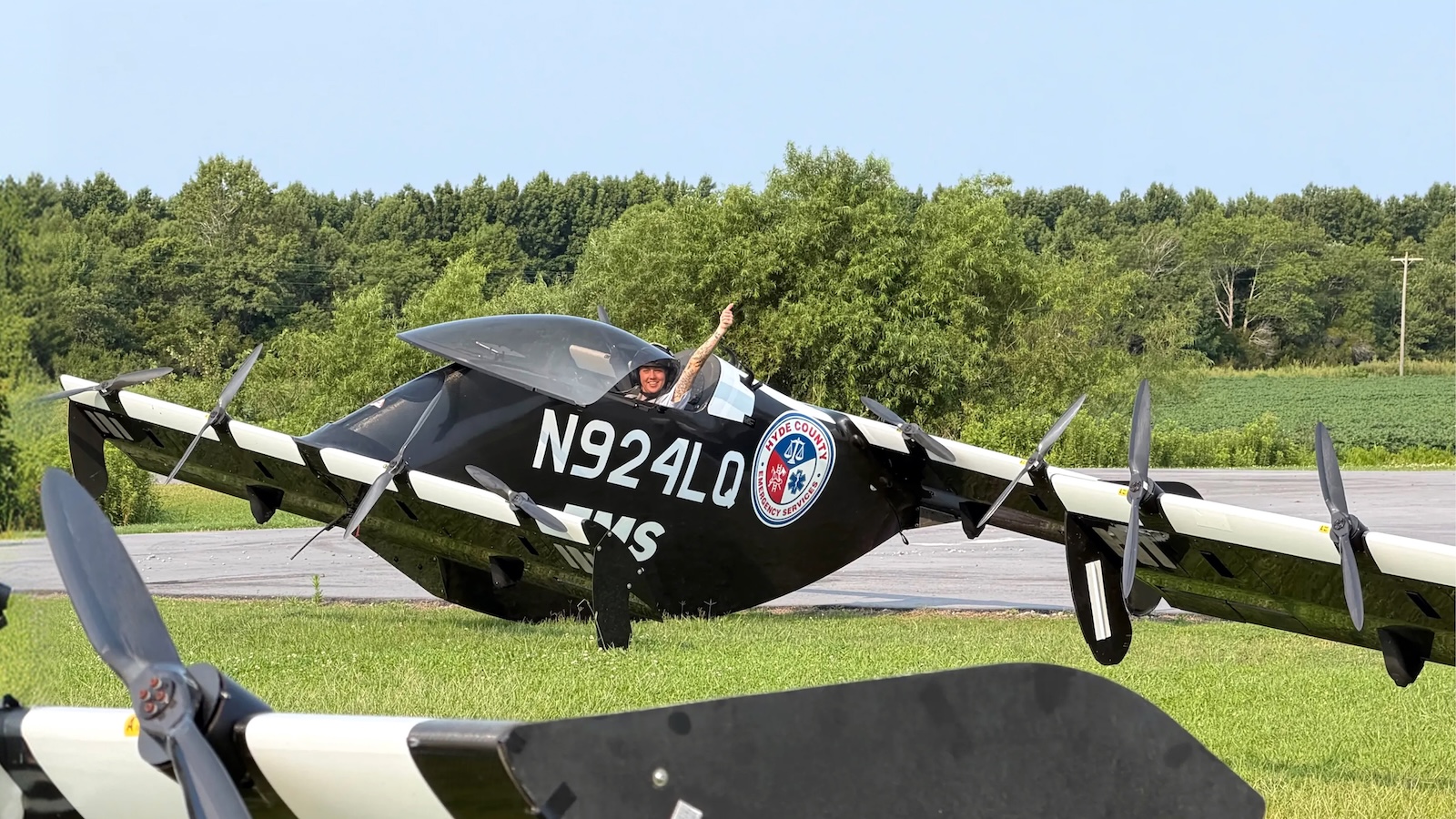
A new trial in rural North Carolina is testing whether electric vertical takeoff and landing aircraft can improve emergency medical response times. In Hyde County, a region characterized by coastal farmland and marshlands, paramedics are using a small, single-seat electric aircraft to reach patients more quickly than traditional ground ambulances. The program, launched in March with Pivotal, aims to address the challenges of covering 1,459 square miles of land and water where response times can be prolonged by distance and terrain.
During one incident, paramedic Quinn Reece piloted a BlackFly aircraft, which resembles an oversized drone with eight propellers. After receiving a dispatch for an emergency, she realized the location data provided by the county’s app was incorrect. Drawing on prior knowledge of the area from previous flights, Reece used the aircraft to visually confirm the correct site and relayed that information to other paramedics en route. She arrived at the scene twenty minutes before the ground team, allowing her to begin administering care immediately.
Brook Cox, the county’s emergency medical services chief, initiated the six-month pilot program to evaluate whether this technology could enhance patient outcomes. Before deploying the aircraft for actual 911 calls, the county conducted more than 300 training flights to ensure safety and operational readiness. The goal is to leverage the aircraft’s ability to fly directly to private addresses, bypassing road networks that may be congested or inaccessible.
This application diverges from the high-profile vision of electric aviation often promoted by major manufacturers and regulators. While companies like Archer Aviation and Joby Aviation are focusing on urban air taxi services and the Federal Aviation Administration is highlighting passenger transport in its integration pilot programs, Hyde County is exploring immediate utility for emergency services. The FAA recognizes emergency medical response as a critical use case, particularly in rural areas where traditional helicopter support may be limited or costly.
The BlackFly aircraft simplifies operations by allowing a single individual to act as both pilot and medic. Kristina Menton, vice president of flight at Pivotal, noted that the simplified controls remove much of the complexity associated with traditional aviation. Cox described the system as intuitive, relying on screen prompts that guide the operator through necessary steps. This design reduces the need for separate flight crews, making it more feasible for smaller jurisdictions to adopt the technology.
Industry experts view these developments as complementary rather than competitive. Carl Dietrich, founder of Jump Aero, sees Pivotal’s work as proof of concept that validates the broader potential of electric aircraft in emergency response. Jump Aero is developing its own aircraft, the JA1 Pulse, which aims for higher speeds and greater range. Dietrich emphasized that these vehicles are not intended to replace helicopters or ambulances entirely but to add a new layer of rapid response capability.
Current limitations include battery range and payload capacity. The BlackFly can travel approximately 20 miles on a single charge and carry up to 200 pounds, while the JA1 Pulse is designed for 70 miles and 350 pounds. These constraints mean the aircraft are not suitable for transporting patients over long distances. Instead, their primary role is to reach emergency scenes quickly, stabilize patients, and wait for ground ambulances to arrive.
Rural areas may offer a more straightforward path for integrating this technology compared to dense urban environments. April Zhang, director of advanced air mobility at the University of South Florida’s Center for Urban Transportation Research, noted that finding suitable landing and takeoff sites in cities presents significant challenges. In contrast, rural landscapes often provide more open space for operations, facilitating easier deployment and testing of these emerging aviation solutions.
The broader promise of electric aviation lies in its potential to decarbonize flight while offering new operational efficiencies. As trials like the one in Hyde County continue, they provide real-world data on how these aircraft can function in critical scenarios. The success of such programs could influence regulatory frameworks and encourage wider adoption across other rural communities facing similar logistical hurdles in emergency response.
Sources behind this briefing
Go to the original reporting
- Grist↗Electric aviation is taking off in unexpected ways