The short version
- Researchers Violet Anniskett and Tony Fischbach discovered the five-month-old calf in September while conducting toxin sampling on a remote Alaskan beach.
- The animal, named Annautaq, required immediate intervention to protect him from scavengers and predators before being transported over 800 miles for professional care.
- Federal wildlife authorities ruled that human imprinting prevented his release into the wild, leading to his permanent placement at a Florida marine park.
A young male Pacific walrus discovered alone on a remote Alaskan beach has been permanently relocated to SeaWorld Orlando in Florida. The transfer marks the conclusion of a complex rescue and rehabilitation effort that began in early September, when wildlife researchers identified the orphaned calf near the carcasses of adult animals. Federal officials determined that the animal had become too accustomed to human interaction to survive if returned to its natural habitat, necessitating a permanent placement in captivity where he can serve as an educational ambassador for his species.
The discovery occurred on September 11 during a scientific survey conducted by Violet Anniskett, a college student and member of the local Inupiaq community, and Tony Fischbach, a wildlife biologist with the U.S. Geological Survey. The pair was tasked with collecting samples from fresh Pacific walrus carcasses to test for algal toxins, aiming to establish baseline health data for the population. Their routine work took an unexpected turn when they spotted a lone, living calf positioned between two dead adults on the beach in northwestern Alaska.
Before initiating any rescue efforts, the researchers prioritized cultural and regulatory protocols. Anniskett emphasized the importance of consulting with her local community, noting that subsistence harvesting is a significant part of Inupiaq culture. They sought approval from both the U.S. Fish and Wildlife Service and the broader community to intervene. Once permission was granted, the team faced immediate logistical challenges due to severe weather conditions that grounded transport options for several days.
During this waiting period, Anniskett and Fischbach provided temporary shelter for the approximately 185-pound calf in an abandoned building on the island. The situation was precarious; a flock of gulls attempted to scavenge the young animal, and two polar bears were active in the vicinity. Lacking specialized formula, the researchers sustained the calf with a mixture of honey and water. Despite initial apprehension, Anniskett developed a close bond with the animal, which sought physical contact for comfort and struggled to sleep without her presence nearby.
The transportation phase presented further difficulties. Community members assisted in moving the walrus to a local airport, where he was placed in a heavy-duty kennel for air travel. The confinement caused significant distress for the calf, who appeared confused and upset by the sudden change in environment. After traveling more than 800 miles south, the animal arrived at the Alaska SeaLife Center in Seward on September 14. Upon arrival, he was dehydrated but otherwise in stable condition, with superficial wounds that were treated using antibiotics and anti-inflammatory medications.
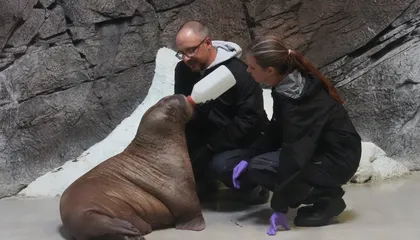
Rehabilitating Pacific walrus calves is an intensive process due to their strong maternal bonds, which typically last one to two years—significantly longer than those of other pinnipeds like harbor seals. Caretakers at the facility acted as surrogates, providing constant physical contact, social interaction, and veterinary support. The calf, named Annautaq after Anniskett’s father, responded well to this round-the-clock care. He gained weight steadily, reaching approximately 250 pounds while receiving up to six bottle feedings daily.
Despite successful rehabilitation, the U.S. Fish and Wildlife Service concluded that releasing Annautaq back into the wild was not feasible. The extensive human contact required for his survival had resulted in imprinting, making him vulnerable to predators and unable to fend for himself independently. Consequently, SeaWorld Orlando was selected as his permanent residence. The facility stated that he would contribute to conservation education efforts while living in a controlled environment.
Annautaq has since completed his quarantine period at the Florida park. He is currently undergoing gradual introductions to other walruses, including Uki, a two-year-old male also rescued from Alaska. The two animals recently made contact through a protective barrier, signaling the beginning of Annautaq’s integration into a new social group. This outcome highlights the complex intersection of wildlife conservation, cultural respect, and animal welfare in managing orphaned marine mammals.
Sources behind this briefing
Go to the original reporting
- Smithsonian Magazine↗This Adorable, Orphaned Baby Walrus Was Rescued by Two Researchers in Alaska. Now, He's Found a New Home in Florida