The short version
- Simulations show cometary impacts were too infrequent and violent to preserve hydrogen cyanide on early Earth.
- The same conditions may have allowed organic molecules to survive better on Mars due to its thinner atmosphere.
- Researchers suggest asteroids or indigenous chemical processes remain stronger candidates for seeding life.
A foundational theory regarding the origins of life on Earth is facing significant scrutiny following new computer simulations that challenge the role of comets in delivering essential biological ingredients. For decades, scientists have posited that icy bodies from the outer solar system acted as celestial couriers, bringing complex organic molecules to our planet during its formative years. However, recent analysis suggests this delivery mechanism was likely far less effective than previously thought, potentially ruling out comets as the primary source of the chemical precursors necessary for life.
The study, published in Scientific Reports by researchers at the University of Cambridge, focused specifically on hydrogen cyanide. This molecule is critical because it contains carbon, nitrogen, and hydrogen, serving as a precursor for lipids, sugars, and nucleotides. Its strong chemical bonds make it relatively stable compared to other organic compounds, allowing it to potentially survive the violent entry into Earth's atmosphere. If hydrogen cyanide could not be delivered effectively by comets, the researchers argue, then more fragile and complex molecules would have faced even greater odds of destruction.
The simulations revealed that the window for successful delivery was narrow and fraught with obstacles. During Earth's first 500 million years, the frequency of comet impacts declined rapidly. In more than half of the simulated scenarios, no cometary impacts occurred at all. When collisions did happen, they were often too few to provide a sustained supply of necessary chemicals. Only a small fraction of simulations resulted in multiple impacts, suggesting that the sheer volume of material delivered was likely insufficient to kickstart biological processes.
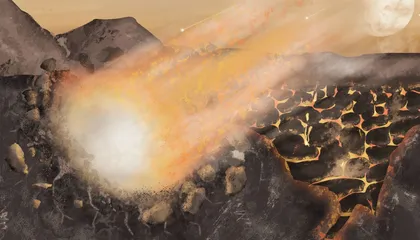
Even when impacts did occur, the physical conditions made survival unlikely for the hitchhiking molecules. Most comets struck Earth at high velocities and steep angles relative to the atmosphere. These high-energy collisions would have generated intense heat and pressure, vaporizing hydrogen cyanide before it could reach the surface. The researchers noted that the immediate post-impact environment was characterized by extreme temperatures that are hostile to prebiotic chemistry, effectively neutralizing any potential benefits from the delivered organics.
Furthermore, even if some molecules managed to survive the atmospheric entry and landed in Earth's early oceans, they would have faced rapid dilution. The vast volume of water would have dispersed the concentrated chemicals quickly, likely before any complex chemical reactions could take place. For life to emerge, specific conditions must align, including the presence of liquid water and other supportive chemicals in close proximity to the delivered organics. The simulations suggest that this precise alignment was practically impossible on early Earth given the nature of cometary impacts.
The findings do not entirely rule out the possibility of a rare, fortuitous impact that successfully delivered life's ingredients. However, the researchers emphasize that such an event would be a statistical outlier rather than a reliable mechanism. The study also highlights that other criteria must be met for these molecules to contribute to life's origins, creating a high barrier for cometary delivery theories. This uncertainty leaves open questions about how Earth acquired the necessary components for biology if not through this common channel.
Interestingly, the simulations point to Mars as a more plausible candidate for successful cometary delivery. The Red Planet's smaller size and thinner atmosphere would have allowed comets to strike at lower velocities and shallower angles, reducing the likelihood of vaporizing organic molecules. This suggests that if comets did deliver life's building blocks anywhere in the inner solar system, Mars was a more likely recipient than Earth. This shift in perspective could influence future missions aimed at searching for signs of past or present life on Mars.
The researchers caution that their model did not account for chemical reactions occurring within the comets themselves before impact. It is possible that hydrogen cyanide transformed into sturdier compounds while still in space, which might have survived the journey better. Additionally, other delivery mechanisms remain viable. Asteroids, which were more frequent visitors to early Earth, could have provided a steadier supply of organic material. Alternatively, the necessary chemistry may have originated entirely on Earth without any extraterrestrial assistance, challenging the assumption that life's ingredients must come from space.
This new research reorients the scientific conversation around abiogenesis by highlighting the limitations of cometary delivery. While the idea of life being seeded from space remains compelling, the data suggests it is an unlikely scenario for Earth. The focus may now shift toward understanding how indigenous chemical processes or asteroid impacts contributed to the emergence of life. As scientists continue to refine these models, the mystery of life's origins remains as enigmatic as ever, but with a clearer view of which pathways are less probable.
The implications extend beyond theoretical biology to practical astrobiology. If comets were not effective distributors of organic molecules on Earth, their role in seeding other planets may also be limited. This could affect how scientists interpret data from missions to Mars and other celestial bodies. Understanding the true source of life's ingredients is crucial for identifying where else in the universe life might exist. The study underscores the need for continued investigation into alternative mechanisms that could explain the diversity of life forms we see today.
Sources behind this briefing
Go to the original reporting
- Smithsonian Magazine↗What Seeded Life on Earth? New Research Challenges the Longstanding Theory That Comets Brought the Ingredients to Our Planet