The short version
- Octopuses employ distinct multi-step maneuvers to pass through openings, adjusting their technique based on whether the gap is larger or smaller than the distance between their eyes.
- Common octopuses successfully navigated tight spaces by using leverage with their arms, while Mayan octopuses refused to attempt passage through holes smaller than their head width.
- The findings highlight the unique physiological resilience of cephalopods, whose soft bodies allow extreme deformation that would cause fatal brain trauma in vertebrates.
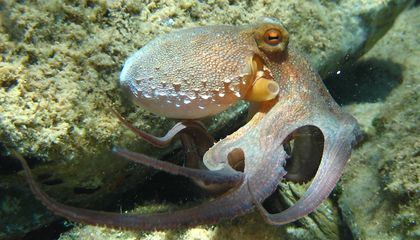
Scientists have long been fascinated by the ability of octopuses to slip through impossibly small gaps, a trait that allows them to evade predators, hunt hidden prey, and escape confinement. While these feats of flexibility are well-documented in nature and captivity, the precise mechanical processes behind them remained largely unexamined until now. A new study published in the Journal of Experimental Biology provides a detailed breakdown of how these creatures contort their bodies to pass through tight spaces, revealing a complex sequence of movements rather than simple squishing.
The research team, led by biologists from Italy and Austria alongside roboticists from Singapore, conducted controlled laboratory experiments to observe this behavior. They worked with three subadult common octopuses and four juvenile Mayan octopuses. To establish a baseline for each animal’s rigid anatomy, the researchers measured the distance between the eyes of each specimen. This measurement is critical because it corresponds to the size of the semi-rigid cartilaginous casing that protects the brain, which is one of only two stiff structures in an otherwise pliable body.
The experiment involved placing individual octopuses in tanks with adjustable acrylic partitions. The team created central holes that were either larger or smaller than the measured eye-to-eye distance, which ranged from approximately 0.4 to 1.4 inches across the subjects. By filming the animals as they attempted to pass through these openings, the researchers could analyze the specific postures and limb movements employed during the process.
When the opening was larger than the distance between their eyes, common octopuses utilized a consistent three-step strategy. First, they extended a single arm into the hole, forming a U-shape at the entrance before pushing the limb through. This initial probe likely serves a tactile function, allowing the animal to assess the size and nature of the gap. Once the first arm was through, the octopus threaded several additional limbs into the space.
The final stage of this maneuver involved using the arms already inside the hole to push against the back side of the partition. This action created leverage, enabling the octopus to pull the remainder of its body through the opening. The researchers noted that this methodical approach suggests a high degree of coordination and spatial awareness, rather than random thrashing or passive compression.
However, when faced with holes smaller than their eye-to-eye distance, common octopuses modified their technique. They still began by probing and threading arms through the gap, but they divided the final pulling stage into two separate steps. After getting all eight limbs through, they paused before pulling their head and mantle through the constriction. The researchers found this adjustment logical, as it allowed the animal to manage the physical strain of passing its largest rigid structure through a tight space in manageable increments.
In contrast, Mayan octopuses displayed different behavior when confronted with small holes. While they used similar strategies for larger openings, they completely ignored gaps smaller than their head width, making no attempt to squeeze through. The reasons for this species-specific difference remain unclear, though the authors suggest it may stem from variations in biology or natural habitat environments. Other octopus species likely possess their own unique adaptations for navigating confined spaces.
The study also underscores the remarkable physiological tolerance of cephalopods. Unlike vertebrates, which have rigid skeletons and fixed brain cases, octopuses can withstand significant physical distortion without injury. An independent neuroethologist noted that if a human or other backbone-bearing animal attempted similar deformation, the resulting pressure on the brain would likely cause severe concussion or death. This resilience allows octopuses to resume normal activities immediately after such extreme contortions.
Beyond biological curiosity, these findings have practical applications in engineering. Understanding the step-by-step mechanics of how soft bodies navigate tight spaces can inform the design of soft robots. Such machines are increasingly being developed for search-and-rescue missions and other tasks requiring access to small, irregular cavities. By mimicking the octopus’s use of leverage and staged movement, engineers may create more efficient and durable robotic systems.
While this research clarifies the mechanical process of squeezing through holes, questions remain about the internal physiological costs of these movements. Scientists do not yet fully understand how octopuses manage the physical demands on their tissues and organs during such extreme deformation. Future studies may explore these biological limits further, potentially revealing even more about the unique capabilities of these intelligent marine animals.
Sources behind this briefing
Go to the original reporting
- Smithsonian Magazine↗Octopuses Are the Ultimate Escape Artists. Now Scientists Know How the Creatures Contort Themselves to Squeeze Through Tiny Holes