The short version
- The Library of Congress purchased a 1760 letter from Martha Washington for $47,500, marking the first known surviving document in her own handwriting.
- The correspondence updates a friend on the health of her young daughter Patsy, who was suffering from symptoms now identified by historians as epilepsy.
- This acquisition joins another recent purchase of a letter from Mary Todd Lincoln, expanding the institution's collection of personal First Lady correspondence.
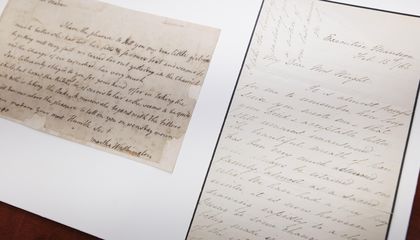
The Library of Congress has added a significant artifact to its manuscript division, acquiring a handwritten letter from Martha Washington that provides a rare window into her private family life. Purchased in June through Heritage Auctions for $47,500, the document was funded by the James Madison Council’s Edwin L. Cox Legacy Trust. This acquisition is particularly notable because it represents the first surviving letter known to be written entirely in Martha Washington’s own hand, distinguishing it from the eleven other letters she authored that are already held by the library.
Dated September 29, 1760, the note was addressed to Margaret Bolan Green and focused on the health of Martha’s four-year-old daughter, known as Patsy. In the brief message, Martha conveyed relief regarding her child’s condition, noting that the girl had stopped experiencing fits and fevers and appeared to be recovering quickly. Elizabeth Novara, a specialist in American women’s history at the library, emphasized that such documentation is crucial for understanding the domestic realities of women during this era, given that Martha Washington appears to have destroyed most of her private correspondence.
Patsy, whose full name was Martha Parke Custis, was one of four children Martha had with her first husband, Daniel Parke Custis. The family endured significant tragedy early on; Daniel died suddenly in 1757 at age 45, leaving Martha a widow with two surviving children, Patsy and John Parke Custis. Two years later, Martha married George Washington, who subsequently raised both stepchildren alongside his own household at Mount Vernon. The letter was written after George Washington’s service as commander of the Virginia Regiment during the French and Indian War but well before he assumed the presidency.
Historians now interpret the 'fitts & fevours' mentioned in the 1760 letter as symptoms of epilepsy, a neurological condition characterized by abnormal electrical activity in the brain. Kevin Butterfield, acting chief of the library’s manuscript division, confirmed that there is no doubt Patsy suffered from this disorder, noting that her condition worsened significantly during her preteen and teenage years. At the time of her illness, medical understanding of epilepsy was limited, leading the Washingtons to consult numerous physicians and attempt a wide array of treatments.
The remedies employed for Patsy included wearing an iron ring on one finger, undergoing bloodletting, visiting mineral springs, and receiving treatments involving mercury and ether. The family also administered cinchona bark, typically used for malarial fevers, along with bitters for stomach ailments. Despite these efforts, the condition progressed. In the summer of 1770, when Patsy was fourteen, George Washington kept a detailed log of her seizures, recording that she experienced fits on twenty-six out of eighty-six days, sometimes suffering two episodes in a single day.
Patsy’s health continued to decline until her death at age seventeen on June 19, 1773. She passed away at Mount Vernon during a seizure, an event George Washington described as sudden and unexpected. In a letter written the following day, he expressed the profound impact of her loss on Martha, stating that the death of the 'Sweet Innocent Girl' had almost reduced his wife to the lowest ebb of misery. The account highlights the personal toll of chronic illness within the founding family, a dimension often obscured by their public political roles.
The acquisition of Martha Washington’s letter coincides with another recent addition to the Library of Congress collection: a note from Mary Todd Lincoln written on February 15, 1865. This second letter, addressed to Caroline R. Wright, references a 'beautiful wreath of hair' believed to be part of the 'Hairy Eagle,' a sculpture made from locks of politicians and their wives to raise funds for Civil War soldiers. It also mentions White House renovations that would prevent hosting visitors in early March, potentially around the time of Abraham Lincoln’s second inauguration.
Together, these two newly acquired letters enhance the Library of Congress’s ability to narrate personal histories that were previously inaccessible. Butterfield noted that while the library already possesses one of the world’s most extensive collections of American historical materials, growth continues incrementally through individual documents. These items allow researchers and the public to engage with the human elements of historical figures, revealing their vulnerabilities and private concerns alongside their public achievements.
Sources behind this briefing
Go to the original reporting
- Smithsonian Magazine↗A Rare Surviving Letter From Martha Washington Sheds Light on Her Young Daughter's Struggle With Epilepsy