The short version
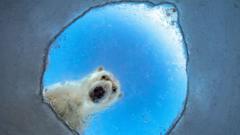
- Norwegian photographer Audun Rikardsen earned high commendation for an underwater image capturing a polar bear peering into a seal's breathing hole.
- A separate entry documents an orca carrying its deceased calf, behavior that recent studies suggest may be more common among killer whales than previously believed.
- The full winners will be announced in October, followed by an exhibition at London's Natural History Museum.
The shortlist for the 2026 Wildlife Photographer of the Year competition has been released, showcasing a diverse array of animal behaviors and environments. The selection highlights not only the technical skill required to capture elusive wildlife but also the emotional resonance of specific moments in nature. Among the highly commended entries is an image titled Icy Window, which offers a rare perspective from beneath the ice.
Norwegian photographer Audun Rikardsen captured this striking scene while working as a guide with Arctic Wildlife Tours. He positioned an underwater camera equipped with a motion sensor below a seal’s breathing hole and waited for hours in the cold darkness. At 4 a.m., a female polar bear approached the ice, peering down into the water. The resulting photograph provides a view from the prey’s perspective, illustrating the tension inherent in Arctic predator-prey dynamics.
Rikardsen did not retrieve his equipment immediately after the encounter. He waited eight hours for the bear to depart before collecting the camera and reviewing the footage. Upon seeing the image, he expressed intense joy, noting that his reaction was loud enough to potentially disturb other bears in the vicinity. This is not Rikardsen’s first recognition; he previously won categories for Birds in 2019 and Oceans: The Bigger Picture in 2025.
Another poignant entry on the shortlist addresses the complex social behaviors of marine mammals. Photographer Vegard Byrkjeland Aasen documented an adult orca carrying the body of a deceased calf through a Norwegian fjord. The image was taken during a drone survey for the Norwegian Orca Survey. The mother whale repeatedly allowed the calf to sink before bringing it back to the surface, a behavior that Aasen described as difficult to witness but important to record.
This type of mourning or protective behavior has been observed in other killer whale populations. Notably, a female Southern Resident killer whale was previously seen carrying her dead calf for at least 17 days. A study published in 2026 suggests that such actions may be more widespread across the species than scientists had earlier assumed, indicating deeper emotional or social bonds within these pods.
The shortlist also features images demonstrating animal adaptability to changing environments. Photographer Miyazawa captured an Eastern Japanese toad navigating a city street after rainfall. While these amphibians are typically found in forests and grasslands, they have shown remarkable resilience in urban settings. The photographer used a slow shutter speed to freeze the moment before the toad retreated into nearby bushes.
Other entries highlight the dangers and intricacies of wildlife photography in various terrains. In Costa Rica, photographers Andrea and Maceo Grammatico discovered a mosquito resting on the head of a fer-de-lance viper only after reviewing their images. They described the shot as one of their most challenging focus stacks. The fer-de-lance is highly venomous and well-camouflaged, posing significant risks to humans in plantation habitats.
In Brazil’s Pantanal wetlands, photographer Parkinson captured a black vulture perched over a dead yacaré caiman. A jaguar later emerged to claim the carcass after the vulture departed. Upon closer inspection, Parkinson noticed a clean, straight wound on the caiman’s head, suspecting it may have been caused by a speeding boat rather than natural predation. This detail adds a layer of human impact to the scene.
The competition continues to showcase the diversity of global ecosystems. From the Namib Desert, where a Namaqua chameleon was photographed amidst a sudden sandstorm, to Kenya’s Tsavo East National Park, where tens of thousands of red-billed queleas gathered to drink, the images reflect both the beauty and fragility of wildlife. These birds, considered the most abundant wild species on Earth, create powerful visual and auditory experiences for observers.
The overall winners of the 2026 Wildlife Photographer of the Year competition will be announced on October 13, 2026. Following the announcement, an exhibition featuring the winning and commended works will open at the Natural History Museum in London on October 16. The event aims to raise awareness about wildlife conservation and the importance of protecting diverse habitats around the world.
Sources behind this briefing
Go to the original reporting
- BBC Science & Environment↗A nosy polar bear and a lucky squirrel: Wildlife Photographer of the Year 2026 shortlist

