The short version
- Hubble observations of gravitational lenses provide high-resolution data essential for modeling mass distribution in foreground galaxies.
- These models will help the Roman Space Telescope identify and analyze a larger volume of lensed objects to test cold dark matter theories.
- The combined capabilities of both telescopes allow researchers to study galaxy evolution and detect small clumps of invisible matter.
NASA is leveraging high-resolution imagery from the Hubble Space Telescope to establish a foundational dataset for the upcoming Nancy Grace Roman Space Telescope. This initiative focuses on gravitational lensing, a phenomenon predicted by Albert Einstein where massive foreground objects bend and magnify light from distant background sources. By analyzing these distorted images, astronomers aim to refine models of mass distribution within galaxies, which is critical for investigating the nature of dark matter.
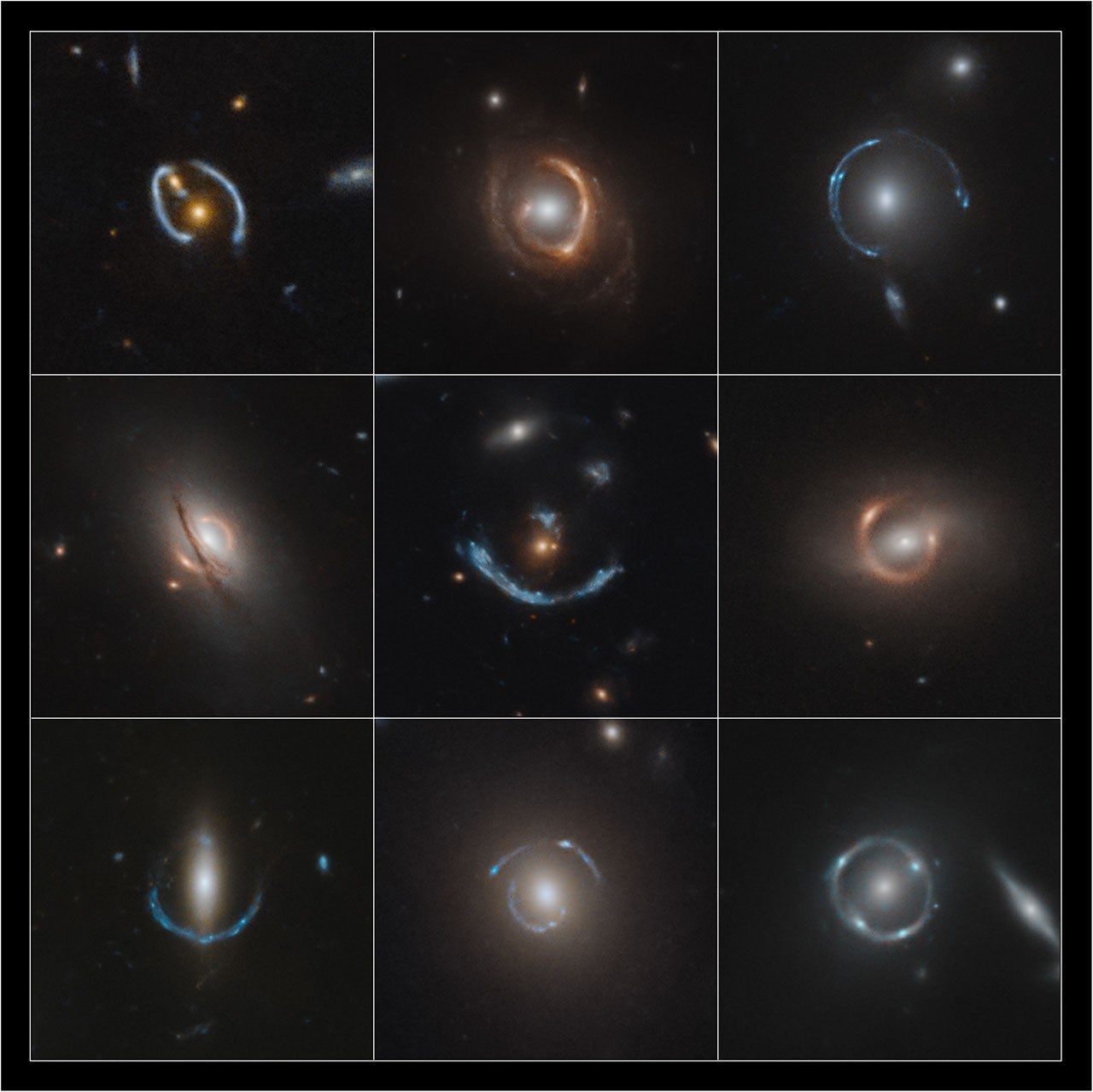
Gravitational lenses form when a distant galaxy aligns precisely with a massive foreground object, such as another galaxy or cluster. This alignment acts as a cosmic magnifying glass, allowing scientists to observe objects that would otherwise be too faint or distant to detect. The resulting images often appear as arcs, rings, or multiple distorted copies of the background galaxy. Hubble’s ability to capture these details in visible and ultraviolet light provides a sharp view of individual lensing events.
The primary scientific goal is to determine the quantity and distribution of mass in the foreground galaxies, including their invisible dark matter components. Researchers are specifically looking for small imperfections or anomalies in the lensed arcs. These subtle distortions could indicate the presence of small clumps of dark matter, ranging from one million to one billion solar masses. Detecting these clumps would support the cold dark matter theory, which posits that dark matter exists in numerous small concentrations rather than just large halos.
While Hubble excels at high-resolution imaging of individual objects, it has a relatively narrow field of view. The Roman Space Telescope, scheduled for future deployment, will observe primarily in infrared light with a much wider field of view. This capability allows Roman to capture panoramic views of the universe and identify a significantly larger number of gravitational lenses. However, Roman’s broader perspective may lack the fine detail needed to resolve complex lensing structures on its own.
To bridge this gap, scientists are using Hubble’s detailed observations to train artificial intelligence tools. These algorithms will be designed to efficiently search for similar lensing patterns in the vast datasets produced by Roman. By combining Hubble’s precision with Roman’s scale, researchers can create a comprehensive catalog of gravitational lenses. This synergy ensures that interesting candidates identified by Roman can be followed up with Hubble’s superior resolution if necessary.
The diversity of lensing configurations captured by Hubble offers valuable insights into galaxy evolution and structure. Some images show arc-counterarc configurations where background galaxies are duplicated by the combined mass of two foreground galaxies. Others display Einstein Rings, where perfect alignment creates a nearly complete circle of light around the foreground object. Quadruply lensed galaxies appear as four smeared dots, sometimes revealing bright knots that likely correspond to active star-forming regions.
Color variations in the lensed arcs provide clues about the age and composition of the background galaxies. Bluish arcs typically indicate the presence of young stars, while reddish arcs suggest older stellar populations. Studying these differences helps astronomers understand how galaxies formed and evolved in the early universe. Most foreground lensing galaxies are elliptical, characterized by their older, denser, and more compact structures. However, some lenses involve spiral or elongated galaxies, offering opportunities to explore different evolutionary paths.
Dust lanes within foreground galaxies can obscure parts of the lensed images, complicating analysis. Hubble’s visible-light sensors reveal these dust features clearly, but they can break the continuity of Einstein Rings. Roman’s infrared capabilities will be crucial in penetrating this dust, potentially revealing more complete ring structures that are hidden from visible-light observation. This complementary approach enhances the accuracy of mass models and improves the reliability of dark matter measurements.
The success of this collaborative strategy depends on the precise modeling of lensing systems. By determining how much mass is concentrated in the foreground galaxies, scientists can test whether dark matter behaves as predicted by current theories. If the expected small clumps are not found, it could challenge the cold dark matter paradigm and prompt new theoretical frameworks. The integration of Hubble’s legacy data with Roman’s future observations represents a significant step forward in cosmological research.
As the Roman Space Telescope prepares for launch, the groundwork laid by Hubble ensures that its mission will be maximally effective. The transition from high-resolution individual studies to large-scale surveys marks a shift in observational astronomy. This approach not only advances our understanding of dark matter but also provides a broader context for galaxy formation and evolution. The combined efforts of these two powerful instruments promise to unlock new secrets about the invisible universe.
Sources behind this briefing
Go to the original reporting
- NASA↗NASA’s Hubble Offers Cosmic Sampler of Targets for Roman

