The short version
- The James Webb Space Telescope has penetrated dense dust clouds in NGC 7129 to reveal stars and protostars previously obscured from view.
- Massive central stars are carving out large cavities through intense radiation and stellar winds, compressing surrounding gas to potentially spark new star formation.
- Younger protostars embedded in the region eject superheated material that creates shock waves and complex textures within the molecular clouds.
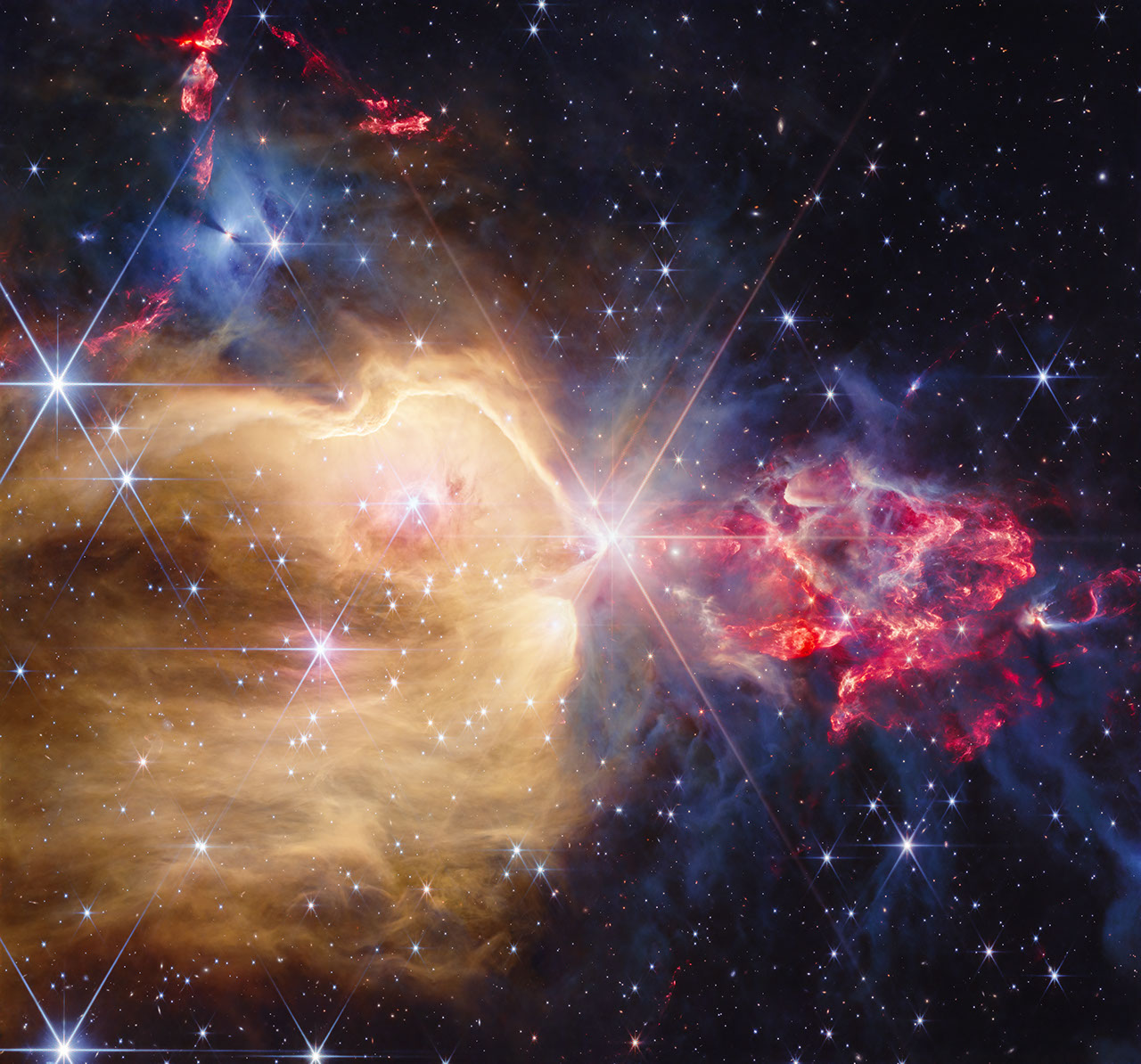
A detailed view of NGC 7129, a stellar nursery located approximately 3,300 light-years from Earth, has been released by NASA following observations with the James Webb Space Telescope. The new imagery provides unprecedented clarity into the early stages of stellar evolution, revealing numerous stars that were previously concealed by thick clouds of dust and gas. Because young stars form within cold, dense molecular clouds, they are often invisible to telescopes that rely on visible light. Webb’s advanced infrared sensitivity allows astronomers to see through these opaque cocoons, offering a clearer picture of how stars begin their life cycles.
The central feature of the image is LkH(alpha) 234, a luminous pre-main-sequence star with a mass estimated between five and eight times that of the Sun. This object represents the most massive and mature star in the cluster. As a pre-main-sequence star, it has largely completed its mass accumulation phase and is now contracting under gravitational pressure. This contraction causes its temperature to rise steadily, preparing it for the eventual hydrogen fusion that characterizes main-sequence stars like our own Sun. The star’s intense energy output dominates the immediate environment, creating visible diffraction patterns in the telescope’s data.
To the left of this central star lies a vast cavity spanning roughly 3.5 light-years, rendered in gold tones to indicate hot, atomic hydrogen gas. This structure serves as a primary example of the central star’s influence on its surroundings. Outflows from earlier phases of the star’s development have carved into the dense molecular cloud, energizing the gas and causing it to glow. While much of this material is being blown away by stellar winds, a significant portion is simultaneously compressed. This compression creates favorable conditions for the formation of additional stars, demonstrating a cycle where existing stars can trigger the birth of new ones.
Within this golden cavity, several smaller pre-main-sequence stars are visible. These embedded objects emit their own stellar winds, which interact with the energetic gas to create bow shocks. These curved regions of compressed gas appear near the smaller stars and form their own miniature cavities. The combined light from both the central massive star and these embedded younger stars generates a hot environment that pushes against the colder, denser molecular gas outside the cavity. This interaction establishes a boundary known as a photodissociation region, where hydrogen molecules break down into individual atoms.
The dynamics at this boundary offer critical insights into the long-term evolution of molecular clouds. By influencing local temperature and chemical composition, the collection of stars in NGC 7129 helps scientists understand how these clouds gradually erode over millions of years. The sharp ridge seen at the top of the golden cavity marks the interface between the heated interior and the cooler exterior. This region acts as a laboratory for studying the physical processes that govern star formation and the subsequent dispersal of the material from which stars are born.
In contrast to the cleared cavity on the left, the region to the right of the central star presents a different narrative of chaotic activity. This area is characterized by clumpy matter shown in red, representing cooler molecular hydrogen gas that has been shocked by embedded protostars. These objects are younger than the pre-main-sequence stars seen elsewhere in the image. The protostar stage occurs after initial compression and fragmentation of molecular clouds but before the star has fully accumulated its mass. As these protostars grow, they eject outflows of superheated material that interact violently with the surrounding dense matter.
The interaction between these protostellar outflows and the enclosing gas creates a textured appearance marked by shocks. The red glow results from this energetic exchange, while multiple overlapping outflows from different stars contribute to the scene’s complex and chaotic visual structure. Additional protostellar activity is visible in the upper left portion of the image, near a blue-colored nebula. At the center of this blue region sits a protostar surrounded by a disk of material shaped like a donut. This disk casts a shadow against the surrounding nebula, a feature reminiscent of structures previously observed by NASA’s Hubble Space Telescope.
The high spatial resolution of Webb’s data builds upon earlier research conducted by NASA’s retired Spitzer Space Telescope, which also studied the gas and dust within NGC 7129. Astronomers plan to continue analyzing this new dataset to further understand how stars and protostars influence their surrounding environments. The James Webb Space Telescope, an international program led by NASA with partners ESA and CSA, continues to serve as a premier observatory for solving mysteries related to the origins of the universe and the life cycles of stars.
Sources behind this briefing
Go to the original reporting
- NASA↗NASA’s Webb Captures Commotion From Nebula’s Stellar Jets

