The short version
- Voyager Technologies' Griffin-1 lander has successfully completed extensive testing at NASA's Jet Propulsion Laboratory, confirming its ability to withstand launch vibrations and extreme space temperatures.
- The infrastructure-class spacecraft is scheduled to launch on a SpaceX Falcon Heavy rocket later this year, carrying over 1,100 pounds of cargo including the largest commercial payload ever sent to the Moon.
- This mission supports NASA's broader Moon Base Program by delivering technology demonstrations from six nations to Nobile Crater near the lunar South Pole, laying groundwork for sustained human presence.
A commercial spacecraft designed to support the establishment of humanity’s first lunar outpost has successfully passed a series of demanding environmental tests at NASA’s Jet Propulsion Laboratory in Southern California. The Griffin-1 lander, developed by Voyager Technologies, underwent simulations that replicated the harsh conditions of space travel and rocket launch. These evaluations confirm the vehicle is prepared for the physical stresses it will encounter during its journey to the Moon.
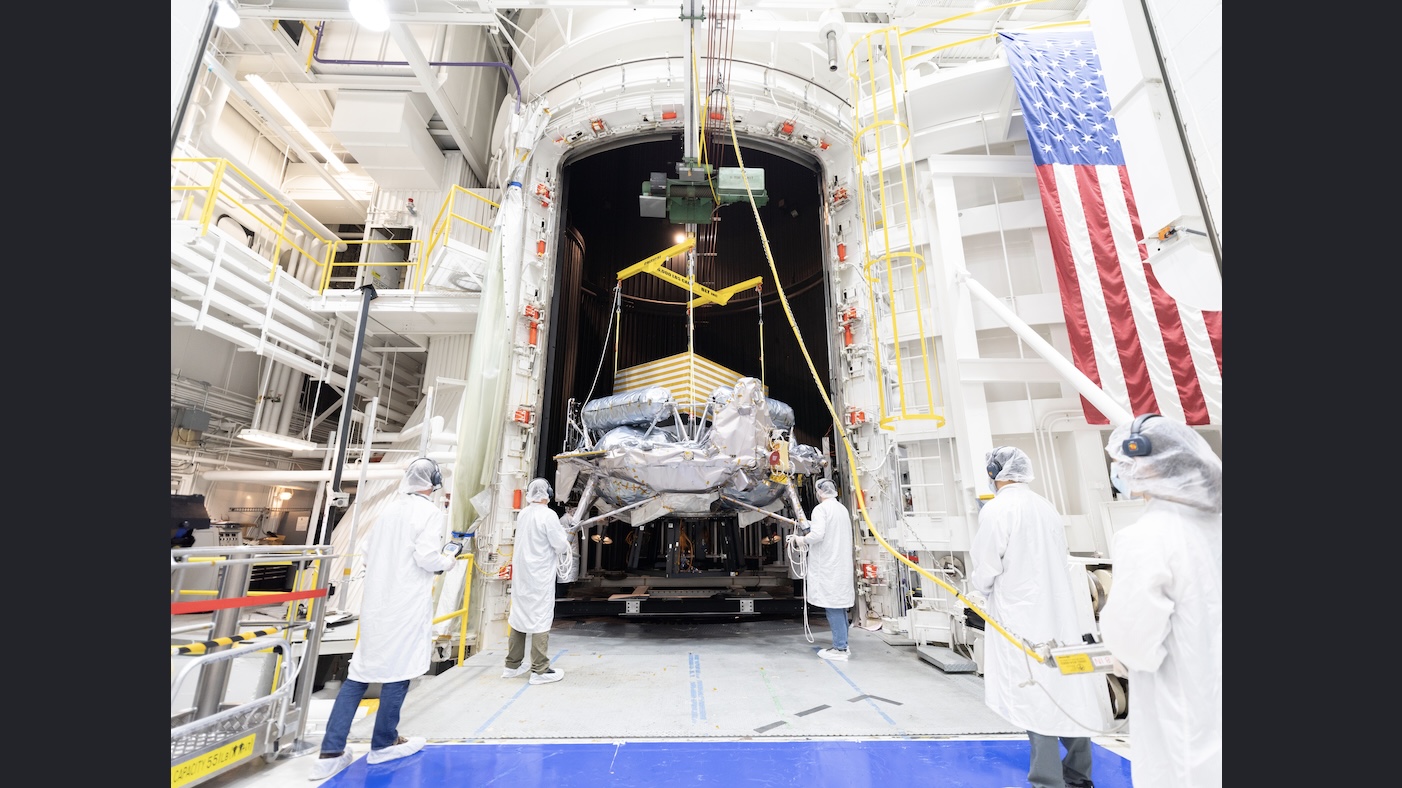
The testing regimen included exposure to extreme temperature fluctuations and high-intensity acoustic noise. Engineers placed the spacecraft inside a thermal vacuum chamber where it cycled between baking at 167 degrees Fahrenheit and freezing at minus 148 degrees Fahrenheit for approximately two weeks. This process mimics the severe thermal shifts the lander will face while traveling through the vacuum of space and operating on the lunar surface.
To simulate the violent launch environment, the Griffin-1 was subjected to intense vibration testing using a shaker table that rattled the vehicle in three directions with increasing force. Additionally, giant horns powered by compressed nitrogen gas blasted the spacecraft with sound levels reaching 153 decibels inside a sealed acoustic chamber. Hundreds of sensors monitored the lander’s structural integrity throughout these procedures to ensure it could survive the roar and shake of liftoff.
Before environmental testing began, the 2,789-pound spacecraft traveled from Voyager Lunar Systems’ manufacturing facility in Pittsburgh to JPL. There, engineers conducted mass properties testing by spinning the vehicle on a specialized table. This procedure helps identify any unexpected wobbles or imbalances that could affect navigation during flight and landing. The data gathered is critical for ensuring precise control as the lander approaches the lunar surface.
Electromagnetic compatibility tests were also performed in an anechoic chamber lined with foam spikes designed to absorb sound and electromagnetic waves. These checks ensured that signals from the spacecraft’s various electronic components would not interfere with one another during operation. Such interference could compromise communication systems or scientific instruments essential for mission success.
Griffin-1 is part of NASA’s Commercial Lunar Payload Services initiative, which leverages private industry capabilities to deliver cargo and technology to the Moon. The lander is classified as infrastructure-class due to its capacity to carry more than 1,100 pounds of payload. It is expected to launch later this year aboard a SpaceX Falcon Heavy rocket, targeting Nobile Crater near the lunar South Pole.
The mission will transport ten science and technology demonstrations from six different countries. Among these is Astrolab’s FLIP rover, which represents the largest commercial payload ever delivered to the Moon. This international collaboration underscores the growing global interest in lunar exploration and the shared effort to build sustainable infrastructure beyond Earth.
Charles Whetsel, manager of the Exploration Systems Development Office at JPL, noted that the laboratory has supported robotic explorers since the Ranger program in the mid-1960s. He expressed pride in providing expertise for this new phase of commercial lunar exploration. The 25-Foot Space Simulator used for testing is listed on the National Register of Historic Places, having supported historic missions including Surveyor, Mariner, and Voyager programs.
John Thornton, executive vice president at Voyager Technologies, described the completion of environmental testing as a major milestone. He emphasized that Griffin-1 is being built to deliver infrastructure and capabilities necessary for the Moon Base Program. The mission aims to transform sustained lunar exploration from a conceptual vision into operational reality.
Following successful testing at JPL, the Griffin-1 has returned to Voyager Lunar Systems’ facility for final assembly operations. The next phase involves launch-readiness preparations before the spacecraft is shipped to Cape Canaveral. This progression marks a significant step forward in NASA’s strategy to establish a long-term presence on the Moon through public-private partnerships.
Sources behind this briefing
Go to the original reporting
- NASA↗NASA JPL Testing Readies Voyager Technologies Lander for Moon Mission