The short version
- Federal prosecutors have charged Wilber Rafael Garcés Pérez with assaulting a federal officer following an incident in which an ICE agent shot him in his vehicle.
- Court documents present conflicting narratives regarding the sequence of events, with agents alleging the driver weaponized his car and the driver claiming he was struck by police before being shot.
- The case highlights ongoing scrutiny of immigration enforcement tactics, particularly the use of vehicular stops and the absence of body-worn camera footage from the shooting officer.
Federal authorities have formally charged Wilber Rafael Garcés Pérez, a Venezuelan delivery driver, with assaulting a federal officer after an Immigration and Customs Enforcement agent shot him in his car in Austin, Texas. The criminal complaint filed Tuesday accuses the 28-year-old of striking an agent with his vehicle’s side mirror while attempting to flee the scene. This development marks the latest legal escalation in an incident that has drawn significant political attention and public outcry regarding federal immigration enforcement practices under the current administration.
Garcés Pérez made his initial appearance before a federal judge in Austin on Tuesday, remaining in the custody of U.S. Marshals after being transferred from a detention facility in South Texas. His legal team has indicated that he still bears a bullet lodged in his back from the shooting, which occurred on September 20. If convicted of the single count of assaulting, resisting, and impeding a federal officer, Garcés Pérez faces a potential prison sentence of up to two decades. His attorneys have also filed a separate civil lawsuit seeking to prevent his removal from the United States.
The government’s case relies heavily on a nine-page affidavit submitted by a Department of Homeland Security agent, which provides the most detailed public account of the encounter to date. According to this document, agents observed Garcés Pérez’s vehicle parked outside a restaurant with emergency flashers activated. After running a database check that revealed the car was registered to him and that he held a final order of removal from the country, officers initiated a traffic stop by activating their lights.
Prosecutors allege that while Garcés Pérez provided his driver’s license through a partially open window, he refused requests to exit the vehicle. Court records describe the initial interaction as conversational and non-aggressive. However, approximately one minute later, the affidavit states that Garcés Pérez abruptly closed the window and drove away. During this maneuver, an officer standing near the driver’s side was struck in the torso by the car’s side mirror, prompting the agent to open fire.
Garcés Pérez offers a sharply different version of events to federal investigators, as recorded in the same affidavit. He claims that an unmarked law enforcement SUV followed him and then cut him off on the roadside. According to his account, he had asked officers to wait for his wife to retrieve the vehicle before taking him into custody. He further alleges that during a brief chase, a police vehicle struck his car, causing it to spin out of control before an agent shot him in the back.
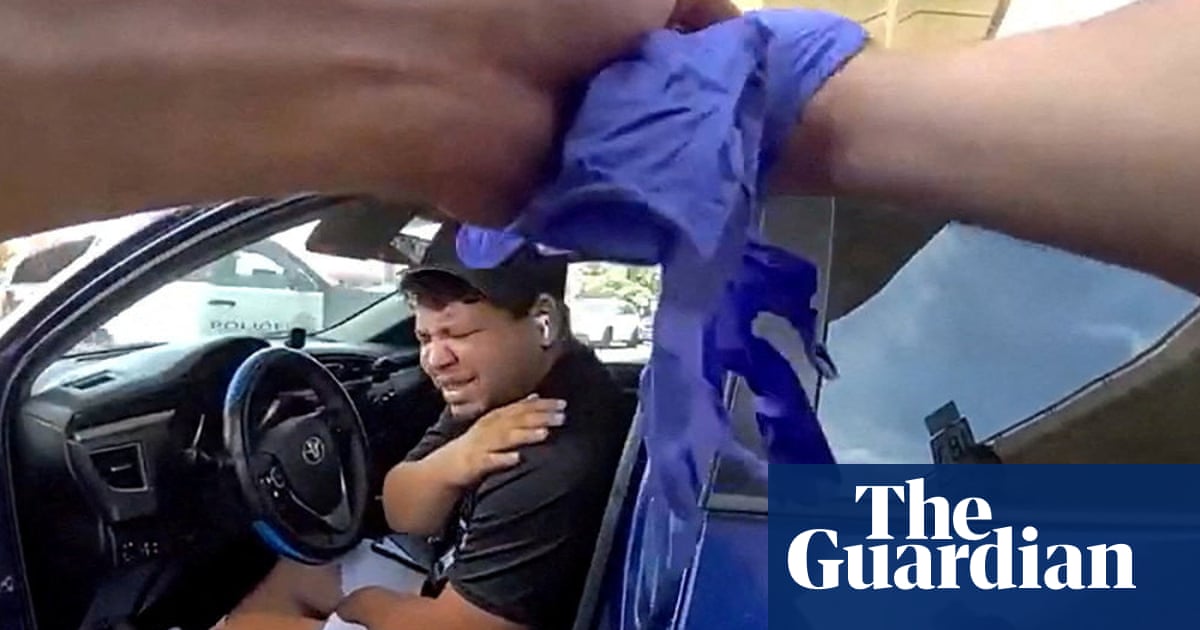
Visual evidence released alongside the complaint includes screenshots from body-worn cameras but excludes video footage of the shooting itself. The images depict an officer standing near the driver’s side mirror and resting hands on the hood of the vehicle, with the mirror appearing close to or touching the officer’s abdomen. Notably, the agent who fired the weapon was not wearing a body camera at the time of the incident. A second officer involved in the pursuit was equipped with a camera but only arrived at the scene after the shooting had concluded.
The lack of comprehensive video evidence has intensified scrutiny of federal immigration tactics. Critics point to previous high-profile cases where agents accused drivers of using vehicles as weapons, allegations that were later undermined or retracted following the release of body-worn camera footage. This incident has renewed debate over the Department of Homeland Security’s reliance on vehicular stops for arrests and the agency’s timeline for equipping field officers with recording devices nationwide.
Local law enforcement in Austin released video from their own officers’ perspectives last week, but that footage did not capture the moment of the shooting or the alleged attempt by Garcés Pérez to drive away. The discrepancy between the government’s assertion that the driver weaponized his vehicle and the driver’s claim that he was struck by police remains central to the legal proceedings. As the case moves forward, it underscores the complex evidentiary challenges inherent in high-stakes immigration enforcement encounters.
Sources behind this briefing
Go to the original reporting
- The Guardian US Politics↗Venezuelan man shot by ICE agent in Texas charged with assaulting an officer
- PBS NewsHour↗Federal prosecutors charge Venezuelan man shot in his car by ICE agent in Texas with assaulting an officer