The short version
- Restorers discovered Michelangelo used custom brushes with multiple tips to create synchronized cross-hatching patterns on the Sistine Chapel ceiling.
- The cleaning process removed decades of calcium lactate buildup, allowing experts to examine brushwork and hidden self-portraits in unprecedented detail.
- Curators interpret a subtle facial likeness in the mural as a reflection of Michelangelo’s recovery from a scaffolding fall near the project's completion.
The Vatican Museums have completed a significant conservation effort on the Sistine Chapel, marking the first major restoration of the space in three decades. Over a period of three months this spring, specialists worked to remove layers of calcium lactate that had accumulated on the walls. This whitish salt residue originated from the dried sweat of millions of visitors and chemical reactions within the plaster itself. The removal process involved applying distilled water and absorbent Japanese paper to gently lift the grime without damaging the underlying 16th-century pigments.
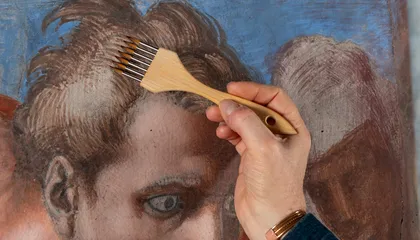
This intensive cleaning provided conservators with a rare, close-up opportunity to examine Michelangelo’s techniques on 'The Last Judgment,' the massive mural situated behind the chapel’s altar. As the original colors emerged from beneath the centuries of buildup, Paolo Violini, the Vatican’s chief restorer, observed unusual patterns in the brushwork. He noted that parallel strokes often appeared perpendicular to one another, creating a distinct cross-hatching effect. More strikingly, he identified identical wobbles in adjacent lines, suggesting they were applied simultaneously rather than sequentially.
These observations led to the conclusion that Michelangelo utilized custom-made brushes with multiple heads. Analysis indicates the artist employed at least two specific types of these tools. One featured three brush tips, while others spanned nearly six inches in width and contained ten individual tips. This innovative approach allowed Michelangelo to produce parallel strokes with a single motion, significantly increasing his efficiency. It also enabled him to replicate a sculpting technique known as gradina, which involves using a multi-pointed chisel to create textured patterns on stone.
By adapting this sculptural method for painting, Michelangelo achieved a richer interaction between the medium and light on the two-dimensional surface. Barbara Jatta, director of the Vatican Museums, described this approach in a new publication detailing the conservation work. She emphasized that Michelangelo painted with the mindset of a sculptor, translating his tactile understanding of form into visual texture. This discovery offers new insight into how the artist bridged the gap between his primary discipline of sculpture and his monumental fresco commissions.
In addition to technical revelations, the restoration allowed researchers to scrutinize hidden self-portraits within the mural’s more than 300 figures. The most prominent likeness appears in the flayed skin held by St. Bartholomew. Historical critics have long interpreted this image as a tragic symbol of martyrdom and oppression. The face depicted features fearful eyes and deep lines, suggesting a profound sense of bitterness or overwhelming calamity. This interpretation has remained consistent since early 20th-century analyses of the work.
A second, more subtle self-portrait was identified in the lower left corner of the 45-foot-tall mural. It appears within the cloak folds of a figure representing Death. Fabrizio Biferali, curator of the Vatican Museums’ Renaissance department, provided context for this inclusion based on Michelangelo’s personal history during the painting process. The artist began work on 'The Last Judgment' in 1536 and completed it in 1541. During this five-year period, he suffered a fall from scaffolding that broke his leg.
Although the fall occurred only a few meters above the ground, it forced Michelangelo to pause his work for several months while he recovered. Biferali suggests that the artist painted his own face among the figures being reborn as a reflection of this personal renewal. The injury and subsequent recovery may have contributed to a sense of rebirth, both physically and creatively, as he approached the final stages of the project. This interpretation adds a layer of biographical significance to the symbolic content of the mural.
The findings from this restoration are documented in 'Michelangelo 2026: The Extraordinary Conservation of the Last Judgment,' a new book released by the Vatican Museums. The publication chronicles both the technical challenges of removing modern pollutants and the historical insights gained from examining the artwork at close range. These discoveries underscore the importance of regular conservation efforts in preserving cultural heritage while revealing new details about artistic processes that were previously obscured by time and environmental factors.
The successful completion of this project sets a precedent for future conservation work at the Vatican. The methods used to remove calcium lactate without harming the original pigments may inform similar efforts on other historic frescoes. As the chapel reopens to the public, visitors will view Michelangelo’s masterpieces with renewed clarity, free from the whitish haze that had accumulated over the past thirty years. The restoration highlights the enduring relevance of these works and the continuous effort required to maintain their integrity for future generations.
While the technical details of Michelangelo’s brushwork have been clarified, some aspects of his intent remain open to interpretation. The precise meaning behind the hidden self-portraits continues to be debated among art historians. Whether they serve as personal markers, theological symbols, or both, depends on individual scholarly perspectives. Nevertheless, the physical evidence uncovered during this restoration provides a concrete basis for understanding how Michelangelo executed his vision, blending sculptural precision with painterly expression in a way that has captivated audiences for centuries.
Sources behind this briefing
Go to the original reporting
- Smithsonian Magazine↗Michelangelo Used These Custom, Multi-Headed Brushes While Painting 'The Last Judgment' to Replicate His Intricate Sculpting Techniques