The short version
- The administration has suspended Microsoft from applying for green cards for H-1B visa holders, citing alleged fraud in the company's hiring practices.
- Vice President JD Vance claimed the firm replaced every laid-off American worker with one and a half foreign workers, describing them as indentured servants.
- This action follows a proposed $70,000 fee for universities hosting international students under the Optional Practical Training program.
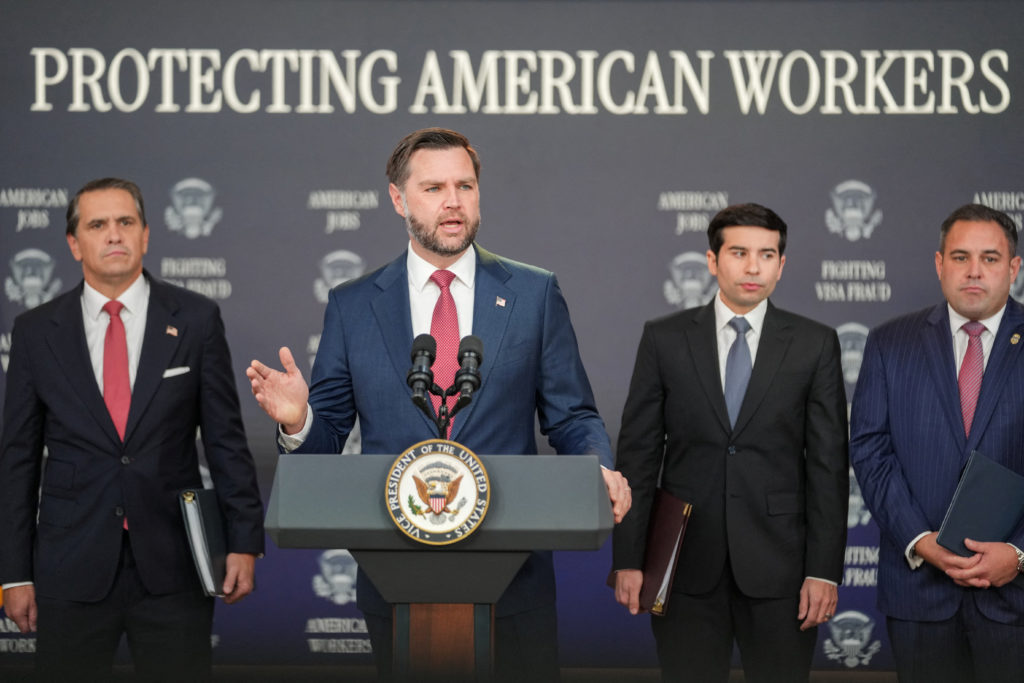
The Trump administration has moved to suspend Microsoft from a federal program that allows employers to sponsor green cards for workers holding H-1B visas. Vice President JD Vance announced the decision on Thursday, accusing the technology giant of systematically abusing the system to replace American employees with foreign labor. The move marks a significant escalation in the administration's efforts to restrict high-skilled immigration and curb what officials describe as corporate exploitation of visa programs.
Vance detailed his allegations during a White House news conference, asserting that Microsoft had laid off 6,000 domestic workers last year while simultaneously securing 6,300 H-1B visas and nearly 3,000 green cards. He argued that these figures demonstrated a pattern of substituting American jobs with foreign ones, claiming that for every worker dismissed, the company replaced them with one and a half individuals he characterized as foreign indentured servants. The vice president emphasized that no other U.S. company had utilized this system to such an extent.
The core of the administration's complaint centers on the process companies must follow before sponsoring green cards. Employers are required to advertise positions domestically to demonstrate a lack of qualified American candidates before applying to the Department of Labor for foreign worker sponsorship. Vance alleged that Microsoft circumvented this requirement by placing advertisements in obscure local newspapers and then claiming no suitable applicants responded. He described this tactic as a method to justify importing labor that effectively undercuts domestic wages.
H-1B visas are designed for specialized roles where qualified U.S. workers are scarce, with technology firms representing the largest share of approvals. Nearly three-quarters of these visas are granted to workers from India. Critics within the Republican base have long argued that the program enables companies to recruit cheaper foreign labor for positions that could be filled by Americans. The administration's current stance reflects a broader political narrative that views these visa categories as detrimental to American wage standards and employment opportunities.
The timing of the announcement drew immediate attention due to its proximity to a scheduled ceremony honoring tech leaders. President Trump was set to award Microsoft CEO Satya Nadella the National Medal of Technology and Innovation later that day, alongside other prestigious science and technology honors for industry allies. The juxtaposition of suspending the company from a key immigration benefit while bestowing upon its leader one of the nation's highest civilian awards highlighted the complex relationship between the administration and the technology sector.
Beyond Microsoft, the administration expanded its critique to include higher education institutions and IT outsourcing firms. Vance singled out nine universities for further investigation regarding their use of J-1 visas, which facilitate temporary work and study exchanges. He suggested these schools were abusing the program at rates disproportionate to their peers, implying a systemic issue within the academic sector's reliance on international visitors.
This action follows closely on the heels of another major policy proposal aimed at international students. The Department of Homeland Security introduced a rule on Wednesday that would impose a $70,000 fee on universities for each student participating in the Optional Practical Training program. OPT allows foreign graduates to work in fields related to their degrees during or after their studies. The proposed fee represents a substantial financial barrier intended to deter the use of these programs.
Microsoft did not immediately respond to requests for comment regarding the suspension and the specific allegations made by Vice President Vance. The company, headquartered in Redmond, Washington, has historically been a major participant in the H-1B program. The administration's characterization of H-1B workers as indentured servants stems from the condition that they must leave the country if their employment ends, a status officials argue creates a power imbalance that suppresses wages compared to American counterparts.
The suspension of Microsoft and the proposed fees for international students signal a coordinated effort to reshape the landscape of high-skilled immigration. By targeting both corporate hiring practices and academic partnerships, the administration aims to address perceived abuses across multiple channels. The long-term impact on the technology sector's ability to recruit global talent remains uncertain as these policies take effect.
Observers note that the administration's approach contrasts with previous periods of more relaxed visa enforcement. The focus on fraud allegations and wage undercutting suggests a shift toward stricter oversight and higher barriers for foreign workers. As the implementation of these measures proceeds, the tech industry may face significant adjustments in its recruitment strategies and reliance on international talent pools.
Sources behind this briefing
Go to the original reporting
- PBS NewsHour↗WATCH: Vance says Microsoft is being suspended from green card program for H-1B visa workers