The short version
- Ecologists recorded frequent mounting and affectionate behaviors between a bull and a male donkey in Ethiopia.
- The pair exhibited selective bonding, rejecting advances from other animals despite the availability of same-species partners.
- Experts note the findings highlight gaps in understanding interspecies relationships but caution against overgeneralizing from domesticated subjects.
A recent study published in Current Biology documents an unusual social and sexual bond between a bull and a male donkey, offering new perspectives on animal behavior. Researchers conducting fieldwork on an Ethiopian plateau initially observed the interaction while studying monkeys, only to notice two other species engaging in unexpected intimacy. The team confirmed that the sighting was not an optical illusion but a consistent pattern of behavior involving licking, rubbing, and sexual contact between the two ungulates.
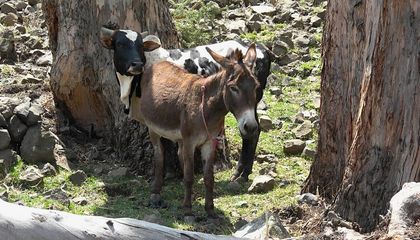
The subjects of the study, nicknamed Achille and Patroclo after figures from Greek mythology known for their close relationship, belong to different owners but share pasture space. Over a period in March, scientists monitored the animals on days when they were together and days when they were separated. During these observations, the team recorded fifty-one mounting events, thirty-four of which involved penetration. The donkey frequently initiated contact by presenting his hindquarters and nibbling the bull, while both animals displayed affectionate gestures before and after their encounters.
What distinguishes this case from typical animal interactions is the selectivity of the bond. Despite the presence of numerous male and female cattle and donkeys in the same grazing area, Achille and Patroclo consistently chose each other for intimate contact. When another bull attempted to approach the donkey, Patroclo responded with aggression, including chasing and biting. Similarly, when Achille tried to mount a different male donkey, that animal exhibited avoidance behaviors such as flattening its ears, a reaction never directed toward the bull.
The researchers emphasize that this appears to be the first documented instance of such a relationship in scientific literature. Elisabetta Palagi, an ecologist at the University of Pisa and co-author of the study, described the interactions as embedded in a highly selective and consistent social relationship. The bond was already known among local herders, suggesting it is a stable feature of these animals' lives rather than a fleeting anomaly.
While same-sex sexual behavior is well-documented across many animal species, including penguins and bonobos, it typically occurs between members of the same species. In nonhuman primates, such behaviors are often linked to social bonding and longevity. However, the evolutionary purpose or social function of this interspecies bond remains unclear. The animals cannot communicate their motivations, and the short duration of the study limits conclusions about long-term benefits or biological drivers.
Experts outside the research team have offered cautious interpretations of the findings. Jo Setchell, a biological anthropologist at Durham University, noted that while the study does not reveal an evolutionary purpose, it underscores the diversity of animal behavior beyond current theoretical frameworks. The observation serves as a reminder that natural behaviors can be more varied than existing models predict.
Vincent Savolainen, an ecologist at Imperial College London, pointed out that the domestication status of the animals may influence their social traits. He suggested that wild animals might not exhibit similar patterns and emphasized the need for studies involving larger groups of wild populations to advance the field of behavioral ecology. The current data is limited to two individuals from domesticated species.
Josh Luke Davis, a science writer and author, advised against reading excessive significance into the relationship. Given that queer behaviors are common in nature and interspecies connections are not entirely rare, the overlap may be less surprising than it appears. The study contributes to a broader understanding of animal diversity without necessarily redefining established biological norms.
The findings highlight ongoing gaps in scientific knowledge regarding social interactions across species boundaries. While the specific motivations of Achille and Patroclo remain unknown, their consistent bond challenges assumptions about convenience or lack of options driving such behaviors. Future research may explore whether similar patterns exist in other domesticated or wild populations.
This case illustrates the complexity of animal social structures and the limitations of current observational methods. As researchers continue to document unusual behaviors, they gain insights into the flexibility of social bonds in the natural world. The study serves as a prompt for further investigation into how domestication and environment shape interspecies relationships.
Sources behind this briefing
Go to the original reporting
- Smithsonian Magazine↗This Bull and Male Donkey Have a Surprisingly Sexual Relationship, Providing Insights Into Interspecies and Same-Sex Bonds