The short version
- A near-total solar eclipse occurred across southern England on Wednesday, offering the clearest view of such an event in the UK since 1999.
- Spectators utilized safety glasses and improvised pinhole cameras made from household items like colanders to observe the Moon passing in front of the Sun.
- The phenomenon caused noticeable environmental shifts, including dropping temperatures and unusual animal behavior, which observers described as eerie and memorable.
A significant astronomical event unfolded across southern England on Wednesday, as the Moon moved in front of the Sun to create a near-total solar eclipse. The celestial alignment provided residents in Kent, Surrey, and Sussex with their most substantial opportunity to witness such a phenomenon since 1999. Between 18:20 and 20:10 British Summer Time, the sky darkened progressively, drawing large crowds to coastal areas, hilltops, and public parks throughout the region.
The event transformed typical summer activities into communal gatherings focused on skywatching. As temperatures climbed into the thirties Celsius, many attendees turned the occasion into outdoor parties or picnics. Coastal roads experienced congestion as enthusiasts queued for access to beaches stretching from Whitstable in Kent to Goring-by-Sea in West Sussex. Inland locations also saw heavy turnout, with spectators flocking to the South Downs and specific beauty spots such as Tunbridge Wells Common and Ockham Common.
Safety remained a primary concern for viewers, leading to widespread use of specialized solar glasses. When commercial supplies were insufficient or unavailable, many individuals resorted to improvised viewing methods. Kitchen colanders emerged as a popular tool for creating pinhole cameras, allowing spectators to project the image of the eclipsed Sun onto surfaces safely. This DIY approach enabled families and individuals to follow the progression of the Moon across the solar disk without risking eye damage.
Observers reported distinct changes in the local environment as the eclipse reached its peak. The light quality shifted dramatically, creating what one spectator described as an eerie atmosphere. Temperature drops were noticeable, adding a tactile dimension to the visual spectacle. Wildlife also reacted to the sudden dimming; birds reportedly ceased their usual activities or took flight in confusion, mirroring behaviors seen during previous eclipses decades ago.
Personal accounts highlighted the emotional impact of the rare occurrence. One resident from Tunbridge Wells characterized the experience as strange and amazing, noting the unique line of sunlight that remained visible. Another observer, who had attempted to view the 1999 eclipse while in Nigeria but was thwarted by rainy weather, expressed satisfaction at finally witnessing the event clearly from the UK. He noted the distinct feeling of cooling air and the visual transformation of the Sun into a crescent shape.
The social aspect of the eclipse was evident in groups who traveled to elevated vantage points for better visibility. On the South Downs, several individuals walked up from their homes to secure a clear line of sight. Some celebrated the occasion with champagne, treating the astronomical alignment as a special milestone worthy of festivity. These gatherings underscored the cultural significance of the event beyond its scientific interest.
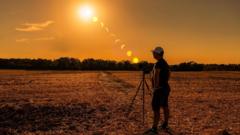
Photographers captured various stages of the eclipse, documenting the partially obscured Sun against the backdrop of local landscapes. Images from Worthing in West Sussex and Lamberhurst showed the striking crescent shape of the solar disk. One notable photograph taken from Sunbury-on-Thames featured a helicopter crossing the path of the partially eclipsed Sun, illustrating the intersection of human activity and celestial mechanics.
The eclipse served as a reminder of the periodic nature of such astronomical events and their ability to draw public attention. While not total in the UK, the near-total coverage provided a dramatic display that engaged communities across multiple counties. The combination of favorable weather conditions and high visibility allowed for widespread observation, ensuring that many residents experienced a memorable natural phenomenon.
As the Moon moved away from the Sun, normal lighting conditions returned, concluding the brief period of darkness. The event left behind a collection of personal memories and photographic records, reinforcing the enduring fascination with solar eclipses. For those who gathered to watch, the experience offered a rare pause in daily routine, marked by shared wonder and scientific curiosity.
Future opportunities for similar viewing conditions in this region will be limited, making this eclipse a notable entry in recent British astronomical history. The successful observation by thousands of people highlights the continued public interest in celestial events and the importance of safe viewing practices. The day concluded with clear skies and satisfied spectators who had waited years for such a clear view.
Sources behind this briefing
Go to the original reporting
- BBC Science & Environment↗Crowds reflect on watching 'incredible' eclipse

