/https://tf-cmsv2-smithsonianmag-media.s3.amazonaws.com/filer_public/be/ed/beed2eb4-3ffa-47b5-834a-c8f00d6901ea/original_1.webp)
The short version
- Researchers found that land snails alter the proportions of collagen and calcium in their mucus to achieve specific textures such as sticky, slippery, or hard.
- The study identifies collagen VI as a primary structural protein, with calcium ions interacting with proteins to adjust density and stiffness based on environmental needs.
- Understanding these biological mechanisms could lead to the development of eco-friendly adhesives, lubricants, and medical materials that mimic nature's efficiency.
Land snails possess a sophisticated biological toolkit that allows them to modify the physical properties of their mucus on demand. Recent research published in the journal Science demonstrates that these gastropods can adjust the texture of their slime to be slippery, sticky, foamy, or rigid depending on immediate survival requirements. This ability to engineer materials from a limited set of molecular components offers significant potential for advancements in sustainable material science and biomedical engineering.
The investigation was conducted by a team including researchers from the Max Planck Institute of Colloids and Interfaces in Germany. The scientists collected brown-lipped snails, native to Europe, during rainy periods to ensure active mucus production. By placing the animals in various controlled scenarios, the researchers induced the secretion of five distinct types of mucus. These included lubricating trails left during movement, adhesive globs used for attachment, defensive foams and thick yellow secretions triggered by stress, and hardened membranes known as epiphragms that seal shell openings during hibernation.
Analysis of these diverse mucus samples revealed a surprising consistency in their molecular composition. Despite the vast differences in texture and function, each type is constructed from largely the same proteins. The key variable is the concentration of these components. For example, the slick lubricant mucus contains only about 0.3 percent protein, whereas the thick, yellow defensive slime comprises approximately 4 percent protein. This variation in protein density allows the snail to tailor the mechanical properties of the secretion without requiring entirely different chemical recipes.
Collagen VI emerged as the primary structural protein across all mucus types. This collagen variant is well-documented in human biology for its roles in maintaining the integrity of skin, bones, and joints. The presence of this familiar protein in snail slime suggests a conserved biological strategy for creating durable yet flexible materials. The researchers noted that the versatility of this single protein type, when combined with other factors, enables the creation of materials with vastly different performance characteristics.
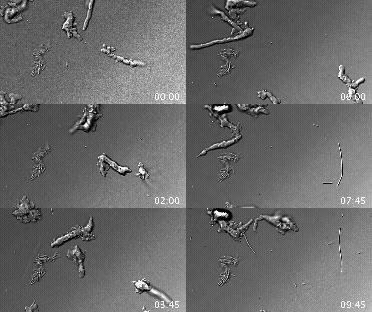
Calcium plays a critical role in determining the final texture of the mucus. High-powered microscopy and laser analysis showed that calcium content varies significantly between mucus types. Calcium ions, which are electrically charged atoms, interact with the protein structures to alter density and cohesion. The study found that higher concentrations of both collagen and calcium result in stiffer, more cohesive, and stickier mucus. This interaction allows the snail to fine-tune the material from a fluid lubricant to a solid barrier.
The mechanism for calcium delivery appears to be highly efficient. Snails store calcium as granules of calcium carbonate within their mucus-secreting tissues. When needed, these granules can release calcium ions into wet mucus varieties or serve as mineral precursors for dry, hardened types like the epiphragm. This storage system enables rapid adjustment of material properties in response to environmental stimuli, such as predation threats or the need for hibernation protection.
Experts outside the research team have highlighted the broader implications of these findings. Biomaterials scientists note that calcium is typically associated with hard, mineralized tissues like shells and bones. Its role in modulating soft tissue properties represents a significant expansion of its known functional range. The ability to optimize limited resources through precise chemical adjustments exemplifies how living organisms achieve complex material functions.
The insights gained from studying snail mucus could inspire the development of new, environmentally friendly materials. Potential applications include biodegradable adhesives for wound healing and specialized lubricants for drug delivery systems. By understanding how nature uses a few basic building blocks to create diverse functionalities, engineers may design sustainable alternatives to synthetic materials that currently rely on complex chemical processes.
The study underscores the importance of looking to biological systems for solutions to material science challenges. The efficiency with which snails produce versatile materials from simple components offers a model for reducing waste and complexity in industrial manufacturing. As research continues, the principles behind snail mucus engineering may provide a roadmap for creating adaptive materials that can change properties on demand, mirroring the resilience and versatility found in nature.
While the immediate focus is on understanding the biological mechanisms, the long-term goal is to translate these findings into practical applications. The collaboration between biologists, chemists, and material scientists highlights an interdisciplinary approach to solving modern engineering problems. By decoding the secrets of snail slime, researchers are paving the way for innovations that could impact fields ranging from medicine to environmental technology.
Sources behind this briefing
Go to the original reporting
- Smithsonian Magazine↗Snails Can Make Their Slime Sticky, Slippery, Foamy or Hard Depending on Their Needs. Here's How They Tweak Their Multipurpose Mucus