The short version
- Wassily Kandinsky’s 1907 painting Das bunte Leben sold at Christie’s London auction for approximately $42 million, exceeding its high estimate.
- The work was returned to the heirs of Dutch Jewish industrialist Emanuel Lewenstein in 2023 after a German advisory commission confirmed it was seized during Nazi persecution.
- The sale represents a resolution to a multi-generational campaign by the Lewenstein family to recover assets lost when their collection was auctioned off without authorization in 1940.
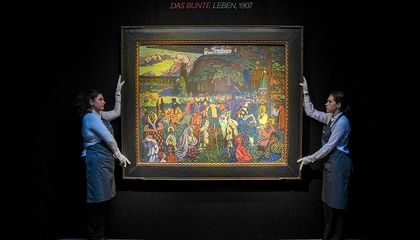
A major Wassily Kandinsky painting, stolen by Nazi forces during World War II and recently returned to its rightful owners, has been sold at auction for nearly $42 million. The sale of Das bunte Leben, or The Colorful Life, marks the conclusion of a complex restitution journey that spanned more than eight decades. The work, which had hung in a German museum for half a century before being legally returned to the heirs of its original owners in 2023, finally found a new private owner at Christie’s 20th/21st Century: London Evening Sale.
The auction event was characterized by intense bidding activity that lasted over six minutes. Bids came from both the packed saleroom and telephone banks, driving the final price well above the pre-sale high estimate of $33 million. Auctioneer Adrien Meyer described the canvas as the most significant early work by the Russian artist to ever appear at auction. The identity of the buyer remains undisclosed, consistent with standard auction house practices regarding private collectors.
Created in 1907 during Kandinsky’s stay in Paris with his partner Gabriele Münter, Das bunte Leben was the largest painting the artist had produced at that time. Measuring more than five feet wide, the work features luminous pigments set against a dark background. The composition depicts various figures, including wanderers, monks, and revelers. Notable details include an elderly traveler with a mint-green beard and lovers embracing while ignoring a distant funeral procession. Kandinsky intended for viewers to feel absorbed in the image, describing his goal as allowing them to take a stroll within the picture.
The painting’s artistic significance lies in its position as a transitional work. It was completed just before Kandinsky moved toward pure abstraction. Influenced by French Fauvism and traditional Russian folklore, the piece is considered iconic by art dealers and historians. Daniella Luxembourg, an art dealer, previously noted that the work captures a key point in the artist’s life and stands as one of his most important creations.
The provenance of the painting reveals a history of displacement and loss. In the 1920s, the work entered the private collection of Emanuel Lewenstein, a Dutch Jewish industrialist, and his wife, Hedwig Lewenstein-Weyermann. After Emanuel’s death in 1930, Hedwig loaned the piece to Amsterdam’s Stedelijk Museum for safekeeping. Upon her death in 1937, the art collection passed to their adult children, who subsequently fled Europe as Nazi influence grew.
In May 1940, Nazi troops invaded the Netherlands. Five months later, works from the Lewenstein collection were auctioned off in Amsterdam without the family’s authorization. Das bunte Leben was sold for a mere 250 Dutch guilders, which represented only 10 to 20 percent of its market value at the time. The family did not receive any proceeds from this forced transaction. The canvas later changed hands privately before being purchased in 1972 by the German bank Bayern LB.
For nearly fifty years, the painting was on long-term loan at the Lenbachhaus museum in Munich. During this period, descendants of the Lewenstein family waged a decades-long campaign to recover the work. They filed a lawsuit against the bank in 2017, challenging the institution’s ownership. The legal standoff persisted until 2023, when Germany’s advisory commission on Nazi-looted art intervened.
The government panel recommended that the painting be returned to the family, affirming that there were numerous indications of seizure resulting from Nazi persecution. This recommendation broke the legal impasse and allowed for the restitution process to proceed. Marc Porter, chairman of Christie’s Americas, stated that the return to the market marks a new chapter for a work holding a significant place in modern art history.
While the $42 million sale price did not surpass Kandinsky’s all-time auction record—set in 2023 when Murnau With Church II sold for $45 million at Sotheby’s—it represents a triumphant close to the family’s multi-generational pursuit of justice. The transaction highlights the ongoing efforts to address historical injustices related to art looted during the Holocaust, providing a resolution that balances market value with moral restitution.
The case of Das bunte Leben underscores the complexities involved in recovering Nazi-looted art. It demonstrates how legal mechanisms and advisory commissions can facilitate the return of cultural heritage to descendants of victims. As the painting enters private ownership once again, its history serves as a reminder of the disruptions caused by war and persecution, as well as the persistent efforts to correct those wrongs through legal and ethical channels.
Sources behind this briefing
Go to the original reporting
- Smithsonian Magazine↗Looted by Nazis and Recently Restituted, a Kaleidoscopic Kandinsky Painting Just Sold for Nearly $42 Million