The short version
- Specialists removed three large murals from the Abbaye de Fontfroide for the first time since their installation in 1911, revealing colorful sketches underneath.
- The hidden drawings appear to be preliminary tests or abandoned fresco attempts by Odilon Redon, offering new insight into his creative process at the site.
- The murals are currently displayed in Paris as part of an exhibition honoring collector Gustave Fayet and will return to the monastery later this year.
A significant art historical discovery has emerged from the walls of the Abbaye de Fontfroide, an eleventh-century Cistercian monastery located in Narbonne, France. For more than a century, the library of this historic site has housed three large-scale murals created by the French Symbolist artist Odilon Redon. These works, titled Le Jour (Day), La Nuit (Night), and Le Silence (Silence), have been permanent fixtures since their installation in 1911. However, when conservators recently detached these panels for transport to a major exhibition in Paris, they uncovered a layer of artistic activity that had remained hidden from view.
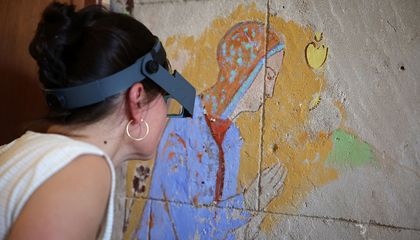
Beneath the finished mural panels, specialists found colorful drawings sketched directly onto the plaster walls. These sketches were not previously documented or known to researchers. The director of the abbey, Alexandre d’Andoque de Sériège, described the finding as a major surprise, noting that no one had anticipated the existence of these underlying images. The discovery provides a rare glimpse into the preparatory stages of Redon’s work in this specific space, suggesting a more hands-on engagement with the architecture than previously understood.
The sketches share visual similarities with the figures and characters depicted in the final murals placed above them. However, they are noticeably smaller in scale and feature a distinct use of color that differs from the finished pieces. Researchers are currently debating the purpose of these drawings. Some theories suggest they served as compositional tests for the final artwork, allowing Redon to visualize how his designs would interact with the library’s dimensions and lighting. Alternatively, they may represent abandoned attempts at creating frescoes directly on the wall, a technique that requires significant time and physical endurance.
Odilon Redon first visited the abbey in 1908 under the commission of Gustave Fayet, a wealthy wine merchant and prominent art collector who had purchased the property. Fayet sought to transform the medieval religious site into a modern cultural hub, funding extensive renovations that included new stained glass windows and interior installations. Redon returned for a ten-day stay in March 1910, after the library renovations were complete. This timing aligns with the period when he was painting the murals in Paris, suggesting he used the visit to assess how his work would appear in its final setting.
The abbey’s director expressed high confidence that the sketches were created during Redon’s 1910 visit. He noted that executing a true fresco would have required a much longer stay and considerable physical labor, making it less likely for an artist of Redon’s age and status. Instead, the drawings may have functioned as spatial studies, helping the artist refine his vision before committing to the large-scale panels. This interpretation adds nuance to the understanding of how Symbolist artists approached monumental commissions in historic spaces.
The three murals are now part of a larger exhibition titled ‘Gustave Fayet: Collector-Designer’ at the Fondation Louis Vuitton in Paris. The show highlights Fayet’s role as an early advocate for avant-garde art, featuring works by Vincent van Gogh, Paul Gauguin, Edgar Degas, and other modern masters. Fayet was particularly known for his extensive collection of Gauguin’s work, having bankrolled the artist and acquired nearly two hundred pieces. The exhibition underscores Fayet’s influence on the art world of his time, despite his relative obscurity today.
Access to the murals at the abbey has historically been limited, with special tours offered only twice a month. Their removal for the Paris exhibition marks the first time they have been detached from the walls since their installation. The discovery of the underlying sketches adds a new layer of interest to these works, transforming them from static decorations into dynamic records of artistic decision-making. Art critics have long praised the murals as thrilling examples of Symbolist landscape and figure painting, and this new context deepens their significance.
The murals are scheduled to be returned to the Abbaye de Fontfroide at the end of the Paris exhibition, which runs until March 8, 2027. Upon their return, they will be reinstalled in their original locations within the library. However, the newly exposed wall drawings will remain visible for a limited time. Visitors have until March to see these sketches before they are covered again by the mural panels. This temporary window offers a unique opportunity to observe the hidden layer of Redon’s creative process.
The finding has been described as an emotional moment for the abbey’s staff and historians alike. It confirms that Redon invested considerable personal effort into the project, going beyond mere execution to engage directly with the space through preliminary sketches. This discovery enriches the narrative of the Abbaye de Fontfroide, linking its medieval heritage with the innovative spirit of early twentieth-century art. As the murals prepare for their journey back to Narbonne, the hidden drawings serve as a testament to the artist’s meticulous approach and the enduring legacy of Gustave Fayet’s vision.
Sources behind this briefing
Go to the original reporting
- Smithsonian Magazine↗Specialists Removed Three Thrilling, Century-Old Murals From the Walls of a French Monastery. Beneath, They Made 'a Discovery for the History of Art'