The short version
- Manx shearwaters exhibit jet lag-like disorientation when flying rapidly across time zones, affecting their sun-based navigation systems.
- GPS data from over a thousand birds shows consistent clockwise veering during eastward trips, independent of wind or coastal cues.
- The navigational errors are minor in distance but suggest these birds rely on multiple conflicting cues to return to breeding colonies.
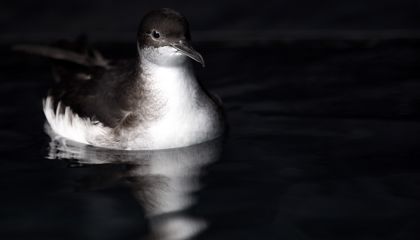
New research indicates that the physiological phenomenon known as jet lag is not exclusive to humans. A study published in Science demonstrates that Manx shearwaters, medium-sized seabirds with black upperparts and white underbellies, experience disruptions to their internal biological clocks when traveling rapidly across time zones. These time shifts interfere with the birds' ability to use the sun as a navigational compass, leading to slight disorientation during their journeys.
The investigation focused on the breeding habits of Manx shearwaters, which see approximately eighty percent of the global population return to steep, grassy islands off the western coast of the United Kingdom each late winter and early spring. These birds reunite with lifelong partners to nest in underground burrows, where females lay a single egg. Once chicks hatch, adults undertake extensive foraging trips, traveling more than six hundred miles west into the Irish Sea and northeast Atlantic Ocean to gather herring, sardines, and sprats.
Scientists have long understood that these birds navigate using the sun's position in the sky. However, utilizing a solar compass requires an accurate sense of time, as the sun's overhead location changes continuously due to Earth's rotation. Researchers hypothesized that the speed of the birds' eastward return flights might cause their internal clocks to lag behind local time, similar to how humans feel disoriented after crossing multiple time zones quickly.
To test this theory, ecologists analyzed twenty years of GPS tracking data collected from 1,045 wild breeding Manx shearwaters. The dataset included 3,688 total trips between breeding and foraging grounds. The researchers isolated 1,837 eastward homing journeys to examine whether rapid travel caused navigational deviations. They predicted that if jet lag were affecting the birds, they would veer clockwise from their intended path.
The data confirmed these predictions. The birds consistently veered clockwise by up to fifteen degrees during their return flights. To ensure that wind strength or distance from the colony were not responsible for these deviations, the team controlled for various environmental factors. The analysis showed that the sun compass effect was the primary predictor of orientation changes, even when birds flew alongside coastlines where visual landmarks might otherwise guide them.
This finding suggests that Manx shearwaters utilize multiple navigational cues simultaneously, even when those cues provide conflicting directions. Sangeeta Rani, a chronobiologist at the University of Lucknow who was not involved in the study, noted that this redundancy is adaptive. She compared it to human navigation in forests, where innate abilities allow travelers to find their way even if specific markers are missing or obscured.
Despite these navigational errors, the practical impact on the birds' survival appears minimal. For a bird traveling roughly six hundred twenty miles, a seven-degree compass error adds only about three extra miles to the trip. Researchers posit that because the energetic cost of these detours is low, natural selection has not favored the evolution of mechanisms to prevent jet lag in this species.
While the study focused exclusively on Manx shearwaters, scientists suspect other long-distance travelers, including various bird species, bats, and insects, may experience similar time-zone disruptions. However, such effects are likely less pronounced during typical migrations, which often follow north-south routes that do not involve rapid east-west crossings across multiple time zones.
The ability of these birds to navigate despite conflicting internal and external cues may prove advantageous in the face of environmental changes. As climate change and human development alter familiar landscapes, reliance on multiple navigation methods could help species adapt to unrecognizable terrains. This research highlights the complex interplay between biology and geography in animal migration.
Future studies may explore whether other fast-flying animals exhibit similar jet lag symptoms. Understanding how internal clocks interact with external navigational aids provides deeper insight into the evolutionary pressures shaping animal behavior. For now, the Manx shearwater serves as a compelling example of how even subtle biological constraints can influence movement patterns in the natural world.
Sources behind this briefing
Go to the original reporting
- Smithsonian Magazine↗It's Not Just You: Some Fast-Flying Birds Also Get Jet Lag