The short version
- Researchers have trapped a single positron using electromagnetic fields for several months, marking a first in antimatter containment.
- The experiment allows for precise measurement of the particle's magnetic properties to test predictions of the standard model.
- Discrepancies between positron and electron behavior could help explain the cosmic imbalance between matter and antimatter.
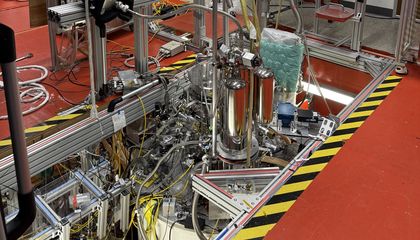
A team of physicists led by Gerald Gabrielse at Northwestern University has achieved a significant milestone in particle physics by trapping a single positron for several months. Published on October 21 in Physical Review Letters, the study details how researchers used specialized electric and magnetic fields to capture and maintain the antimatter particle in a controlled environment. This capability allows scientists to observe and manipulate the particle’s quantum energy states with unprecedented precision, opening a new avenue for testing fundamental theories about the composition of the universe.
Positrons are the antimatter counterparts to electrons, possessing the same mass but an opposite electrical charge. Antimatter particles generally annihilate upon contact with regular matter, converting their mass into energy. This property makes containment exceptionally difficult, as any physical container would cause the particle to disappear. To overcome this, the team suspended the positron in a near-perfect vacuum at temperatures just above absolute zero, effectively creating a wall-less trap that relies entirely on electromagnetic forces to hold the particle in place.
The process began with a rare radioactive isotope of sodium, which emits high-energy positrons during decay. These particles move too quickly for immediate capture, so the researchers passed them through a tungsten crystal to slow them down. While some positrons were annihilated during this deceleration phase, others survived and were successfully captured by the electromagnetic trap. Once contained, the team used microwaves to control the particle’s quantum transitions, observing what they describe as 'quantum jumps' between its lowest energy states.
This experimental setup addresses a profound mystery in cosmology: why the observable universe consists almost entirely of matter. According to current understanding, the Big Bang should have produced equal amounts of matter and antimatter. If this had occurred, the two would have annihilated each other completely, leaving no material for stars, planets, or life to form. The fact that matter dominates suggests an asymmetry in physical laws that the standard model of particle physics cannot currently explain.
The standard model is a highly successful framework for describing the interactions between fundamental particles and forces. However, it lacks a mechanism to account for the matter-antimatter imbalance. By comparing the magnetic properties of positrons with those of electrons, physicists hope to identify subtle deviations from theoretical predictions. The current theory posits that these properties should be identical, but any measurable difference could indicate new physics beyond the standard model.
Gerald Gabrielse emphasized that the standard model is likely incomplete or incorrect in some respects. The team’s approach involves examining the most fundamental and simple systems to pinpoint where the theory breaks down. By achieving long-term containment, they can perform measurements with a level of accuracy previously unattainable for antimatter particles. This precision is critical for detecting any minute discrepancies that might have been obscured by shorter observation times or less stable trapping conditions.
Independent experts have praised the technical achievement. Stefan Ulmer, a researcher at RIKEN in Japan, noted the extreme difficulty of trapping antiparticles, while Barbara Latacz from CERN described the work as a remarkable accomplishment. Their comments underscore the significance of overcoming the inherent instability of antimatter for sustained study. The ability to control a single positron for months represents a major leap forward in experimental particle physics.
The next phase of this research will involve rigorous comparison of the positron’s magnetic moment with that of the electron. If the measurements reveal a difference, it could provide crucial clues about why regular matter is so much more ubiquitous than antimatter. Such a finding would not only challenge existing theoretical frameworks but also potentially illuminate the conditions that allowed our universe to exist in its current form. The team aims to deliver an unambiguous answer to one of physics’ most enduring questions.
This development highlights the ongoing effort to refine and test the boundaries of known physics. While the standard model has proven extraordinarily accurate in many domains, its inability to explain the origin of matter remains a glaring issue. By leveraging advanced trapping techniques, scientists are now positioned to probe these foundational gaps with greater clarity. The results of these comparative studies could reshape our understanding of the fundamental forces that govern the cosmos.
Sources behind this briefing
Go to the original reporting
- Smithsonian Magazine↗For the First Time, Scientists Trapped an Elusive Antimatter Particle—and Contained It for Months. It Could Allow Them to Test an Enduring Physics Theory