The short version
- The burst originated in a primitive dwarf galaxy formed roughly ten billion years ago, long before the solar system existed.
- Low metal content in the host galaxy supports theories that magnetars, rather than neutron star mergers, generate these signals.
- Researchers plan to use similar detections to map unseen plasma across eighty percent of cosmic history.
Astronomers have identified the oldest fast radio burst ever recorded, tracing its origin to a galaxy that existed when the universe was only three billion years old. The discovery, published in the journal Science on October 8, provides a rare glimpse into the early cosmos and offers new methods for mapping matter that is otherwise invisible to telescopes. The signal, designated FRB 20240304B, was first captured by the MeerKAT radio telescope array in South Africa during March 2024.
Fast radio bursts are brief but intensely powerful flashes of radio waves. Since the first detection in 2007, thousands of these events have been observed, yet their exact origins remain a subject of active debate. Leading hypotheses suggest they may arise from the collision of two neutron stars or from magnetars, which are young neutron stars possessing exceptionally strong magnetic fields. While previous research indicated that at least one burst likely came from a magnetar, scientists have not confirmed whether this mechanism applies to all such events.
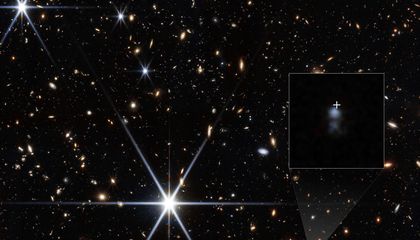
To determine the source of the new signal, researchers utilized NASA’s James Webb Space Telescope. The analysis revealed that the burst emanated from a small, primitive dwarf galaxy. This finding contrasts with earlier expectations that such energetic events would originate in large, well-formed galaxies rich in stars. Despite its modest size, the host galaxy was actively forming stars at the time the signal was emitted.
The timing of the event places it approximately ten billion years ago, a period long before the formation of our own solar system. The sun and Earth did not exist when this light began its journey across the universe. As noted by study co-author Manisha Caleb, an astrophysicist at the University of Sydney, civilization had to develop and construct radio telescopes just to catch this glimpse of a time before human existence.
The characteristics of the host galaxy provide clues about the nature of the burst’s source. The galaxy contained low levels of heavy elements, often referred to as metals in astronomy. This composition is consistent with theories that link fast radio bursts to magnetars. If confirmed, this connection would help narrow down the specific astrophysical objects responsible for these mysterious flashes.
Beyond identifying the source, the study highlights the utility of fast radio bursts as tools for probing the universe. As the radio waves traveled through space, they passed through various clouds of plasma. Different frequencies within the burst arrived at Earth at slightly different times, a phenomenon known as dispersion. By measuring this delay, scientists can estimate the amount of material the signal encountered along its path.
This method allows researchers to map the distribution of matter across vast distances. Themiya Nanayakkara, another co-author from the University of Sydney, explained that the discovery demonstrates the ability to probe approximately eighty percent of cosmic history. The further back in time these detections reach, the more effectively scientists can chart the unseen matter that fills the space between galaxies.
Independent experts have praised the study for validating the power of fast radio bursts as observational tools. Matthew Bailes, an astrophysicist at Swinburne University of Technology who was not involved in the research, described the findings as a significant step forward in understanding how these signals can be used to explore the universe. The work underscores the potential of combining radio astronomy with space-based telescopes.
The research team plans to continue searching for similar ancient bursts. They estimate that the MeerKAT telescope could detect several more old fast radio bursts each year. Additionally, the group has secured observation time with the James Webb Space Telescope to identify the sources of other distant signals. Finding more examples will help place stronger constraints on the objects and mechanisms that produce these flashes.
As more data accumulates, scientists hope to resolve the ongoing debate regarding the origins of fast radio bursts. Each new detection adds a piece to the puzzle of how matter is distributed across the universe and what violent events occurred in its infancy. The ability to look back ten billion years offers a unique window into the conditions that shaped the cosmos we observe today.
Sources behind this briefing
Go to the original reporting
- Smithsonian Magazine↗Astronomers Detect the Oldest Known Fast Radio Burst, Spewed From an Ancient Galaxy Just Three Billion Years After the Big Bang