The short version
- The Okefenokee Swamp was inscribed on the UNESCO World Heritage List in July 2026, marking a first for properties managed solely by the U.S. National Wildlife Refuge System.
- Experts describe the site as the world’s largest intact subtropical lowland freshwater peatland, characterized by ancient carbon stores and dynamic interactions between fire and water levels.
- While the designation elevates the swamp's global profile, it does not extend legal protections against development outside existing refuge boundaries, leaving long-term security uncertain.
In July 2026, the Okefenokee Swamp in southeastern Georgia and northeastern Florida was formally added to the UNESCO World Heritage List. This designation marks a significant milestone for American conservation efforts, as the site is the first property managed entirely by the U.S. National Wildlife Refuge System to receive such international recognition. The swamp joins an exclusive roster of celebrated American landscapes, including Yellowstone, Yosemite, and the Everglades, though its significance stems from ecological integrity rather than dramatic geological formations.
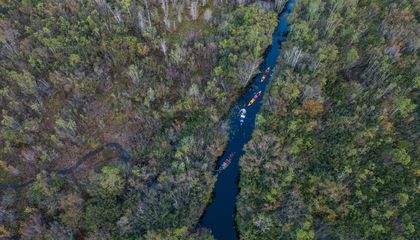
The Okefenokee spans more than 400,000 acres, encompassing a complex mosaic of open prairies, cypress forests, pine uplands, and forested islands. Its dark, tannin-rich waters feed two major rivers: the Suwannee, which flows toward the Gulf Coast, and the St. Marys, which empties into the Atlantic Ocean. Beneath this surface lies a substantial layer of peat, composed of partially decomposed vegetation that has accumulated over approximately 7,500 years. According to evaluations by the International Union for Conservation of Nature, the swamp likely represents the world’s largest and most intact lowland freshwater peatland in the subtropical zone.
This ancient peat deposit serves as a critical carbon sink, storing organic matter accumulated over millennia while preserving a detailed record of environmental change. The landscape’s value lies not in static preservation but in its dynamic nature. Rainfall causes water levels to fluctuate significantly, sometimes exposing vegetation and peat to fire during prolonged dry periods. As water returns, plant communities regenerate, and the swamp gradually rearranges itself. Open prairies may transition into denser vegetation, while fires create openings that allow different habitats to emerge.
Sarah Ratcliffe, an interpretive ranger at Okefenokee State Park, describes the landscape as both old and young, defined by the interplay of water and fire. This apparent contradiction is central to understanding the ecosystem. Rather than attempting to freeze the landscape in a fixed state, refuge managers utilize prescribed fire in surrounding uplands to maintain fire-adapted habitats and mitigate wildfire risks near refuge boundaries. Conservation scientist Reed Noss notes that this rich mosaic of habitat patches has been minimally altered by human activity, allowing natural processes to continue shaping the environment on an immense scale.
Sara Brown Aicher, a retired U.S. Fish & Wildlife Service biologist who spent 31 years monitoring wildlife and tracking environmental changes at the refuge, emphasizes the site’s rarity. During the long effort to secure UNESCO recognition, she compared the Okefenokee to ecosystems elsewhere in the world, noting its extraordinary status as one of the last places where such natural processes remain largely intact. The designation acknowledges a landscape where natural forces, rather than human intervention, continue to drive ecological change across a vast area.
Despite the prestige of the UNESCO label, the designation does not provide additional legal protections against development beyond the refuge’s existing boundaries. The recognition places the swamp under a global spotlight, potentially increasing public scrutiny and pressure for continued conservation. However, whether this international attention translates into lasting support for protecting the water systems and natural processes that earned the site its status remains an open question. The future of the Okefenokee depends on maintaining the delicate balance between public access, scientific study, and the preservation of its unique hydrological and fire-driven dynamics.
The inscription also highlights the subtropical habitats of the North American Coastal Plain, a region recognized as a global biodiversity hotspot. By placing a sprawling blackwater wilderness on the World Heritage List, UNESCO has drawn attention to an ecosystem that is increasingly difficult to find in its intact form. The Okefenokee’s significance is not immediately apparent to casual observers, lacking the monumental rock formations or dramatic summits of other heritage sites. Instead, its value lies beneath dark water and within cypress forests, offering a rare glimpse into a landscape where natural processes still operate with minimal human interference.
As the swamp gains global prominence, stakeholders face the challenge of balancing increased visibility with the need for quiet conservation. The designation serves as both an honor and a responsibility, urging continued vigilance over one of America’s most unusual and ecologically vital landscapes. Whether the international spotlight will strengthen local conservation efforts or introduce new pressures remains to be seen, but the Okefenokee’s status as a national treasure is now formally recognized on the world stage.
Sources behind this briefing
Go to the original reporting
- Smithsonian Magazine↗America's Newest UNESCO World Heritage Site Is a Swamp—and That's Exactly Why You Should Go