The short version
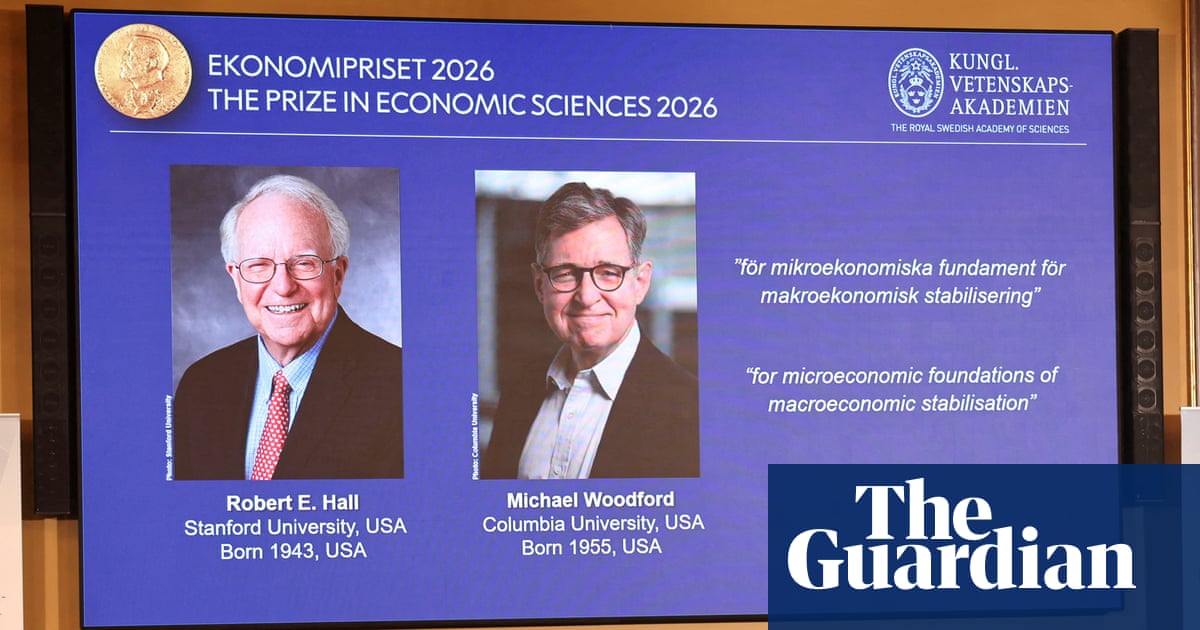
- The Royal Swedish Academy of Sciences awarded the 2026 Nobel Memorial Prize in Economic Sciences to Robert Hall and Michael Woodford for their contributions to macroeconomic stabilisation models.
- Their work established microeconomic foundations for understanding how individual household and business behaviors aggregate to influence broader economic cycles, improving upon earlier Keynesian approaches.
- These frameworks have become standard tools for central banks worldwide, aiding in the management of crises such as the 2008 financial collapse and the subsequent pandemic-era economic disruptions.
The Royal Swedish Academy of Sciences has awarded the 2026 Nobel Memorial Prize in Economic Sciences to two American academics for developing theoretical frameworks that have fundamentally reshaped how governments manage economic stability. Robert Hall of Stanford University and Michael Woodford of Columbia University were recognized for creating what the academy described as the microeconomic foundations of macroeconomic stabilisation. The award, which carries a combined prize money of $1.2 million, highlights their success in providing policymakers with more precise instruments to mitigate the severity of recessions and control inflationary pressures.
The laureates’ research addressed significant limitations in earlier economic models, particularly those associated with John Maynard Keynes. Previous frameworks struggled to account for complex scenarios such as the stagflation experienced during the 1970s oil shocks, where high inflation coincided with weak growth and elevated unemployment. Hall and Woodford reconstructed these traditional models by focusing on the actions of individual households and businesses. By demonstrating how these micro-level decisions collectively drive macroeconomic outcomes, they offered a more robust explanation for business cycle fluctuations.
Hall’s specific contribution involved shifting the focus toward forward-looking consumer behavior. Rather than relying on the mechanical rules of thumb that linked variables like inflation, unemployment, and gross domestic product in earlier theories, Hall emphasized how expectations shape economic activity. Woodford expanded upon this foundation to create the New Keynesian model, a comprehensive framework for macroeconomic stabilisation. This model is now widely adopted by central banks and finance ministries around the world as a primary tool for navigating economic turbulence.
The practical impact of these theories has been evident in major global crises. Policymakers utilized these models during the aftermath of the 2008 financial crisis to steer the global economy away from a potential second Great Depression. The frameworks also proved instrumental during the economic disruptions caused by the pandemic, helping authorities implement measures that prevented deeper contractions. John Hassler, chair of the committee for the economics prize, noted that the laureates’ work provides a stable theoretical basis for dealing with various shocks, including energy crises and sudden shifts in household consumption patterns.
One significant application of their research is the development of forward guidance, a strategy where central bankers communicate their expectations regarding future interest rates. This tool became particularly important when interest rates were cut to record lows following the 2008 crisis and during the pandemic. By signaling future policy directions, central banks aim to influence current economic behavior. However, the utility of forward guidance remains a subject of debate among economists and policymakers.
Critics argue that excessive reliance on forward guidance can create ambiguity rather than clarity. Kevin Warsh, the current chair of the US Federal Reserve, has suggested that such communication should play only a limited role during normal economic times. Historical precedents also highlight the risks; in 2014, Mark Carney, then governor of the Bank of England, faced criticism for hinting at interest rate increases that did not materialize, leading to his characterization as an unreliable communicator. These controversies underscore the challenges inherent in translating theoretical models into precise policy signals.
The award also draws attention to the broader academic landscape in which Hall and Woodford operate. Hall is well known for categorizing US economists into two distinct groups: freshwater and saltwater economists. The freshwater school, typically associated with inland universities near the Great Lakes such as the University of Chicago, tends to favor free markets, neoclassical price theory, rational expectations, and monetarism. In contrast, the saltwater group, clustered at coastal institutions like Harvard, MIT, and Columbia, generally aligns with Keynesian and New Keynesian views that support active government and central bank intervention in demand management.
Woodford expressed elation upon receiving the news, describing the honor as a surprise but a tremendous achievement. The recognition of Hall and Woodford underscores the enduring relevance of theoretical economics in addressing real-world policy challenges. As global economies continue to face volatility from energy markets, geopolitical shifts, and changing consumption patterns, the tools developed by these laureates remain central to the efforts of central bankers aiming to smooth out economic peaks and troughs.
The decision by the Swedish Academy marks a paradigm shift in how stabilisation policy is understood and implemented. By grounding macroeconomic theory in microeconomic behavior, Hall and Woodford have provided a clearer path for navigating uncertainty. Their work continues to influence how financial institutions respond to shocks, ensuring that policymakers are better equipped to maintain stability in an increasingly complex global economy.
Sources behind this briefing
Go to the original reporting
- The Guardian World↗Nobel Prize for economics awarded to Hall and Woodford for work on ‘smoothing’ crises