The short version
- Researchers have released Lumina, a massive simulation covering 1.5 billion light-years that details the formation of the first stars and galaxies.
- The model reveals that the reionization process was uneven, with ionized bubbles forming around large structures while vast regions remained neutral.
- This computational work provides essential theoretical predictions to help interpret data from the James Webb Space Telescope and the Nancy Grace Roman Space Telescope.
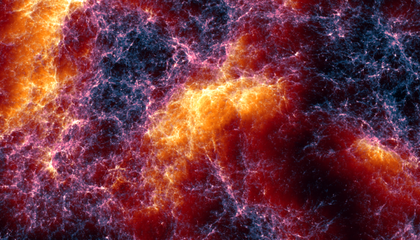
A major new computer simulation has provided astronomers with their most detailed view yet of the cosmic dark ages, a period in the early universe when no stars or galaxies existed to emit light. The model, named Lumina, traces the transition from a simple mix of hydrogen and helium gas to the complex web of structures that characterizes the modern cosmos. By mapping this era, which occurred between 50 million and 200 million years after the Big Bang, scientists aim to clarify how the universe broke free from its initial darkness.
For roughly 380,000 years following the Big Bang, the universe was a hot, dense plasma of electrons and atomic nuclei. As it cooled, electrons combined with hydrogen and helium nuclei to form neutral atoms, plunging the cosmos into obscurity because there were no free electrons to scatter light and no luminous bodies to generate it. This phase, known as the cosmic dark ages, represents a shift from simple physical conditions to increasingly complex interactions, a transition that has remained difficult for researchers to observe directly.
Lumina addresses this observational gap by simulating the epoch of reionization, the period when the first sources of light began to strip electrons from atoms, turning neutral gas back into charged ions. The simulation covers a volume more than 100 times larger than previous comparable models, spanning 1.5 billion light-years on each side. This vast scale allows researchers to observe both the broad evolution of cosmic structures and the detailed development of individual galaxies within that framework.
The results indicate that reionization did not happen uniformly across space. Instead, the simulation shows ionized bubbles forming around massive structures where the first stars and black holes emerged. These regions of charged particles expanded over time, but significant portions of the universe remained neutral for extended periods. The process involved two distinct waves: starlight was sufficient to remove the first electron from helium atoms, but stripping the second electron required more intense radiation from developing supermassive black holes.
Creating such a comprehensive model required immense computational resources. The team utilized the Frontier supercomputer at Oak Ridge National Laboratory, employing over 100,000 processing cores and approximately 15,000 graphics processing units. At its peak, the project consumed about 600 terabytes of memory, equivalent to storing roughly 150,000 high-definition movies. The entire simulation took approximately six months to complete, running through millions of lines of code to track the interactions of dark matter, gas, stars, and radiation.
The development of Lumina builds upon earlier foundational work, including the 2005 Millennium Simulation and the 2017 IllustrisTNG project. Many of the scientists involved in those previous efforts contributed to this new model, which serves as a direct successor in the lineage of large-scale cosmological simulations. The continuity of these projects allows for refined comparisons between theoretical predictions and actual astronomical data, enhancing the reliability of the findings.
Experts not involved in the study have praised the engineering feat required to make such a large-scale simulation run efficiently on modern hardware. Achieving accurate results for helium reionization, which occurs later and requires finer resolution, was particularly challenging. The ability to maintain high detail across such a vast volume of space represents a significant advancement in computational astrophysics, allowing for more precise testing of theories regarding the early universe.
The practical significance of Lumina lies in its role as a predictive tool for current and future observatories. As the James Webb Space Telescope and the upcoming Nancy Grace Roman Space Telescope gather data on distant galaxies, astronomers will need robust theoretical models to interpret their findings. By translating abstract theories into detailed visual predictions, this simulation helps bridge the gap between what scientists expect to see and what these powerful instruments actually detect.
Lead researcher Oliver Zier noted that the project involved years of work with varying levels of success, but seeing the predictions come to life in video form has been rewarding. The visualization shows webs of radiation emanating from early structures and eventually expanding to encompass the entire universe, marking the end of the dark ages. This new era of light set the stage for the formation of the galaxies we observe today.
While the simulation provides a clear picture of how ionization progressed, uncertainties remain regarding specific local conditions and the exact timing of star formation in different regions. The uneven nature of reionization suggests that the universe’s evolution was highly localized, with some areas lighting up earlier than others. Future studies will likely focus on refining these models further as new observational data becomes available, continuing to shed light on this cloudy chapter of cosmic history.
Sources behind this briefing
Go to the original reporting
- Smithsonian Magazine↗See a Stunning Simulation of the Early Universe, Which Will Help Astronomers Shed Light on the Cosmic Dark Ages