The short version
- A proof-of-concept test using NASA's PUNCH mission data predicted a solar storm's arrival within thirty minutes of the actual time.
- This accuracy represents a tenfold improvement over current methods, which typically offer a five-hour window for impact predictions.
- Continuous imaging reveals that solar material is clumpier and evolves differently than previously understood during its journey to Earth.
A new approach to monitoring solar activity has demonstrated the ability to predict when space storms will hit Earth with unprecedented precision. Scientists utilized data from NASA’s Polarimeter to Unify the Corona and Heliosphere mission to forecast the arrival of a coronal mass ejection within a thirty-minute margin of error. This level of accuracy marks a substantial improvement over existing forecasting techniques, which generally provide a much broader five-hour window for potential impacts.
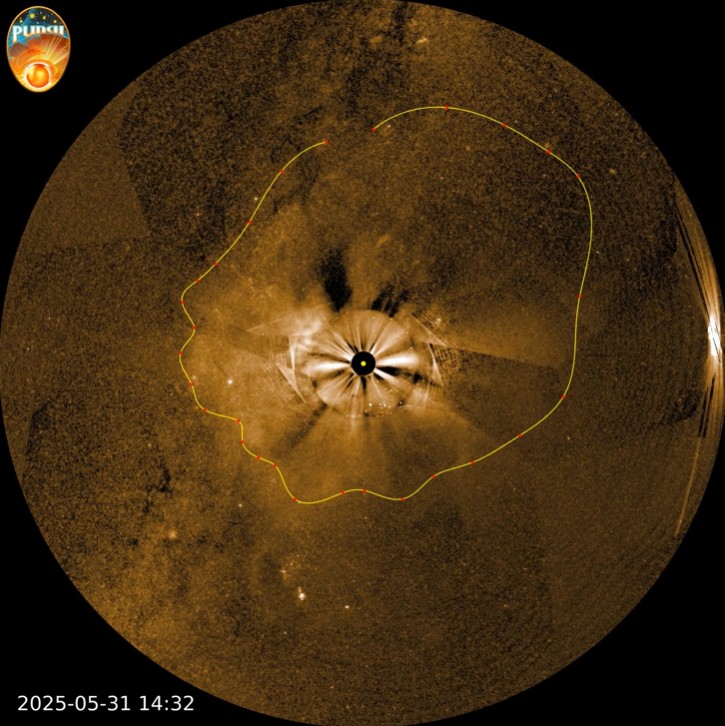
The test involved analyzing imagery from a solar eruption that departed the Sun in late May 2025. Researchers fed continuous images into a computer model designed to track the leading edge of the ejected material as it traveled through the inner solar system. By monitoring the speed and geometric changes of the cloud over time, the system calculated an arrival time twelve hours after the initial eruption. The final prediction proved highly reliable, stabilizing well before the storm reached Earth.
This breakthrough addresses a long-standing limitation in space weather monitoring. Prior to the deployment of the PUNCH constellation, observers could only detect coronal mass ejections during the first fifth of their journey from the Sun to Earth. For the remaining distance, scientists had to rely on extrapolation and guesswork regarding how the material would behave. The new system eliminates this blind spot by providing a continuous view of the entire transit.
The PUNCH mission consists of four spacecraft operating in low Earth orbit. These satellites work together to create three-dimensional observations of the inner solar system, capturing new images every four minutes. This high-frequency data stream allows for routine tracking of solar explosions nearly all the way to their destination. The ability to observe the full trajectory provides critical information that was previously inaccessible.
Craig DeForest, the principal investigator for the mission at Southwest Research Institute, described the results as stunning. He compared the advancement to the transition from steam engines to modern internal combustion engines in terms of technological leap. The success of this initial proof-of-concept test suggests that the wide-field imagery capability is far more effective than initially anticipated for operational forecasting purposes.
Beyond improving timing predictions, the high-resolution data has revealed new details about the physical nature of coronal mass ejections. The images show that clouds of solar material are not uniform but rather clumpy and dynamic. These structures continue to evolve significantly as they cross the solar system, challenging previous assumptions about their stability and composition during transit.
Accurate forecasting is essential for protecting infrastructure vulnerable to space weather. Solar storms can disrupt power grids, damage satellites, and pose radiation risks to astronauts. Knowing exactly when a storm will arrive allows operators to take protective measures in advance. The ability to narrow the uncertainty window from hours to minutes provides a much more actionable timeline for mitigation efforts.
The findings were presented at the Committee on Space Research Scientific Meeting and are currently under review by the journal Space Weather. While this test used retroactive data, it demonstrates the potential for real-time application. Scientists believe that further refinement of the models and continued data collection could extend the lead time for accurate forecasts even further.
The mission also offers broader scientific benefits beyond immediate weather forecasting. Understanding how plasma moves across space helps astrophysicists study similar phenomena in other parts of the galaxy, such as star-forming regions where small-scale observations are difficult. The PUNCH data provides a unique laboratory for observing plasma behavior in our own solar neighborhood.
Southwest Research Institute leads the mission and operates the spacecraft from facilities in Boulder, Colorado. NASA’s Goddard Space Flight Center manages the mission operations. As more data becomes available, researchers expect to refine their understanding of both the mechanics of solar eruptions and the practical applications for protecting Earth-based technology and human spaceflight activities.
Sources behind this briefing
Go to the original reporting
- NASA↗NASA’s PUNCH Sharpens Solar Storm Forecasting in First Test

