The short version
- A new two-part documentary investigates historical chemical dumping at a Shropshire landfill site formerly managed by Monsanto.
- Local clergyman and campaigner Paul Cawthorne reports finding dangerously high levels of toxic chemicals at multiple sites, contradicting official safety assessments.
- Telford and Wrekin Council maintains that regular testing shows no cause for concern and denies records indicate toxic waste was tipped at the location.
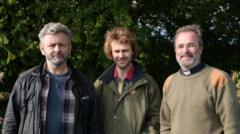
A new television investigation is bringing renewed scrutiny to a former landfill site in Shropshire, challenging official narratives regarding its environmental safety. The two-part BBC documentary, titled Buried, features Welsh actor Michael Sheen as he explores the history of toxic waste disposal linked to the chemical giant Monsanto. The series centers on findings presented by Rev Paul Cawthorne, a local vicar and long-time environmental campaigner who has spent two decades researching contamination in the region.
Cawthorne’s work focuses on Stoney Hill, a site near Coalbrookdale where Monsanto legally disposed of waste between 1985 and 1988. During this period, the landfill was managed by Shropshire County Council. Cawthorne argues that the historical disposal practices have left a legacy of contamination that has been overlooked or minimized by authorities. His investigation extends beyond Stoney Hill to other locations in Herefordshire and north Wales, identifying sites he believes require further testing due to documented historical dumping activities.
The core of the controversy lies in conflicting assessments of the site’s current condition. Cawthorne claims that testing revealed dangerously elevated levels of polychlorinated biphenyls, or PCBs, at nine out of ten sites discussed in the accompanying radio series. He describes these man-made chemicals as persistent and difficult to break down in nature. According to Cawthorne, some results were so high they exceeded measurement scales, suggesting a significant environmental hazard that professional circles can no longer ignore.
In contrast, Telford and Wrekin Council, which has managed the site since 1998, firmly disputes these allegations. A council spokesperson stated that information regarding the active management plan is publicly available on their website. The council asserts that records received from the previous Shropshire County Council administration contain no evidence of toxic materials being tipped at Stoney Hill. They maintain that regular testing has not identified any cause for concern and that the site does not pose a harm to the local environment.
The council points to a detailed assessment conducted by the Environment Agency in 2008 as further proof of the site’s safety. This review concluded that the landfill did not present a risk, supporting the council’s position that no immediate action is required. Despite these official findings, Cawthorne has called for a full fresh statutory investigation into the former landfill. He believes that existing data may be insufficient or outdated given the persistent nature of PCBs and the potential for long-term exposure risks.
The documentary aims to bridge the gap between technical reports and public understanding by highlighting the personal mission of Cawthorne. Sheen’s involvement brings mainstream attention to what has been a localized dispute over environmental health and historical accountability. The series explores how disposal legislation tightened in 1974, yet waste continued to be managed at sites like Stoney Hill for another decade. This timeline raises questions about the adequacy of monitoring during that transitional period.
Details regarding Monsanto’s specific involvement were recently clarified through a Freedom of Information request, confirming the company’s role in dumping waste at the site under the previous council’s management. While the disposal was legal at the time, the long-term implications remain a subject of debate. Cawthorne’s identification of Sutton Walls and Cefn Mawr as additional sites of concern suggests a broader pattern of potential contamination that may not be fully captured by current regulatory frameworks.
As the series airs on BBC Two, BBC One Wales, and BBC iPlayer starting August 17, it is likely to intensify pressure on local authorities to address these lingering questions. The conflict between Cawthorne’s independent findings and the council’s official stance highlights the difficulties in assessing historical environmental damage. Whether this leads to renewed testing or policy changes remains uncertain, but the public interest in the matter has clearly been rekindled by the broadcast.
The situation underscores broader challenges in managing legacy industrial sites across the UK. As regulations evolve, past practices that were once compliant may now be viewed as hazardous. The discrepancy between the council’s confidence in existing safety measures and Cawthorne’s alarm over PCB levels illustrates the complexity of environmental governance. Residents and experts alike will be watching to see if the documentary prompts a re-evaluation of sites previously deemed safe.
Ultimately, the series serves as a case study in how historical industrial activity continues to impact contemporary communities. The clash between official records and independent investigation raises important questions about transparency and accountability in environmental management. While Telford and Wrekin Council stands by its assessment, the persistent advocacy of Cawthorne ensures that Stoney Hill remains a focal point for discussions on toxic waste and public health.
Sources behind this briefing
Go to the original reporting
- BBC Science & Environment↗Hollywood actor seeks help from vicar for series

