The short version
- A new multi-telescope image of the Tarantula Nebula highlights unexpected deficits in X-ray emitting gas.
- Researchers identify three distinct processes causing energy loss: gas escaping shell walls, thermal mixing, and heat conduction.
- The findings suggest that massive stellar winds do not retain their energy as previously predicted by theoretical models.
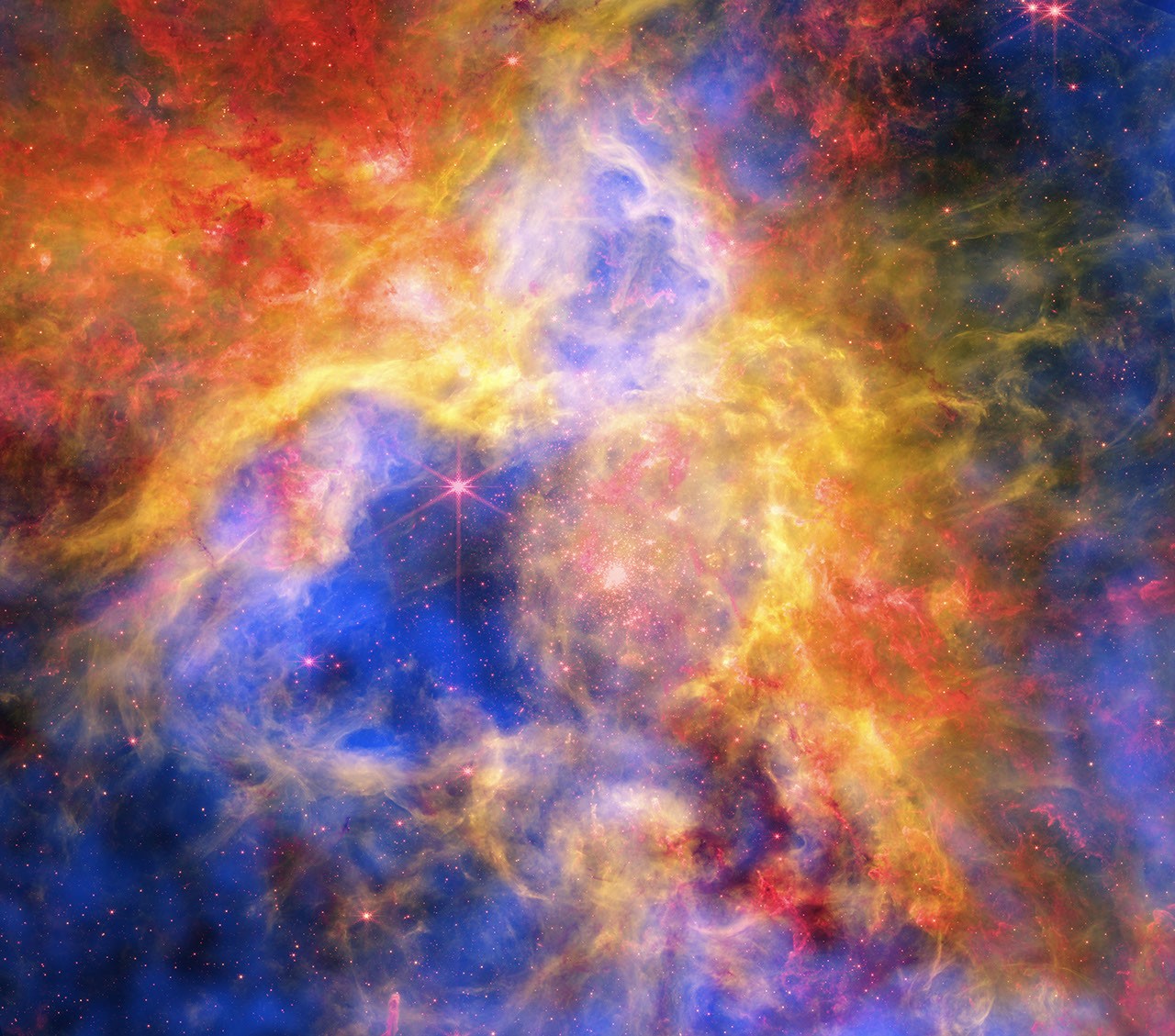
Astronomers have released a new composite visualization of the Tarantula Nebula, also known as 30 Doradus, combining data from three major NASA space observatories. This region, located in the Large Magellanic Cloud approximately 160,000 light-years from Earth, serves as a critical laboratory for studying star formation due to its proximity and high activity. The image layers X-ray observations from the Chandra X-ray Observatory in blue, infrared data from the James Webb Space Telescope in red, and optical imagery from the Hubble Space Telescope in green. This multi-wavelength approach allows scientists to examine different physical components of the nebula simultaneously, revealing a complex structure of gas, dust, and young stars.
The Tarantula Nebula contains thousands of young, massive stars embedded within a honeycomb-like network of material. These stars generate powerful winds that blow away surrounding gas and heat it to millions of degrees through shock waves similar to sonic booms. Under standard theoretical models, this intense energy input should result in significant amounts of hot gas emitting X-rays. However, the new analysis indicates a substantial discrepancy between predicted and observed levels of X-ray emission, prompting researchers to investigate where the expected energy has gone.
The investigation, led by Jennifer Rodriguez of The Ohio State University and published in the Astrophysical Journal, utilized data from Chandra, Webb, Hubble, and the retired Spitzer Space Telescope. By comparing observational data with computer simulations, the team identified three primary mechanisms responsible for the nebula’s energy loss. These findings challenge the assumption that stellar winds efficiently heat and retain gas within star-forming regions, suggesting instead that energy dissipates more rapidly than previously thought.
The first mechanism involves the physical escape of hot gas from the nebula. The study suggests that up to half of the heated material leaks through the walls of the gas and dust shells that structure the region. This leakage allows high-energy particles to exit the system entirely, reducing the overall temperature and X-ray brightness of the nebula. The visual data shows regions where the blue Chandra layer stands alone or overlaps with other wavelengths, highlighting areas where this escape may be occurring.
Secondly, the research points to stirring and mixing between cold gas near the shell walls and the hotter interior gas. This interaction lowers the overall temperature of the mixture, preventing it from reaching the extreme temperatures required for strong X-ray emission. The infrared data from Webb reveals swaths of cool dust that serve as ingredients for future star formation, while Hubble’s optical data uncovers warmer hydrogen gas. The interplay between these different temperature zones facilitates thermal exchange that dampens the expected heat signatures.
The third identified process is conduction, which involves direct physical contact between hot and cooler materials. Similar to heat transfer in a frying pan on a burner, this mechanism allows hot gas to equalize in temperature with cooler surrounding material without necessarily mixing with it. This process is particularly effective in the densest regions of the nebula where shells are thickest. The combination of these three channels—leakage, mixing, and conduction—explains the lower-than-expected X-ray output observed by Chandra.
The composite image provides a holistic view of these processes, with colors blending to show where different data sets overlap. In the central region, all three telescopes’ data combine to create red, orange, yellow, green, and blue hues, illustrating the complexity of the environment. The study underscores the importance of multi-messenger astronomy in understanding stellar evolution and nebular dynamics. By integrating X-ray, infrared, and optical perspectives, scientists can disentangle the various physical processes at work.
This research contributes to a broader understanding of how massive stars influence their surroundings. The Tarantula Nebula is often used as an analog for early universe star formation conditions due to its metallicity and activity level. Insights gained from this study may help refine models of galaxy evolution and the lifecycle of stellar populations. The findings also highlight the capabilities of current and retired NASA missions in providing complementary data that no single telescope could capture alone.
The team behind the paper includes researchers from Ohio State University, Columbia University, San Diego State University, the Space Telescope Science Institute, and NASA’s Goddard Space Flight Center. Their work demonstrates how collaborative analysis of archival and new data can resolve long-standing questions in astrophysics. As more data becomes available from Webb and other observatories, similar studies may be applied to other star-forming regions to test the universality of these energy loss mechanisms.
Future observations will likely focus on quantifying the rates of gas leakage and conduction in greater detail. Understanding these processes is crucial for modeling the feedback loops between stars and their interstellar environments. The Tarantula Nebula remains a key target for such studies, offering a nearby window into the violent and dynamic processes that shape galaxies. The new image serves not only as a scientific tool but also as a testament to the power of combined observational strategies in modern astronomy.
Sources behind this briefing
Go to the original reporting
- NASA↗NASA Telescopes Create Colorful ‘Craft’ From Nearby Nebula

