The short version
- NASA successfully tested autonomous landing guidance systems using a drone at Edwards Air Force Base.
- The technology uses light-detection sensors to create high-resolution maps and identify safe landing zones in real time.
- The validation raises the technology readiness level, preparing the system for integration into future lunar missions.
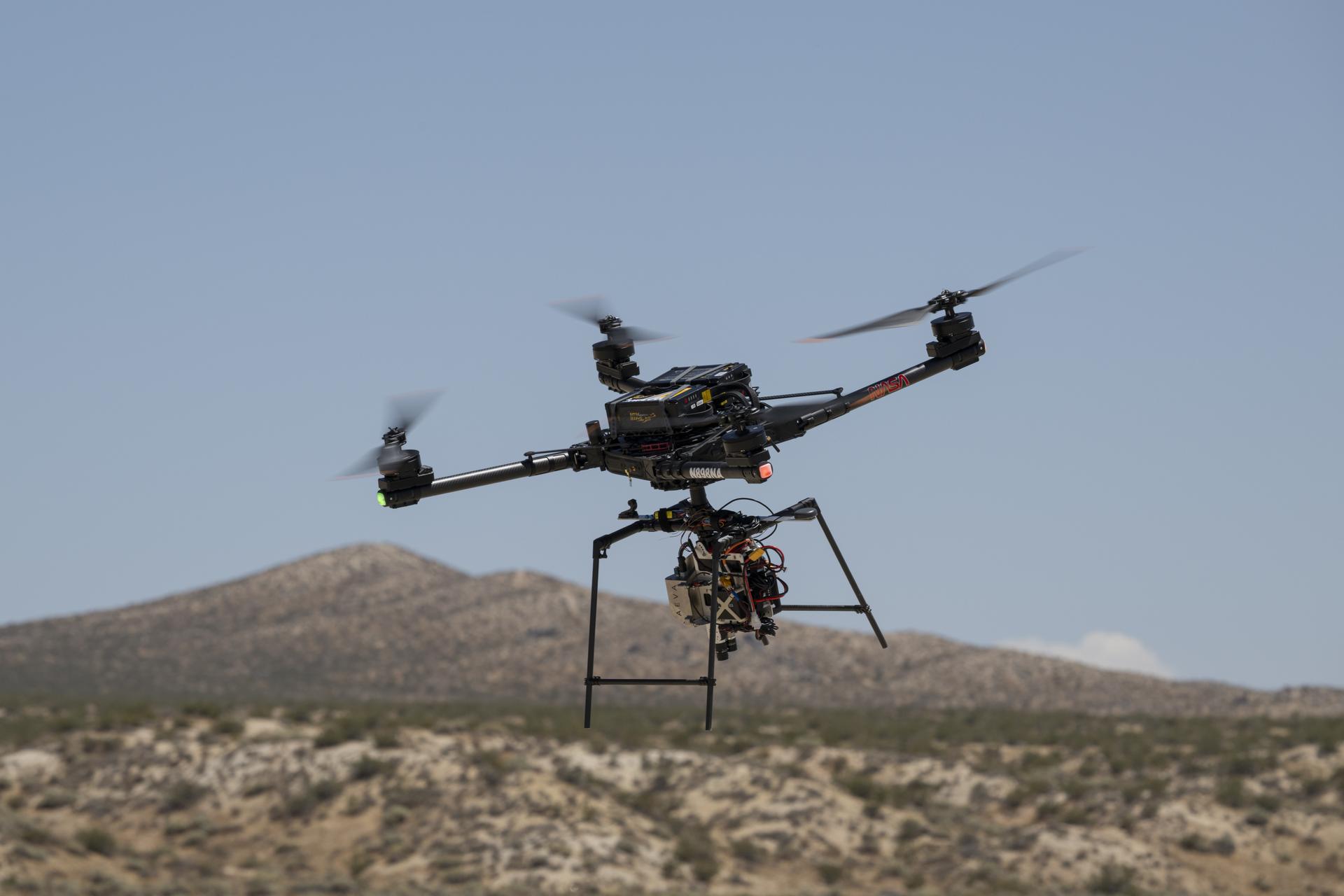
NASA has confirmed the successful operation of a new autonomous navigation system designed to guide spacecraft to safe landing sites on the Moon and other planetary bodies. The demonstration took place on August 27 at Rogers Dry Lake, located near the Armstrong Flight Research Center in Edwards, California. An Alta-X drone served as the test platform, carrying the agency’s Safe and Precise Landing – Integrated Capabilities Evolution (SPLICE) payload. This flight marked a critical milestone in validating guidance, navigation, and control technologies that are essential for future exploration efforts.
The core function of the SPLICE system is to autonomously assess terrain during descent. By utilizing light-detection and sensor data, the payload generates high-resolution digital elevation maps of the landing area. If the onboard algorithms determine that the targeted site contains hazards or is otherwise unsafe, the system automatically diverts the vehicle to a more secure location. This capability addresses one of the most significant risks in planetary exploration: the inability to react to unexpected terrain features during the final stages of landing.
The development of this payload was led by researchers at NASA’s Johnson Space Center in Houston. They collaborated with specialists at NASA Armstrong to integrate the technology onto the drone and conduct preliminary testing throughout June and July. These earlier flights focused on verifying fundamental performance metrics, including communications reliability, data handling efficiency, telemetry accuracy, and command-control responsiveness. The success of these initial checks paved the way for the full-scale simulation conducted in late August.
Davis Adams, the NASA project manager for SPLICE, described the recent flight as the culmination of nearly ten years of work. He noted that the test successfully raised the technology readiness level of the system, a key metric used by the agency to gauge how mature a technology is before it is deployed in space. According to Adams, this advancement primes the guidance and navigation systems for integration into both robotic and crewed lunar missions scheduled for the near future.
The validation of these systems has broad applicability beyond just lunar landings. The underlying principles of autonomous terrain mapping and hazard avoidance are relevant to descent and landing operations on Mars as well as terrestrial applications. By proving that the system can operate effectively in a simulated environment, NASA has demonstrated its potential to enhance safety and precision across various mission profiles. This versatility makes the technology a valuable asset for diverse exploration strategies.
NASA is actively coordinating with commercial partners to implement iterations of SPLICE into their lunar lander platforms. Several companies involved in upcoming Moon Base missions are leveraging data collected during the development of systems like SPLICE to execute soft touchdowns on the lunar surface. Adams indicated that the agency plans to make the guidance system available in its software catalog this fall, facilitating broader industry adoption and further testing.
Commercial entities are currently evaluating the navigation capabilities of the system for precision landing applications. Some partners are also exploring potential extensions for autonomous surface mobility, which could allow rovers or other vehicles to navigate complex terrain without direct human intervention. This collaboration between government agencies and private industry aims to accelerate the deployment of reliable landing technologies while reducing costs and development timelines.
The foundation for this recent success was laid by NASA’s Flight Opportunities project, based at Armstrong. This program enabled early flight testing of SPLICE components, which helped advance the technology readiness level from its initial stages to its current state. Previous tests included a descent altitude and landing trajectory simulation in 2019 that mirrored expected lunar mission parameters. Additionally, two NASA-developed precision landing sensor systems were demonstrated in 2020, providing critical data that informed the design of the current payload.
Looking ahead, the next phase involves further testing at Voyager Technologies in Mojave, California, later this month. These upcoming trials will build on the data gathered from the Rogers Dry Lake demonstration, ensuring that the system performs consistently under varied conditions. As NASA continues to refine these autonomous landing capabilities, the agency moves closer to enabling safer and more precise exploration of celestial bodies, supporting both scientific discovery and human presence beyond Earth.
The successful integration of SPLICE represents a significant step forward in spaceflight safety. By automating the process of hazard detection and avoidance, NASA reduces the reliance on pre-mapped landing sites, which may not account for all potential risks. This flexibility allows mission planners to target scientifically interesting areas that might previously have been considered too dangerous. As the technology matures, it will play a crucial role in enabling sustained exploration of the Moon and eventual missions to Mars.
Sources behind this briefing
Go to the original reporting
- NASA↗NASA Navigation Experiment Shows Promise for Planetary Landings