The short version
- NASA has issued a request for information asking commercial entities to propose methods for raising Hubble’s orbit or performing essential maintenance before 2032.
- Without intervention, the telescope is projected to reenter Earth's atmosphere and burn up between 2033 and 2034 due to steady altitude loss since the shuttle era ended.
- While no funding is currently allocated for such a mission, recent advances in robotic satellite servicing suggest that extending Hubble’s life by decades may be technically feasible.
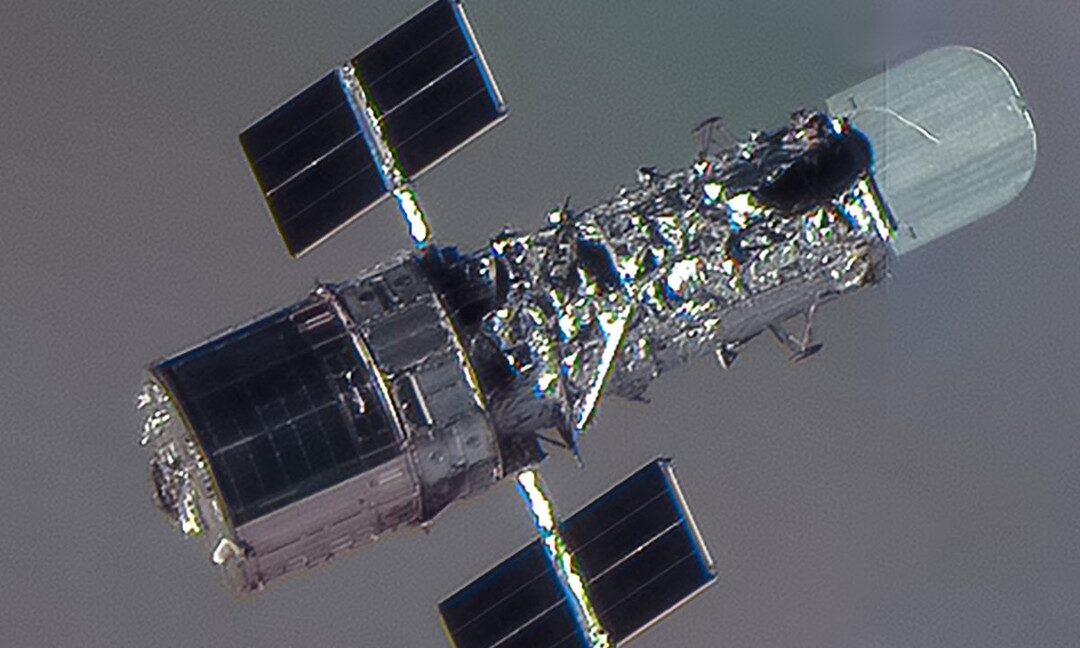
NASA has formally asked commercial aerospace companies to submit ideas for saving the Hubble Space Telescope from eventual atmospheric reentry. The space agency released a request for information on Thursday, seeking proposals that could capture the observatory, boost its orbit, or guide it to a controlled disposal. Responses are due by November 30. This move marks a renewed effort to preserve one of the most significant scientific instruments of the modern era, which has operated continuously for 36 years but is steadily losing altitude.
The urgency stems from Hubble’s current trajectory. Without external intervention, orbital dynamicists predict the telescope will plunge back into Earth’s atmosphere in either 2033 or 2034. The observatory lacks onboard propulsion systems to adjust its path. Its last orbital boost occurred in 2002 during a Space Shuttle servicing mission. Since the retirement of the shuttle fleet in 2011, Hubble has been unable to receive such assistance, causing it to glide from an altitude of 362 miles down to approximately 292 miles above Earth.
The new solicitation outlines specific technical requirements for potential contractors. NASA is looking for solutions that can raise the telescope’s orbit to at least 373 miles, or 600 kilometers. Achieving this altitude would likely extend Hubble’s operational lifespan by at least 25 years. The agency also expressed interest in proposals that could enhance the telescope’s performance through servicing or ensure a safe, controlled reentry if preservation is not viable. Any successful mission must occur by 2032 and must not harm the spacecraft.
Contractors responding to the request would be responsible for providing the launch vehicle, the servicing spacecraft, and mission operations support. Crewed missions are an option but not a requirement. NASA emphasized that it is not currently committing funds to purchase a rescue mission. Instead, the agency aims to gauge market interest, understand cost estimates, and identify which companies possess the realistic capability to reach Hubble before its orbit decays further.
This is not the first time NASA has explored commercial solutions for Hubble’s preservation. In 2022, the agency issued a similar request for information and received eight responses. Among them was a joint robotic reboost proposal from Astroscale and Momentus, which aimed to combine satellite servicing technology with in-space transport capabilities. Additionally, billionaire astronaut Jared Isaacman approached NASA that year with a plan to fund a crewed mission using SpaceX’s Dragon spacecraft to reboost the telescope and replace failing gyroscopes.
At that time, agency officials characterized some of these plans as notional concepts rather than fully developed missions. Mark Clampin, who led NASA’s astrophysics division in 2024, noted that the servicing plans from Isaacman and SpaceX lacked sufficient detail to move forward immediately. However, the landscape of space logistics has shifted significantly since then. The commercial satellite servicing industry has matured, with several startups securing contracts for demonstration missions with the US Space Force and NASA.
Recent developments suggest that a rescue mission is more feasible now than it was four years ago. Northrop Grumman launched an advanced robotic servicing satellite earlier this year in partnership with DARPA. Smaller companies like Astroscale and Starfish Space are also conducting servicing and refueling demonstrations. These advancements indicate that the technical barriers to reaching and manipulating Hubble have lowered, making a 2032 deadline increasingly attainable for well-resourced contractors.
The agency’s approach may be influenced by its recent experience with the Swift satellite. NASA awarded a $30 million contract to Katalyst Space Technologies last year to develop a rapid rescue mission for Swift, which was also facing orbital decay. Katalyst built and launched a rescue satellite within nine months, getting within six miles of Swift before aborting the final approach due to technical issues with power and control systems. While that mission did not succeed in boosting Swift, it demonstrated that servicing operations do not necessarily require billions of dollars or years of development.
Hubble represents a far more valuable asset than Swift, implying that any successful rescue effort would likely involve greater investment and longer timelines. NASA currently has no funding allocated for procuring a Hubble reboost or servicing mission. The request for information serves as a preliminary step to assess the commercial market’s capacity and willingness to undertake such a complex operation. If viable proposals emerge, they could pave the way for future budget requests aimed at preserving Hubble’s scientific contributions for another generation.
The outcome of this solicitation will determine whether Hubble continues its legacy of astronomical discovery or meets its end in the atmosphere. With solar activity capable of altering reentry forecasts, the window for intervention remains narrow but open. The agency’s decision to engage commercial partners reflects a broader shift toward leveraging private sector innovation for critical space infrastructure maintenance. As responses come in over the coming weeks, NASA will evaluate which options offer the best balance of technical feasibility, cost, and risk.
Sources behind this briefing
Go to the original reporting
- Ars Technica↗Think you can save the Hubble Space Telescope? NASA wants to know.