The short version
- Scientists observed a rare pileus cloud forming atop a smoke-filled pyrocumulus during a research flight over the Sand Creek fire in Montana.
- The formation indicates intense vertical air movement, as rising heat from the fire displaced moist air layers to create the distinct cap-like structure.
- Data collected by NASA’s ER-2 aircraft helps link surface fire behavior with upper-atmosphere cloud processes during the INSPYRE experiment.
Researchers conducting aerial studies of wildfire smoke in Montana captured unusual atmospheric phenomena on August 11, 2026. During a flight over the Sand Creek fire, scientists documented a rare pileus cloud hovering above a towering pyrocumulus plume. This observation provides valuable data for understanding how intense fires interact with the atmosphere to create complex cloud structures.
The INSPYRE campaign, which stands for Injected Smoke and Pyrocumulonimbus Experiment, aims to study how wildland fires inject smoke into the upper atmosphere. While the primary goal was to intercept smoke-infused clouds, the team encountered this specific cloud formation as an unexpected bonus. The sighting offers a detailed look at the mechanics of fire-driven convection that are difficult to observe from the ground.
Pileus clouds, named after the Latin word for cap, typically appear as smooth, veil-like layers. They form when rising columns of air collide with a moist layer aloft. In this instance, the heat from the wildfire created a powerful updraft that acted like a mountain, forcing horizontal layers of moist air upward. As this displaced air rose and cooled, water vapor condensed to form the distinct cloud cap.
Neil Lareau, deputy project investigator for INSPYRE, explained that the process mirrors how air forced over terrain produces clouds, but with the pyrocumulus itself serving as the obstacle. The presence of such a cloud signals vigorous convection within the fire plume. These formations are usually ephemeral, lasting only minutes before being overtaken by the underlying rising air.
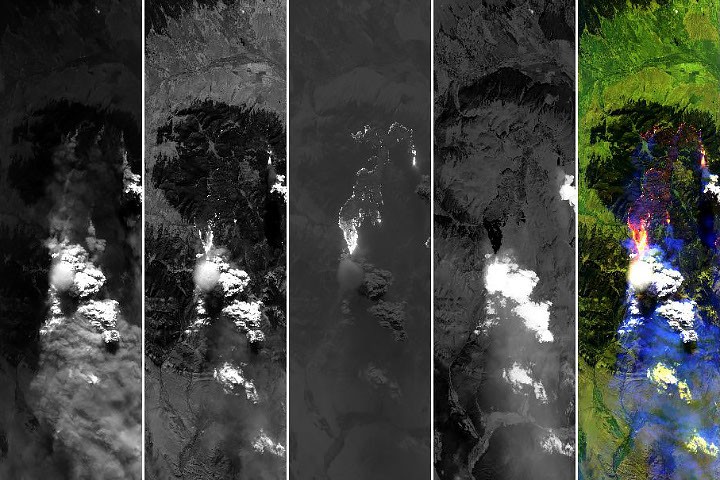
The imagery was captured at 5:40 p.m. local time using the MASTER instrument aboard NASA’s ER-2 high-altitude research aircraft. The natural-color image reveals a thin, circular pileus atop the turret of smoke and water vapor. A second image incorporating shortwave-infrared observations highlights the burned areas and active burning spots along the fire’s perimeter, providing a comprehensive view of the event.
During the flight, scientists collected imagery roughly every thirty minutes. The pileus cloud was clearly visible in only one scene, underscoring its transient nature. Its brief appearance hints at extreme updraft dynamics within the plume. At the time of capture, the fire was advancing rapidly up the western side of Mount Comet, aided by winds aligned with drainage channels leading up the mountain.
Lareau described the scene as central to the goals of the INSPYRE mission. The combination of visible light imaging, infrared data, and downward-pointing radar allowed the team to map surface fire dynamics to convective plumes and cloud processes. This multi-faceted approach helps connect ground-level behavior with atmospheric responses.
While wildfires are a primary driver of such convection, pileus clouds can also form above severe thunderstorms and volcanic eruptions. Previous studies, including NASA’s CRYSTAL-FACE experiment in Honduras, have noted similar formations associated with thunderstorm activity. Astronauts have also photographed pileus clouds cloaking volcanic plumes, such as those from the Sarychev volcano in 2009.
The data gathered during this flight contributes to a broader understanding of how extreme weather events influence atmospheric conditions. By linking surface fire behavior with upper-atmosphere processes, researchers can improve models predicting smoke dispersion and cloud formation. These insights are critical for assessing air quality impacts and wildfire management strategies.
As the INSPYRE campaign continues, scientists will analyze further data to refine their understanding of pyrocumulus dynamics. The rare observation over the Sand Creek fire serves as a case study in the complex interactions between fire, wind, and moisture. Future flights may reveal additional insights into how these powerful natural forces shape our atmosphere.
Sources behind this briefing
Go to the original reporting
- NASA↗Fire Cloud with a Pileus on Top