The short version
- Perseverance has finished exploring the Lac de Charmes area, analyzing ancient igneous and impact-formed rocks that predate Jezero crater sediments.
- A new navigation algorithm improved driving accuracy, allowing the rover to create thirteen abrasion patches for detailed scientific analysis.
- The mission is shifting focus to the Idubi region, where hard boulders with unique textures have challenged sampling efforts but promise significant geological insights.
NASA’s Perseverance rover has concluded an extensive survey of the Lac de Charmes region on Mars, a terrain characterized by valleys and ridges located west of the Jezero crater rim. This area represents a frontier for the mission, offering access to some of the oldest geological formations the vehicle has encountered. The rocks found here formed during the early history of the planet, a period marked by intense asteroid bombardment. These ancient materials predate the sedimentary layers inside Jezero crater, which were created later by rivers and lakes. Studying these primordial stones provides critical data on how rocky planets evolved during the turbulent early stages of the solar system.
The science team prioritized a thorough exploration of this ancient landscape before selecting specific rocks for sampling. Perseverance followed a looping trajectory between various outcrops to build a comprehensive understanding of how the Lac de Charmes region formed. During this phase, the rover created thirteen abrasion patches on rocks that attracted scientific interest. These patches allowed instruments to analyze fresh surfaces, generating a substantial amount of data. Initial investigations indicate that many of these rocks are igneous in origin, formed from cooled lava or magma. Others appear to be impactites, created by the violent energy of asteroid strikes. Some specimens show evidence of both geological processes occurring in sequence.
Operational efficiency during this campaign was enhanced by a new algorithm that repurposed a processor originally designed for communication with the Ingenuity helicopter. This software update enabled longer and more precise drives across the rugged terrain. The improved navigation capabilities allowed the rover to access difficult outcrops safely and efficiently. As the exploration of Lac de Charmes nears its conclusion, the data collected from these abrasion patches continues to refine models of early Martian history. The findings suggest a complex geological environment where volcanic activity and impact events intersected.
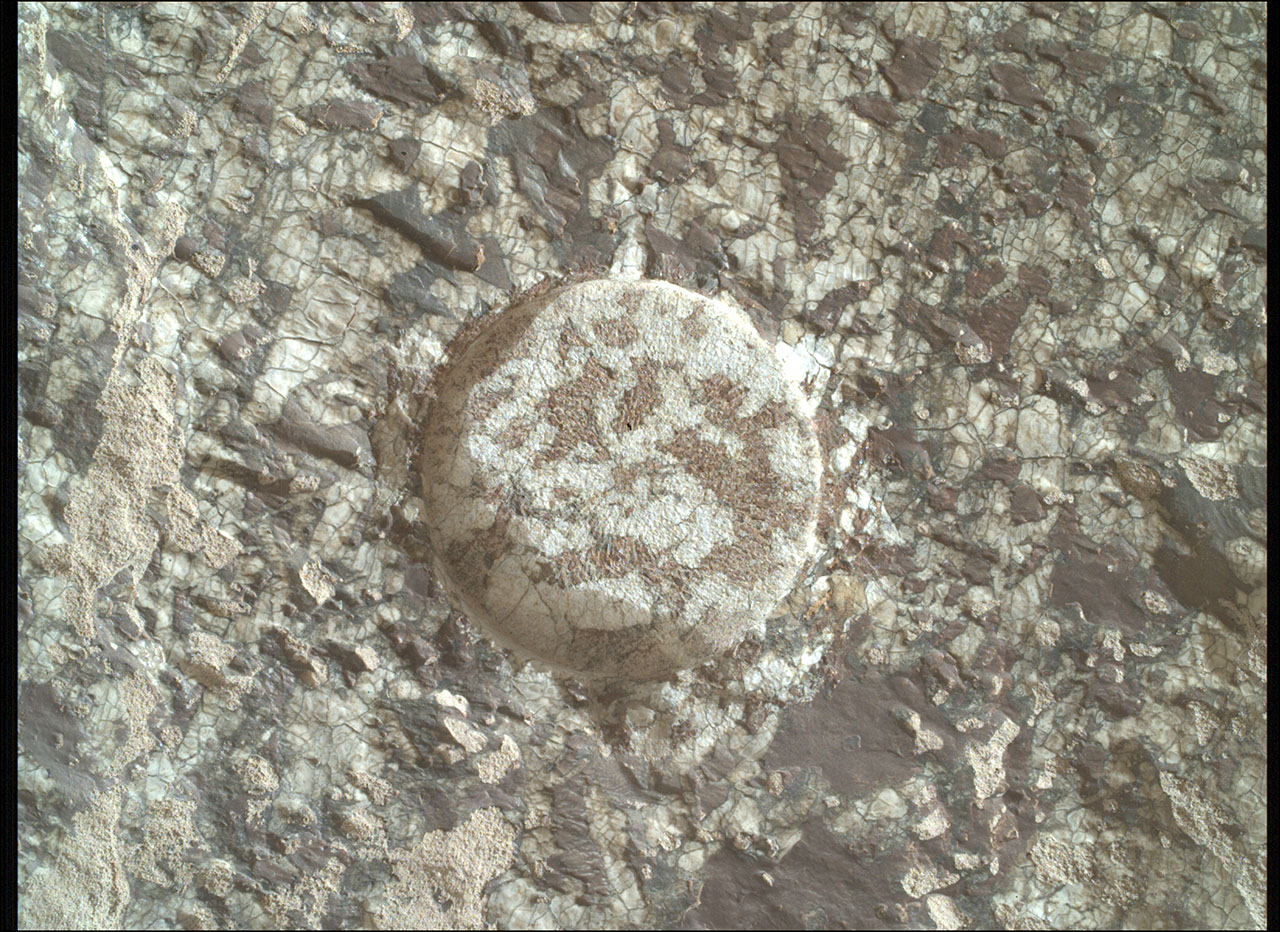
The mission is now transitioning toward a new area nicknamed Idubi, which was identified from orbit as containing hundreds of light-toned boulders. This region has emerged as a site of significant scientific interest due to the concentration of rocks with varying textures and compositions. When Perseverance investigated one of these boulders, it created an abrasion patch named Badger Peak. The exposed surface revealed a striking pattern of light and dark textures that differs from any previously observed by the rover. This unique appearance suggests a distinct geological history or composition that warrants further study.
Efforts to collect a sample from the Badger Peak boulder were unsuccessful because the rock proved too hard for the drilling mechanism. The hardness exceeded the operational limits of the sampling equipment, preventing the retrieval of a core sample. Consequently, the science team is searching for similar rocks elsewhere in the Idubi region that might be more suitable for collection. In the meantime, Perseverance has paused to examine a nearby outcrop named Gardenia. This formation may be a breccia, a type of rock composed of fragments from older geological materials cemented together. Analyzing such a rock could provide insights into the layering and history of the Martian crust.
The rover is scheduled to attempt an abrasion on the Gardenia outcrop this week to give scientists a detailed look at its surface composition. This step will help determine if the rock is indeed a breccia and what materials it contains. The ongoing surprises in the Lac de Charmes and Idubi regions highlight the dynamic nature of Martian geology. Even after months of exploration, the team continues to encounter unexpected features that challenge existing assumptions. The shift from Lac de Charmes to Idubi marks a progression in the mission’s strategy, moving from broad surveying to targeted investigation of specific geological anomalies.
The Perseverance rover serves as the first leg of the Mars Sample Return Campaign, an interplanetary relay effort designed to bring Martian materials back to Earth. The samples collected during this mission will eventually be analyzed in laboratories on our planet, allowing for more detailed study than is possible with onboard instruments. The rocks from Lac de Charmes and Idubi are particularly valuable because they represent the earliest era of Martian history. Understanding these ancient formations helps scientists reconstruct the conditions that existed when Mars was young. This knowledge contributes to broader questions about planetary evolution and the potential for life in the early solar system.
As Perseverance prepares to move onward from its current location, the mission remains focused on gathering diverse samples that tell the story of Mars’ geological past. The combination of igneous rocks, impactites, and potential breccias offers a multifaceted view of the planet’s history. The challenges encountered with hard boulders like Badger Peak underscore the difficulties of remote sampling operations. However, the adaptability of the science team and the capabilities of the rover continue to yield new discoveries. The upcoming analysis of Gardenia and other targets in Idubi will further expand our understanding of the Red Planet’s complex surface.
Sources behind this briefing
Go to the original reporting
- NASA↗Mars Has Its Charmes