The short version
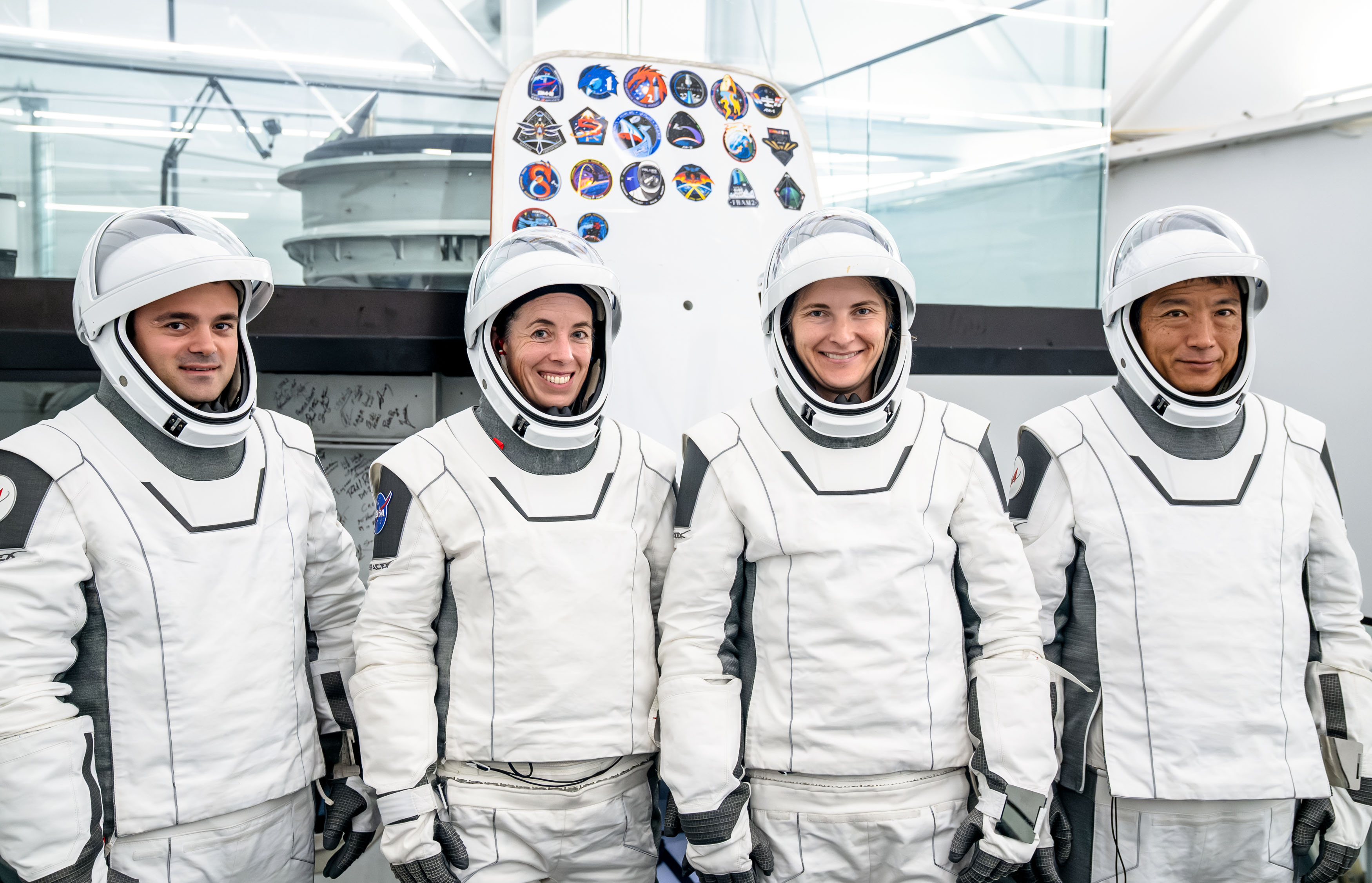
- The mission will carry two NASA astronauts, one JAXA astronaut, and one Roscosmos cosmonaut to the International Space Station.
- Kayla Barron returns for her second flight while Chris Birch, Makoto Suwa, and Arutyun Kiviryan embark on their first space missions.
- The crew will conduct scientific research aimed at supporting future lunar and Martian exploration efforts.
NASA has officially designated the four-member team for the SpaceX Crew-14 mission, marking the next step in the agency’s ongoing partnership with commercial partners to maintain a continuous human presence in low Earth orbit. The group is scheduled to launch no earlier than the spring of 2027, joining the International Space Station for a long-duration expedition that will overlap with Expeditions 75 and 76. This assignment represents the fourteenth rotation under NASA’s Low Earth Orbit Program, continuing a steady cadence of crewed flights that have become standard for maintaining station operations and conducting vital research.
Leading the mission is Kayla Barron, who will serve as the spacecraft commander. A veteran of the U.S. Navy and a former submarine warfare officer, Barron brings extensive experience to the role, having previously flown to the space station in 2021 aboard the Crew-3 mission. During that earlier expedition, she spent nearly six months in orbit, completed two spacewalks, and served as the lead robotics operator. Her background includes a master’s degree in nuclear engineering from the University of Cambridge and significant recent work supporting technology development for NASA’s Artemis program, which aims to return humans to the Moon.
Serving as pilot alongside Barron is Chris Birch, who is embarking on her first spaceflight. Selected as an astronaut candidate in 2021, Birch holds a doctorate in biological engineering from MIT and has a diverse professional history that includes teaching bioengineering at UC Riverside and scientific communication at Caltech. Before joining NASA, she was a competitive track cyclist for the U.S. National Team and made the Olympic Long Team for the Tokyo Games. Her prior contributions to space operations include serving as a capsule communicator and acting as crew lead for Expedition 72, where she helped manage daily station activities.
The mission also includes two international partners who will serve as mission specialists. Makoto Suwa of the Japan Aerospace Exploration Agency (JAXA) is flying for the first time after completing his basic astronaut certification in 2024. His career path to spaceflight was unconventional; before being selected as an astronaut candidate in 2023, he spent nearly ten years working with the World Bank Group and served as a volunteer in Rwanda. He also held positions with the United Nations World Meteorological Organization and holds a doctorate in geosciences from Princeton University.
Rounding out the crew is Arutyun Kiviryan, a cosmonaut from Roscosmos who will also be making his debut in space. Kiviryan was selected for the Gagarin Research and Test Cosmonaut Training Center’s corps in 2021 and has been active as a test cosmonaut since 2023. His educational background includes studies at the Baltic State Technical University, where he specialized in rocket science engineering, and earlier training in computer-controlled machine operations. His inclusion underscores the continued multinational cooperation required to sustain the International Space Station.
The primary objective of the Crew-14 mission is to conduct a wide array of scientific investigations and technology demonstrations. These experiments are designed not only to benefit people on Earth but also to address the specific challenges associated with long-duration human spaceflight. By testing new systems and gathering data in the microgravity environment, the crew will help pave the way for more ambitious exploration goals, including sustained missions to the lunar surface and eventual journeys to Mars.
The International Space Station has served as a continuous laboratory for over twenty-five years, enabling research that cannot be replicated on Earth. The ongoing presence of crews like Crew-14 is critical for maintaining this infrastructure and expanding commercial opportunities in low Earth orbit. As NASA transitions toward its Artemis goals, the station remains a proving ground for the technologies and operational procedures necessary for deep space exploration.
With the crew assignments now public, attention will shift to the final phases of training and vehicle preparation leading up to the 2027 launch window. The mission highlights the diverse backgrounds of modern astronauts, ranging from military engineering and competitive athletics to international development and meteorology. As the fourteenth commercial rotation, it reinforces the reliability of the current launch architecture while setting the stage for future missions that will push the boundaries of human spaceflight.
Sources behind this briefing
Go to the original reporting
- NASA↗NASA Shares SpaceX Crew-14 Assignments for Space Station Mission

