The short version
- Maine Beer Company adopted NASA-derived technology after a critical shortage of commercial carbon dioxide threatened to spoil its inventory.
- The system, originally developed for Martian resource harvesting, captures and purifies CO2 for reuse in brewing, winemaking, and energy production.
- Chart Industries acquired the developer Earthly Labs in 2021, expanding the technology's application to helium production and power plant emissions.
A shortage of carbon dioxide at a Maine brewery in 2021 highlighted a vulnerability in the beverage industry that traces its solution back to space exploration. When the supplier for the Maine Beer Company failed to deliver adequate amounts of CO2, sustainability manager Dave Love warned that the lack of gas would prevent bottling, kegging, and centrifuge operations. Without these processes, the beer stored in tanks faced the risk of going stale, creating an urgent operational crisis.
The resolution came from technology initially engineered for Mars missions. In the 1990s, Pioneer Astronautics secured contracts from NASA’s Johnson Space Center to develop systems capable of generating resources on the Red Planet. These systems were designed to capture carbon dioxide from the Martian atmosphere and combine it with hydrogen to produce water for life support and methane for rocket fuel. While the underlying chemistry was not novel, Pioneer’s approach focused on making the equipment compact, efficient, and fully automated.
Pioneer Astronautics founder Robert Zubrin later established Pioneer Energy to adapt these subsystems for the oil and gas sector. He recognized that the same mechanisms used to capture and purify carbon dioxide on Mars could be applied to breweries. This led to the creation of the Craft Brewery Recovery System, which captures CO2 emitted during the brewing process for reuse in carbonation. By 2015, this system was in production, though Pioneer eventually chose to license the technology rather than continue manufacturing it directly.
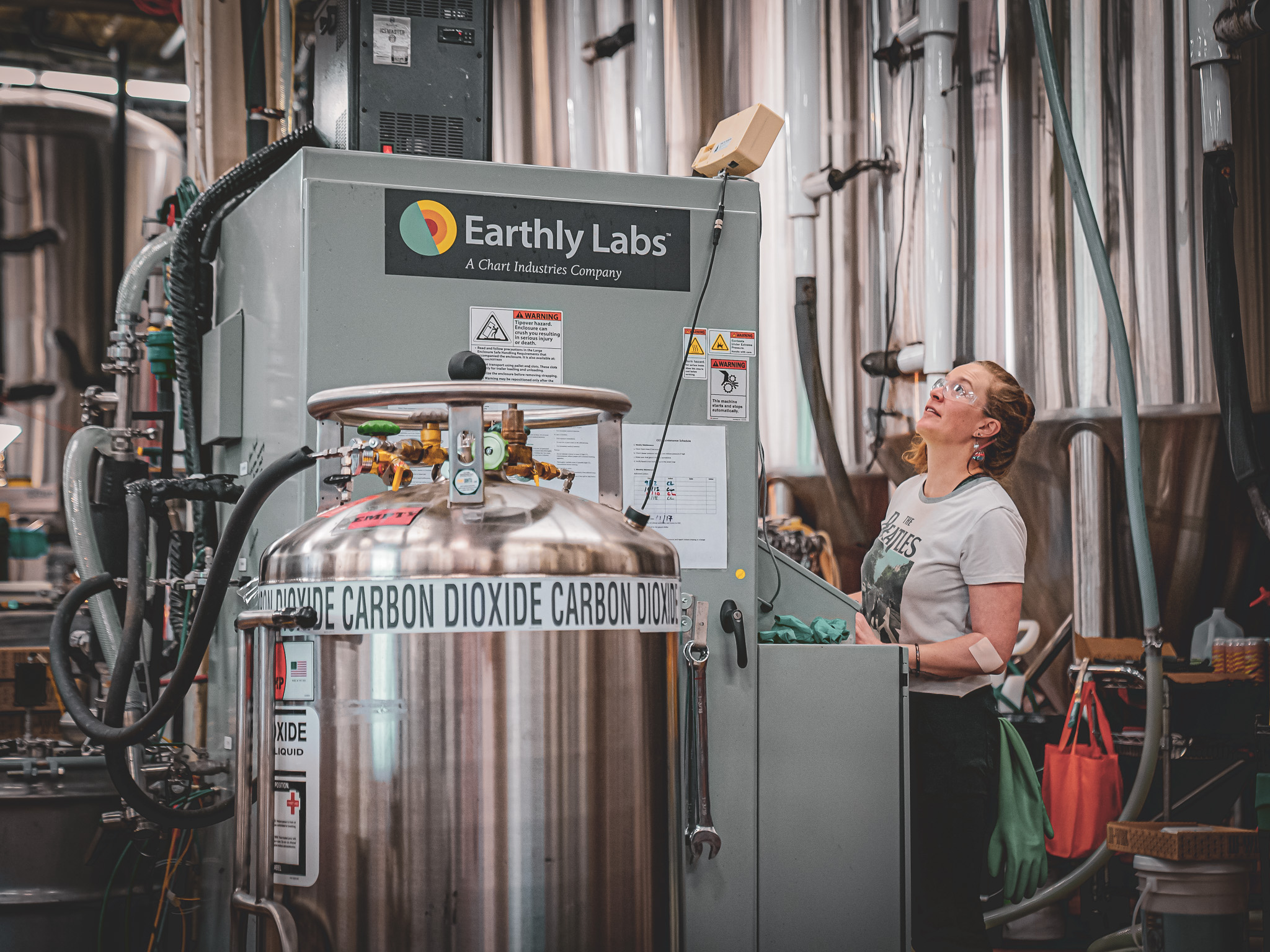
Amy George, who founded Earthly Labs in Austin, Texas, in 2016, obtained an exclusive license for the Craft Brewery Recovery System. Her company focused on developing small-scale carbon capture solutions, finding a ready market in the beverage industry. The technology allows facilities to recycle their own emissions, reducing reliance on external suppliers and lowering operational costs. This circular approach proved particularly valuable as global supply chains faced disruptions.
The utility of this technology has expanded beyond breweries. Earthly Labs began serving wineries and distilleries, which also require carbon dioxide for various processes. Additionally, energy companies that generate CO2 as a by-product have become customers, using the system to capture and sell the gas. This diversification has helped stabilize demand for the technology even as specific sectors fluctuate.
Another emerging application is in helium production. Helium, essential for manufacturing microchips and fiber-optic cables, is found in underground deposits mixed with other gases like methane and carbon dioxide. The separation process requires precise gas handling, a capability provided by the adapted NASA technology. This has opened new markets for Earthly Labs beyond the beverage and energy sectors.
The broader context for this adoption includes ongoing volatility in the carbon dioxide market. George noted that shortages and price instability, exacerbated by pandemic-related disruptions, have become major drivers of interest in on-site capture solutions. By reducing dependence on external supply chains, facilities can mitigate risks associated with global logistics failures or regional shortages.
In 2021, Chart Industries Inc., a company specializing in cryogenic equipment engineering, acquired Earthly Labs. This acquisition has facilitated the scaling of the technology for larger applications, including power plants. The integration into a major industrial firm suggests that Mars-derived resource harvesting techniques are becoming standard tools for terrestrial environmental and operational management.
The trajectory from space exploration to industrial utility illustrates how research intended for extreme environments can yield practical benefits on Earth. What began as a method to sustain human life on Mars has evolved into a tool for economic efficiency and emissions reduction in multiple industries. As supply chain vulnerabilities persist, such adaptive technologies may play an increasingly important role in maintaining operational stability.
This case underscores the broader impact of NASA’s technology transfer programs. Innovations developed for space missions often find secondary applications that address terrestrial challenges. The success of the carbon capture system in stabilizing brewing operations and supporting helium production demonstrates the potential for cross-sector innovation driven by aerospace research.
Sources behind this briefing
Go to the original reporting
- NASA↗NASA’s Machines for Mars Make Beer Bubbly

