The short version
- A significant humanitarian corridor allowed residents of Russian-occupied Oleshky to evacuate to Ukrainian-held territory, marking the most substantial ceasefire since the war began.
- The operation was facilitated by U.S. First Lady Melania Trump and involved transport through Russia and Belarus, with families reuniting at the border.
- Amid the truce, the United States approved a major sale of Patriot interceptors funded by allied donations, though delivery timelines remain a concern for Kyiv.
A large-scale humanitarian operation concluded on Saturday as evacuees from the Russian-occupied town of Oleshky crossed into Ukrainian-controlled territory. This movement represents the most significant truce achieved since Russia launched its full-scale invasion four and a half years ago. The ceasefire, which began early Tuesday in Ukraine’s southern Kherson region, is scheduled to hold through Sunday evening, providing a narrow window for civilian rescue efforts that had been previously impossible due to intense combat.
The evacuation deal was brokered by U.S. First Lady Melania Trump, who played a central role in coordinating the logistics between the warring parties. Civilians traveled by bus and plane through Russian and Belarusian territory to reach safety. Ukrainian authorities have imposed strict restrictions on disclosing specific details about the number of people evacuated or the exact border crossing points used. Organizers stated these measures are necessary to protect those who chose to remain in Oleshky and to safeguard the viability of future humanitarian missions.
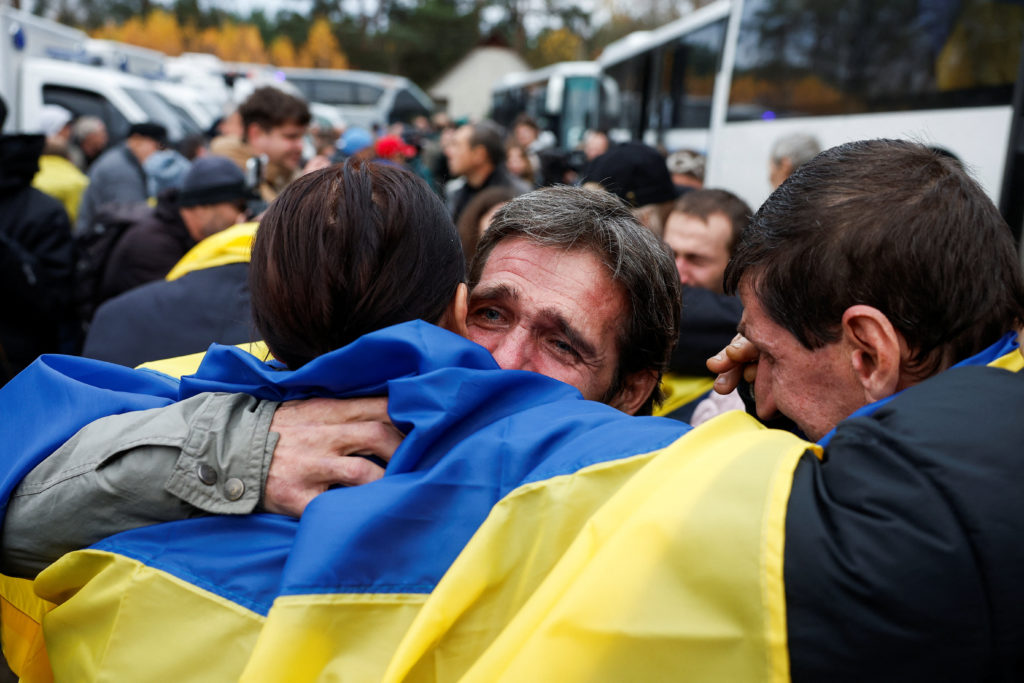
Residents in Oleshky were given three options: travel to Ukrainian-held territory, move to Russian-controlled areas, or stay behind with replenished food and medical supplies. Estimates suggest approximately 2,000 people remained in the city at the start of the truce. Those opting to return to Ukraine were transported to the Russian city of Anapa before being flown to Homel in Belarus. From there, they proceeded across the border into Ukraine, where relatives had gathered for reunions.
At the Ukrainian-Belarusian border, volunteers from organizations such as the Red Cross, Doctors Without Borders, and World Central Kitchen set up aid tents and coffee stands. Special provisions were made for pets accompanying the evacuees, with police officers and emergency services assisting in handling animals. Among those waiting was Liza Paliy, 19, who had not seen her father in more than two and a half years after fleeing occupied territory while he stayed behind. Another resident, Daria Pavlyn, reunited with her father Mykhailo, who had remained due to concerns about caring for their home and animals and fears regarding the arduous journey without Russian documents.
Russian officials confirmed that buses also transported residents who chose to relocate to Russia. Media outlets showed civilians arriving at a temporary accommodation site in Simferopol on the Crimean peninsula, which Moscow annexed in 2014. Yana Lantratova, Russia’s ombudswoman and lead representative on the mission, oversaw these movements. While neither side specified exact figures for how many chose each path, First Lady Trump stated on social media that the convoy could safely evacuate more than 750 people.
International pressure contributed to the agreement, with Pope Leo XIV, the first American pontiff, urging both Russian and Ukrainian leaders to permit aid deliveries and civilian evacuations. The diplomatic effort highlights a rare moment of cooperation in a conflict that has seen limited humanitarian access for years. The success of this operation may set a precedent for future negotiations, although the temporary nature of the truce limits its long-term impact on the broader war.
Beyond the evacuation, significant developments occurred regarding military aid. Ukrainian President Volodymyr Zelenskyy welcomed U.S. approval for the purchase of 500 PAC-3 Patriot interceptors but urged partners to supply weapons from existing stocks to address immediate winter defense needs. He warned that newly authorized sales could take years to deliver, leaving Ukraine vulnerable in the short term. The Trump administration announced the $2.1 billion sale on Friday, noting that it would be funded by donations from Canada, Germany, and Norway through a U.S. program, with no American taxpayer money involved.
Zelenskyy emphasized the urgency of air defense capabilities, citing over 30 Russian strikes on critical power grid components in October alone. He accused the Pentagon of delaying deliveries of vital munitions needed to counter ballistic missiles. The new agreement aims to bolster Ukraine’s ability to protect its energy infrastructure, which has been a primary target for Russian forces seeking to destabilize civilian life and economic stability during the colder months.
Despite the truce in Kherson, violence continued elsewhere. A Ukrainian drone attack killed a 30-year-old woman and a 41-year-old man in Russia’s western Bryansk region, with five others wounded, according to local Governor Yegor Kovalchuk. Additional drone strikes were reported in the Russian republic of Bashkortostan, where media outlets noted fires in the capital city of Ufa, home to several oil refineries. These incidents underscore that while localized ceasefires can facilitate humanitarian efforts, the broader conflict remains active and volatile.
The coming days will test the durability of the current truce and the effectiveness of the evacuation framework. If successful, this model could be replicated for other occupied territories, offering hope to thousands trapped in combat zones. However, the continued exchange of fire outside the Kherson region suggests that any peace remains fragile. The international community now faces the challenge of sustaining humanitarian access while navigating complex diplomatic and military pressures.
Sources behind this briefing
Go to the original reporting
- PBS NewsHour↗Residents evacuated from Russian-occupied Oleshky reach Ukraine after localized ceasefire