The short version
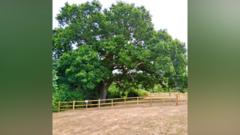
- South Kesteven District Council has installed wooden fencing around an ancient oak in Manthorpe to mitigate severe soil compaction caused by public interaction.
- Experts estimate the tree is between two and three centuries old, with historical maps confirming its presence during the 1800s.
- The conservation strategy prioritizes minimal intervention to protect the rooting environment while maintaining the site as a habitat for thousands of dependent species.
Local authorities in Lincolnshire have implemented new physical barriers around a prominent oak tree in Manthorpe, near Grantham, to address growing concerns about its structural integrity and long-term survival. South Kesteven District Council announced the installation of wooden fencing designed to limit public access to the immediate vicinity of the trunk. This decision follows observations that the ground surrounding the tree had become significantly compacted, a condition exacerbated by visitors hanging ropes from its branches for recreational use. The council described these actions as necessary steps to safeguard both the historic specimen and the safety of the general public.
The primary objective of the intervention is to restore the health of the soil environment essential for the tree’s root system. By restricting foot traffic, officials aim to alleviate pressure on the ground, allowing for better aeration and water retention. A council spokesperson emphasized that this approach represents a strategy of minimal intervention, intended to yield maximum ecological benefits without altering the natural character of the site. The goal is to ensure the oak remains viable for future generations while preserving its status as a notable local landmark.
Historical records suggest the tree has stood in this location for several centuries. Dr. Kate Lewthwaite, citizen science manager at the Woodland Trust, noted that maps from the 1800s already depict the oak, indicating it was of substantial size at that time. Based on growth rates and historical documentation, experts estimate the tree is at least two hundred years old, with a probable age closer to three hundred years. Its inclusion in the Woodland Trust’s Ancient Tree Inventory underscores its significance within the regional landscape.
The location holds particular cultural resonance due to its proximity to Woolsthorpe Manor, the birthplace of Sir Isaac Newton. Although Newton lived and conducted his scientific research there during the late seventeenth century, the current tree likely predates or postdates his specific lifetime, given the estimated age range. Nevertheless, the association with the era of Newton’s groundbreaking work on gravity adds a layer of historical interest to the conservation effort. The narrative of Newton observing a falling apple remains a popular cultural touchstone, linking the local heritage to broader scientific history.
Beyond its historical value, the oak serves as a critical ecological hub. Native oak trees are known to support an extensive network of biodiversity, hosting up to 2,300 different species. Of these, 326 species rely entirely on oak for their survival, making the health of individual ancient trees vital for local ecosystems. The Woodland Trust highlighted that protective measures such as fencing increase the likelihood that the tree will continue to thrive and provide habitat for wildlife well into the future.
Councillor Rhys Baker, the cabinet member for environment, described the oak as one of the area’s most notable natural features. He stated that restricting access would not only improve the rooting environment but also help conserve this historic feature for ongoing public appreciation from a distance. The council’s approach balances preservation with accessibility, ensuring that while physical contact is limited, the tree remains a visible and celebrated part of the community’s heritage.
The implementation of these measures reflects a broader trend in managing ancient trees across the United Kingdom, where soil compaction and mechanical damage pose significant threats to longevity. By addressing specific issues such as rope hanging and foot traffic, local authorities are attempting to reverse degradation before it becomes irreversible. The success of this intervention will depend on consistent enforcement of access restrictions and ongoing monitoring of the tree’s health.
As the fencing takes effect, the immediate impact on visitor behavior remains to be seen. However, the council has signaled a commitment to maintaining the site’s safety and ecological value. This case illustrates the delicate balance required when managing living historical monuments that are both public attractions and fragile biological entities. The outcome of these conservation efforts may serve as a model for similar sites facing comparable pressures from tourism and recreational use.
Looking ahead, the Woodland Trust and local officials will likely monitor the tree’s response to the reduced soil stress. If the measures prove effective, the oak could continue to grow and support its diverse array of dependent species for many more decades. The situation highlights the importance of proactive conservation strategies in preserving natural heritage that connects communities to their past while sustaining biodiversity for the future.
Sources behind this briefing
Go to the original reporting
- BBC Science & Environment↗Measures in place to protect historic oak tree

