The short version
- Research indicates the Barnes Ice Cap began expanding around 2,000 years ago, marking the initial stages of a new glacial period.
- This natural cooling trend ceased in the late 1950s as rising global temperatures caused the ice to retreat rather than grow.
- Scientists conclude that human-driven climate change has effectively skipped the next predicted ice age cycle for hundreds of thousands of years.
A new analysis of geological records from Canada suggests that humanity’s greenhouse gas emissions have fundamentally altered Earth’s long-term climate trajectory. Researchers published findings in the journal Science on October 22, indicating that natural processes had begun to push the planet toward a new ice age approximately two thousand years ago. However, this gradual cooling trend was abruptly interrupted by industrialization, specifically during the mid-twentieth century when global temperatures began to rise sharply.
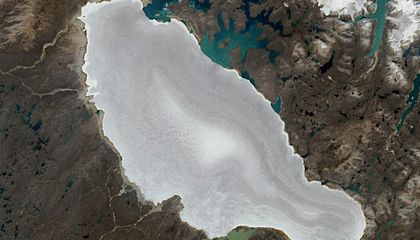
The study focuses on the Barnes Ice Cap, located on central Baffin Island in Nunavut. This remnant is a small fraction of the massive Laurentide Ice Sheet that once dominated North America. During its peak roughly twenty thousand years ago, that ancient ice sheet covered nearly thirty percent of the continent, stretching from above the Arctic Circle down to present-day Illinois and reaching thicknesses of more than two miles in certain areas. Today, only a Delaware-sized portion remains.
To reconstruct the history of this ice cap, scientists utilized a unique geological feature: the Barnes Ice Cap is frozen directly to its bedrock rather than sliding over it. This characteristic allows vegetation that grows near the ice margins to become encased and preserved when the ice expands, rather than being crushed by movement. Lead author Nicolás Young, a paleoclimatologist at Columbia University, explained that mosses colonize newly exposed land during retreats but are killed and trapped when the ice advances again.
The research team employed two primary methods to date these events. They analyzed the buildup of beryllium in bedrock and surrounding boulders, an element that accumulates when rock is exposed to cosmic rays from the atmosphere. Additionally, they carbon-dated the dead vegetation found within the ice margins to determine precisely when the plants died, which corresponds to the timing of the last ice expansion over those specific areas.
The data revealed a distinct pattern in the ice cap’s behavior over thousands of years. The Barnes Ice Cap reached its smallest extent approximately 3,600 years ago. Following this minimum, it began a steady period of regrowth around 2,000 years ago. This expansion is interpreted by scientists as the early signal of a new glacial inception, consistent with Earth’s natural cycles between ice ages and warmer interglacial periods like the current Holocene epoch.
However, this natural progression did not continue indefinitely. The ice cap kept growing until the late 1950s, at which point its expansion stopped completely. In the following decade, the trend reversed as increased summer temperatures caused the ice to lose more mass than it could accumulate during winter months. This shift marks a clear departure from the natural cooling trajectory that had been underway for millennia.
The implications of these findings extend beyond historical curiosity. The study supports previous research suggesting that human activity has become a dominant force in shaping global climate patterns. By reversing the onset of a new ice age, industrial emissions have effectively skipped what would have been the next glacial cycle. This alteration is not temporary; it represents a significant deviation from predictable natural cycles.
Shaun Marcott, an Earth scientist at the University of Wisconsin-Madison who did not participate in the study but wrote an accompanying perspective, noted that another ice age is unlikely to occur in the next predicted cycle. He emphasized that the number of skipped glacial cycles depends entirely on future human choices regarding carbon emissions. The research underscores that humans have become geologic agents capable of offsetting Earth’s climate for hundreds of thousands of years.
While earlier speculation in the 1970s about an impending ice age was sometimes misused to deny global warming, this new work highlights the opposite reality. It demonstrates how drastically human-induced climate change is altering natural, predictable patterns. The reversal of a two-thousand-year cooling trend serves as a stark indicator of the magnitude of modern environmental impact.
The findings provide a rare opportunity to understand how re-glaciation begins and how major ice sheets like the Laurentide might reform under natural conditions. By preserving the first steps of ice-sheet growth in the landscape, the Barnes Ice Cap offers critical insights into Earth’s climatic past and the profound changes currently underway due to anthropogenic influence.
Sources behind this briefing
Go to the original reporting
- Smithsonian Magazine↗Two Thousand Years Ago, a New Ice Age Began—but Human-Caused Climate Change Recently Reversed It, According to New Research