The short version
- The Hubble Space Telescope has identified unusual rotational dynamics in NGC 4698, a spiral galaxy located within the Virgo Cluster.
- Unlike typical spirals, this galaxy features a central bulge that extends perpendicular to the main disk of stars and gas.
- Astronomers attribute this misalignment to past interactions with external gas sources or minor galactic mergers.
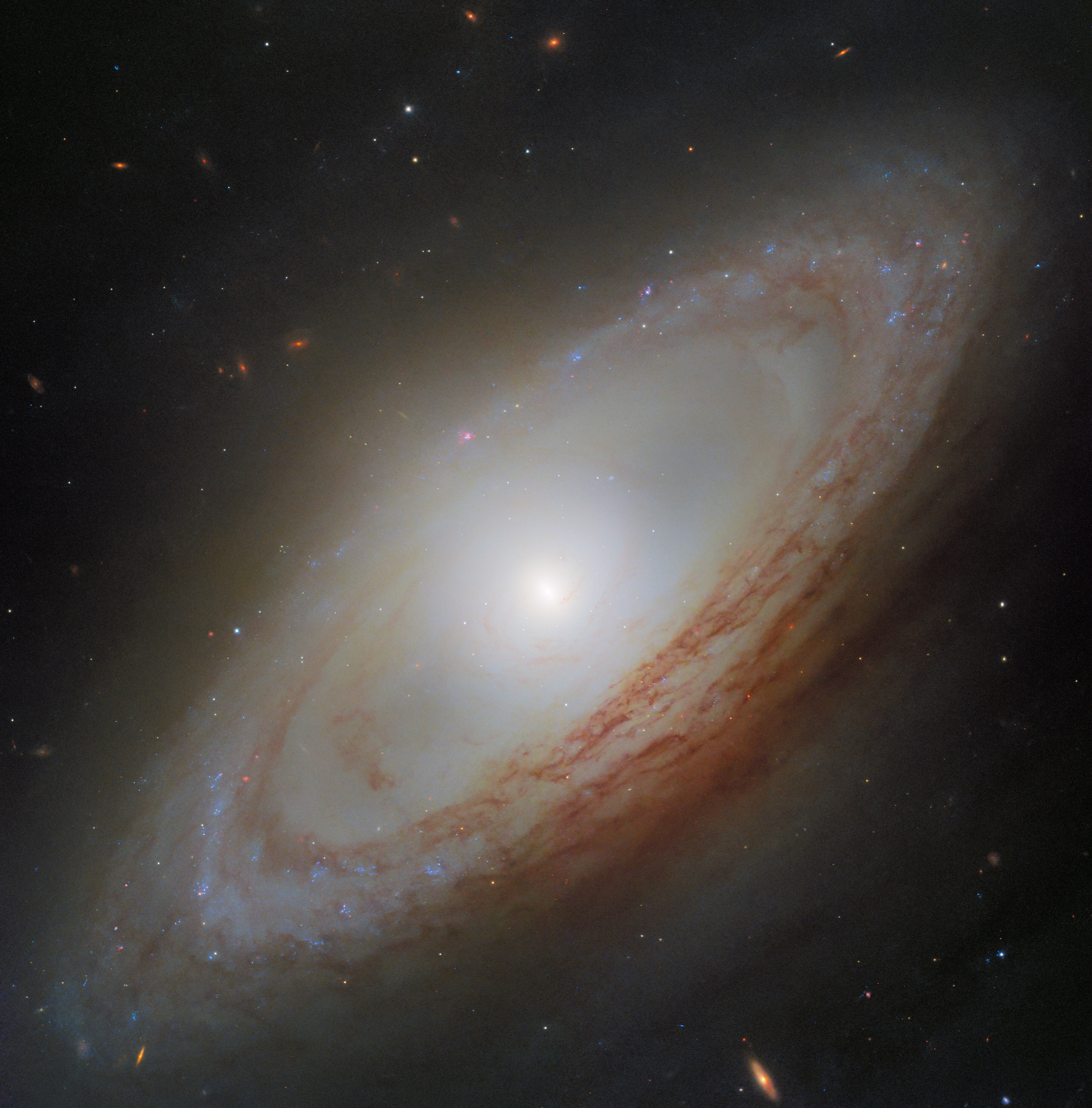
The Hubble Space Telescope has captured new imagery of NGC 4698, a spiral galaxy situated approximately 55 million light-years from Earth in the constellation Virgo. While the object appears visually tranquil, recent analysis reveals significant structural anomalies that challenge standard models of galactic formation. The galaxy is part of the Virgo Cluster, the nearest large grouping of galaxies held together by gravitational forces, making it a prime candidate for detailed study regarding how cluster environments influence stellar evolution.
NGC 4698 shares many characteristics with the Milky Way, including a thin disk composed of stars, gas, and dust. Its spiral arms are defined by dense concentrations of brown dust and clusters of young, bright blue stars. However, the distribution of these arms differs from typical spirals. Instead of winding tightly toward the galactic center, the arms remain confined to the outer regions of the disk, forming a ring-like structure that avoids the central core.
The most striking deviation from normalcy lies in the galaxy’s center. The core is dominated by an elongated bulge composed of older, cooler stars that emit a diffuse off-white glow. These stars orbit a supermassive black hole with a mass millions of times greater than the Sun. Evidence indicates that this black hole is currently active, drawing in surrounding gas through gravitational attraction. This central region stands in sharp contrast to the dynamic star formation occurring in the outer arms.
What distinguishes NGC 4698 from the vast majority of spiral galaxies is the orientation of its components. The central bulge extends out from the main disk at a right angle. Hubble’s high-resolution imaging reveals this misalignment clearly, showing the ghostly glow of the starry bulge protruding above and below the dusty plane of the galaxy. This geometric anomaly suggests that the internal dynamics of the galaxy are not synchronized.
Further complicating the picture is the rotational behavior of the galaxy’s matter. Observations confirm that the stars and gas located nearest to the center rotate perpendicular to the rest of the disk. This out-of-sync rotation is rare among spiral galaxies and points to a complex history involving significant structural changes. The alignment issues are not merely cosmetic but reflect fundamental differences in how different parts of the galaxy formed or evolved.
Astronomers propose that external influences likely caused this unusual configuration. One leading theory suggests that NGC 4698 accreted gas from an outside source. This newly acquired material could have settled into a disk within the galaxy’s center, oriented at an angle relative to the pre-existing disk. Such an event would explain the perpendicular rotation and the distinct separation between the inner bulge and outer arms.
Support for this hypothesis comes from additional observations indicating a past minor galactic merger. A short tail of hydrogen streaming from one side of the galaxy serves as evidence of such an interaction. These types of collisions or close encounters can disrupt existing structures and introduce new material with different angular momentum, leading to the misaligned features seen today.
The data supporting these conclusions come from a broader observing program focused on galaxies within the Virgo Cluster. This initiative aims to examine fine details such as individual star clusters and nebulae while also assessing larger evolutionary trends. By studying how galaxies interact within a cluster environment, researchers hope to understand how these interactions affect star formation rates and overall galactic morphology.
This discovery adds to the growing body of evidence that galaxy evolution is often driven by external factors rather than internal processes alone. The case of NGC 4698 highlights the role of mergers and gas accretion in shaping galactic structures. As telescopes continue to probe the Virgo Cluster, similar anomalies may be identified, further refining our understanding of how galaxies assemble and change over cosmic time.
The findings underscore the importance of continued observation with instruments like Hubble. By capturing detailed images of nearby galaxies, scientists can trace the history of stellar populations and gas dynamics with greater precision. The study of NGC 4698 provides a specific example of how gravitational interactions leave lasting imprints on galactic architecture, offering clues to the broader mechanisms governing the universe.
Sources behind this briefing
Go to the original reporting
- NASA↗NASA’s Hubble Spots an Out-of-Sync Galaxy

