The short version
- Houthi forces have advanced significantly toward the Bab al-Mandab strait, threatening Saudi oil export routes and prompting urgent diplomatic consultations.
- Saudi Arabia and the United Arab Emirates are holding talks to reconcile their differences, driven by the need for a unified military response against Houthi separatists.
- Deep divisions persist regarding the role of southern separatist forces, with Riyadh fearing state fragmentation while Abu Dhabi seeks leverage through its allied militias.
The geopolitical landscape of Yemen has shifted dramatically following a rapid mid-September offensive by Iran-aligned Houthi forces. This military push has reached the narrow Bab al-Mandab strait, a critical chokepoint for global shipping and Saudi oil exports. The advance defeated pro-government troops, including the National Resistance Forces led by Tareq Saleh, whose front collapsed quickly under sustained pressure. This unexpected success has transformed regional dynamics, forcing neighboring powers to reconsider their strategies in a conflict that had previously seen them divided.
In response to the escalating threat, Saudi Arabia is being urged to reconcile with the United Arab Emirates. The two Gulf monarchies had backed anti-Houthi factions but saw relations plummet in January when Riyadh attacked forces aligned with the UAE-backed Southern Transitional Council. That move was intended to crush separatist ambitions for a distinct southern state, leading Abu Dhabi to effectively withdraw from active involvement in Yemen. Now, the price of forming a military alliance capable of repelling the Houthis appears to be healing this rift.
Diplomatic activity has intensified across the region. A meeting in Abu Dhabi on Sunday brought together Israeli Prime Minister Benjamin Netanyahu, UAE President Mohammed bin Zayed al Nahyan, and representatives from several Arab states, including Saudi Arabia. Reports indicate that Netanyahu offered assistance to Riyadh in defeating the Houthis, a proposal that Saudi officials are likely to reject due to domestic sensitivities regarding cooperation with Israel. Despite this, the gathering signaled a willingness among regional actors to address the crisis collectively.
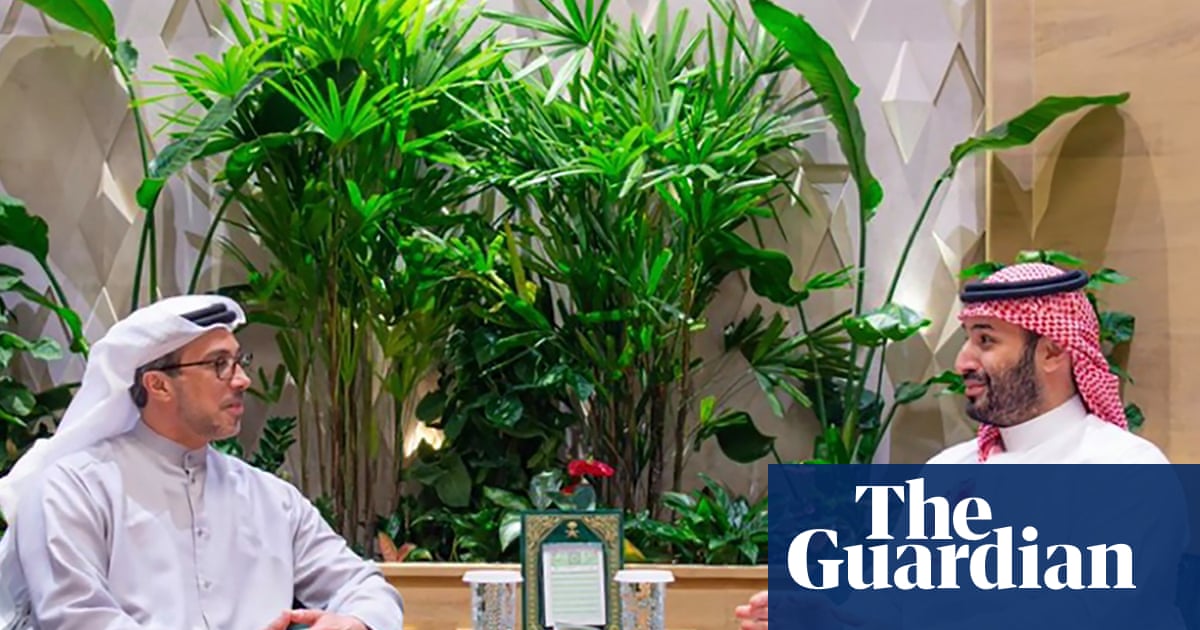
Further discussions took place in Riyadh on Tuesday between Prince Khalid bin Salman al Saud, the Saudi defense minister, and Mansour bin Zayed Al Nahyan, the UAE vice president. These talks are part of a broader set of signals suggesting both nations may seek a path to reconciliation, even if limited initially to energy security concerns. The White House has also privately encouraged the two countries to bury their differences and establish a unified military command that includes the Southern Giants Brigades, a force trained by the UAE.
However, significant obstacles remain. The UAE’s alignment with the STC makes it difficult for Riyadh to welcome Abu Dhabi back into the fold without compromising its stance against southern separatism. Saudi Arabia has long resisted supporting separatist movements, fearing that dividing Yemen would entrench Houthi rule in the north along its border. The Houthis have already used drones and missiles to target Saudi energy infrastructure, making the security of the southern border a paramount concern for Riyadh.
On the ground, fighting continues in Taiz, a southwestern city that serves as a key defensive line. Houthi forces are launching simultaneous waves of attacks to exhaust the defending Taiz Axis force. While defenders have pushed back some assaults, the Houthis return the next day on different fronts, creating a grueling war of attrition. The intensity of the battle has led the parliament of the UN-recognized Yemeni government to sanction a general mobilization of the population, despite ongoing air cover and support from Saudi Arabia.
Political complexities further complicate military efforts. Khaled Alyemany, a former Yemeni foreign minister and STC supporter, argues that Saudi Arabia must reconsider its approach to the southern issue. He notes that the Giant Brigades provide some of the most reliable and well-equipped forces available to stem the Houthi advance. However, these forces have been urged by the STC to resist merging with government troops, arguing that doing so would undermine their goal of independence.
Alyemany contends that without a clear horizon for self-determination, southern fighters lack motivation to retake Sana’a on behalf of a government they view as illegitimate. He asserts that as long as the Yemeni government derives its legitimacy from Saudi funding rather than popular support, Riyadh’s stated goal of securing its southern borders will remain elusive. The UN-recognized government, operating in exile, insists on unity but offers no promises regarding the south’s political future.
The human cost of the conflict continues to rise. The World Health Organization reported that 838 people were killed and 3,643 others injured due to recent escalations between August 2025 and the present. As diplomatic talks proceed, the question remains whether Saudi Arabia and the UAE can overcome their fundamental differences to present a united front. Without such cooperation, the Houthi advance may continue unchecked, further destabilizing the region and threatening global trade routes.
The coming weeks will be critical in determining whether these diplomatic efforts yield tangible results. If reconciliation fails, the Houthis may consolidate their gains and press deeper into Yemen, potentially altering the balance of power permanently. Conversely, a unified command could halt the advance but at the cost of legitimizing separatist forces that Riyadh has long sought to marginalize. The outcome will have profound implications for regional security and the future of Yemen itself.
Sources behind this briefing
Go to the original reporting
- The Guardian World↗Saudi Arabia urged to reconcile with UAE to drive back Houthi separatists in Yemen