The short version
- Navajo Reservoir levels rose nearly sixty feet between September and November 2026 due to intense rainfall events.
- The storms ended short-term drought conditions in the Southwest but caused record-breaking river levels and evacuations in Colorado.
- Long-term water scarcity persists despite recent gains, as El Niño patterns continue to influence regional weather dynamics.
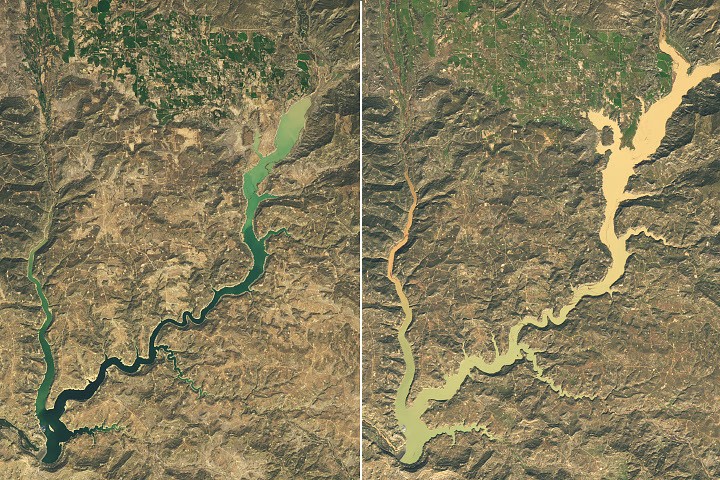
Water levels in Navajo Reservoir, located on the border of New Mexico and Colorado, have surged dramatically following a series of intense rainstorms in late October and early November 2026. Satellite imagery from NASA reveals that the reservoir, which is the second-largest in New Mexico, rose by approximately sixty feet, or eighteen meters, between September 20 and November 7. This rapid increase marks a significant shift for a region that has struggled with persistent dryness.
The reservoir reached its highest level since August 2019, holding one hundred and eight percent of its average capacity for that time of year. This stands in stark contrast to late September, when the lake contained only sixty percent of its typical volume. The surge occurred despite a lack of significant growth during the spring months, a period when snowmelt usually contributes to reservoir levels. The previous winter was characterized by a severe snow drought across the western United States, which limited natural replenishment.
The heavy precipitation was driven by back-to-back extreme weather events that inundated the Four Corners area. These storms were associated with an El Niño pattern, which strengthened the jet stream near the equatorial Pacific and steered moisture-laden systems toward the Southwest interior. Experts noted that the low-pressure system responsible for the autumn rainfall operated at a lower latitude than usual for this time of year, drawing energy from unusually warm ocean temperatures.
While the rain provided much-needed relief to short-term drought conditions, it also created immediate hazards for communities along river systems. The San Juan and Piedra rivers swelled with runoff, reaching record or near-record levels in several locations. In Pagosa Springs, Colorado, situated about forty miles northeast of the reservoir, flooding was particularly severe. The town received over five inches of rain during the first storm round, pushing the San Juan River to major flood stage.
A second spike in river levels occurred on November 1, bringing water nearly to the historic high set during a devastating flood in 1911. Local officials issued evacuation orders and emergency responders rescued dozens of residents as streets were inundated and property damage mounted. The flooding highlighted the dual nature of the weather events, which brought both drought mitigation and significant risk to infrastructure and public safety.
Precipitation totals across the Four Corners region, including parts of Colorado, Utah, Arizona, and New Mexico, were two to four times the average from early September through early November. This area has been beset by long-term drought conditions that were exacerbated by high temperatures and low snowpack in 2026. The recent storms have altered the landscape visibly, with satellite data capturing the rapid expansion of water surfaces around Navajo Dam.
According to the U.S. Drought Monitor, which combines satellite data with ground observations, short-term drought has ended for the Southwest and Great Basin regions. However, long-term drought persists in many areas, indicating that while immediate moisture deficits have been addressed, structural water scarcity remains a challenge. The Bureau of Reclamation had previously decreased releases from Navajo Dam in mid-September, which may have contributed to the reservoir's ability to absorb the sudden influx of water.
The situation underscores the complex relationship between climate patterns and water management in the American West. While El Niño events can increase the likelihood of beneficial rainfall, they also bring the potential for extreme weather that strains local resources. As winter approaches, officials will continue to monitor reservoir levels and river flows to balance flood control with long-term water storage needs.
Sources behind this briefing
Go to the original reporting
- NASA↗Water Surges Into Navajo Reservoir