The short version
- Male hawkmoths use specialized genital scales to produce ultrasound that disrupts bat echolocation.
- This defensive trait evolved independently up to seven times over the last 30 million years.
- The sound-producing mechanisms likely originated as mating displays before being co-opted for survival.
A recent study published in the Proceedings of the Royal Society B details how certain moth species have developed sophisticated acoustic defenses to evade bat predation. Researchers found that male hawkmoths utilize their genitalia to emit high-frequency sound waves capable of scrambling the sonar systems used by bats to hunt. This evolutionary adaptation has emerged independently multiple times, highlighting the intense pressure predators exert on prey behavior and morphology.
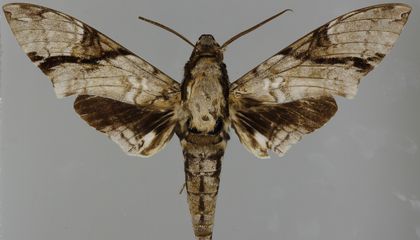
The investigation focused on hawkmoths, also known as sphinx moths, which are large, nocturnal insects found in tropical regions worldwide. With approximately 1,600 species globally, these moths are known for their ability to hover while feeding on nectar. The study examined 143 distinct species and determined that 77 of them possess the ability to produce ultrasound. However, the mechanisms behind this sound production vary significantly across different lineages.
Scientists identified three distinct methods by which these moths generate defensive noise. In some species, males scrape enlarged genital scales against rows of scales near the abdomen's end. Others rub these structures against stiff spines along the abdominal edge. A third group, representing a newly identified mechanism, drags their genital scales across a patch of tiny bumps located on the underside of their bodies. This last method appears to offer the greatest versatility, allowing for a wider range of acoustic signals.
The diversity in sound production suggests that hawkmoths have multiple evolutionary strategies to counter bat attacks. The sounds produced range from continuous squeaks to irregular bursts, potentially confusing predators during an attack. Marc Holderied, a biologist at the University of Bristol who was not involved in the research, noted that this variety indicates hawkmoths possess numerous adaptive tricks. This versatility may provide an advantage by allowing species to develop new acoustic defenses as bat hunting strategies evolve.
The origins of these ultrasound-producing systems remain a subject of scientific inquiry. Researchers suspect that the behavior initially evolved for mating purposes rather than defense. Ian Kitching, an entomologist at the Natural History Museum in London, suggested that males may have originally used these sounds to attract females. The effort required to produce such noise could serve as a signal of fitness during courtship.
Over time, this mating display was likely co-opted for survival. When bats swoop in to capture prey, the sudden emission of ultrasound can temporarily confuse the predator, causing it to miss its target. This dual-purpose adaptation illustrates how biological traits can shift function based on environmental pressures. The interaction between bats and moths has driven significant diversity in bioacoustic defenses among insect populations.
To reach these conclusions, the research team conducted behavioral experiments after dark. They tethered individual moths with thin fishing line to allow them to fly in place while playing recordings of bat calls. Researchers also gently handled the insects to simulate a predator's grasp, recording any ultrasonic responses. These tests were complemented by detailed anatomical dissections and imaging to understand the physical structures involved in sound production.
The study also analyzed evolutionary family trees to determine when different hawkmoth species diverged from common ancestors. The findings indicate that these defensive adaptations arose between five million and thirty million years ago. This timeline suggests a long-standing arms race between bats and moths, with each side developing new strategies to outmaneuver the other.
Bat predation has been a major driver of insect evolution, contributing to the remarkable diversity of defenses seen today. The research underscores how complex adaptations can emerge from simple reproductive traits. As scientists continue to study these interactions, they gain deeper insights into the evolutionary forces that shape biodiversity in nocturnal ecosystems.
The implications of this research extend beyond understanding moth survival strategies. It highlights the importance of studying predator-prey dynamics to uncover the mechanisms of convergent evolution. By examining how different lineages solve similar problems, researchers can better appreciate the complexity of natural selection and the intricate adaptations that allow species to thrive in challenging environments.
Sources behind this briefing
Go to the original reporting
- Smithsonian Magazine↗These Moths Use Their Genitals to Fend Off Bats—but Not in the Way You Think. They Emit Ultrasound to Scramble the Predators' Sonar