The short version
- Researchers propose that gravitational wave signals from binary white dwarf systems can reveal the presence of orbiting exoplanets through specific frequency modulations.
- The James Webb Space Telescope could validate these detections by identifying infrared excesses produced by planets in such systems, reducing false positive risks.
- This method targets a distinct population of worlds around stellar remnants, expanding the scope of exoplanet discovery beyond traditional star-hosted planets.
Astronomers have identified a novel method for discovering exoplanets that relies not on light, but on the subtle ripples in spacetime known as gravitational waves. Two new studies led by NASA astrophysicists demonstrate how the Laser Interferometer Space Antenna (LISA), a space-based observatory currently under development, could detect planets orbiting binary systems composed of two white dwarfs. This approach opens a window to a previously unexplored population of worlds within our galaxy, distinct from those found around single stars or other stellar types.
The core mechanism involves the gravitational influence of a planet on its host stars. In double white dwarf systems, the two dense stellar remnants orbit each other closely, emitting continuous gravitational waves at a steady frequency. If a massive planet orbits this binary pair, its gravity exerts a tug on the stars, causing them to wobble slightly. This reflex motion introduces a Doppler modulation to the gravitational signal, creating secondary signals or sidebands at frequencies adjacent to the primary wave. These sidebands carry information about the planet’s presence, similar to how radio carriers transmit data through frequency shifts.
Casey McGrath, a postdoctoral researcher at NASA’s Goddard Space Flight Center and the University of Maryland, Baltimore County, led the first study detailing this detection method. The research identifies specific ranges for planet masses and orbital periods where this technique would be most effective. While exoplanets have been found around isolated white dwarfs, none have yet been detected in binary white dwarf systems. Consequently, any discoveries made via LISA would represent a unique class of celestial bodies, offering new insights into planetary formation and survival in extreme stellar environments.
The second study, co-authored by McGrath and colleagues including Scott Noble from NASA Goddard, addresses the critical need for confirmation. Gravitational wave detections alone may produce false positives, so independent validation is essential. The team proposes using the James Webb Space Telescope to verify these findings. Planets in double white dwarf systems emit a significant amount of infrared radiation relative to their host stars. Webb’s sensitive instruments can detect this infrared excess, providing a complementary line of evidence that confirms the gravitational signals correspond to genuine planetary bodies rather than instrumental noise or other astrophysical phenomena.
Testing this combined approach on a hypothetical system located 500 light-years away reveals promising capabilities. Under ideal conditions, LISA could detect sub-Jupiter mass planets through their gravitational signatures. Meanwhile, Webb would be capable of identifying larger planets, approximately five times the mass of Jupiter, by observing their thermal emissions. This synergy between gravitational wave astronomy and infrared imaging creates a robust framework for verifying discoveries, ensuring that the new population of exoplanets is accurately characterized.
The Milky Way galaxy is estimated to contain roughly 10 million double white dwarf systems with orbital periods shorter than an hour. These systems generate gravitational waves within the frequency range accessible to LISA. Scientists anticipate that the observatory will resolve approximately 10,000 individual systems and around 100 mixed binaries involving neutron stars or black holes. This vast sample size increases the likelihood of finding planets, even if they are rare in such environments, potentially transforming our understanding of planetary distribution across the galaxy.
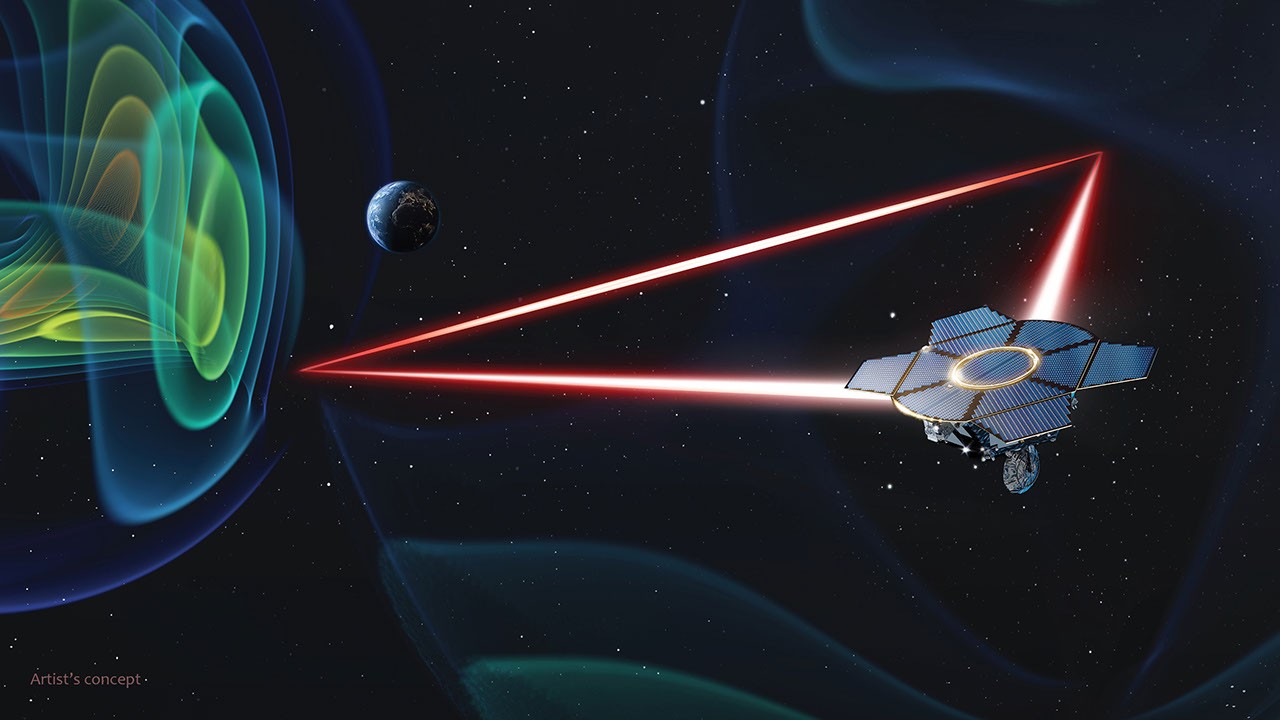
LISA is a collaborative mission led by the European Space Agency, with NASA contributing critical hardware, including telescopes and engineering support. The observatory will consist of three spacecraft forming a triangular array with sides stretching 1.6 million miles. As they follow Earth’s orbit around the Sun, these spacecraft will use infrared laser beams to measure minute changes in distance caused by passing gravitational waves. Scheduled for launch in the mid-2030s, LISA represents a significant leap in observational astronomy, enabling scientists to probe cosmic events that are invisible to traditional telescopes.
The concept of detecting exoplanets via gravitational waves was first proposed by Japanese astronomer Naoki Seto in 2008. The recent studies build on this foundational idea, providing detailed methodologies for detection and confirmation. By combining data from LISA and Webb, researchers aim to establish a reliable pipeline for discovering and validating these hidden worlds. This effort not only expands the catalog of known exoplanets but also tests theories about planetary system evolution in the aftermath of stellar death, offering a deeper comprehension of the universe’s diversity.
As development continues toward the mid-2030s launch window, the scientific community awaits the first data from LISA. The ability to detect planets through gravitational waves marks a paradigm shift in exoplanet research, moving beyond reliance on electromagnetic radiation. This new frontier promises to reveal worlds that have remained hidden until now, challenging existing models of planetary formation and survival. The collaboration between space agencies and international researchers underscores the global effort to unlock these secrets, paving the way for future discoveries that could redefine our place in the cosmos.
Sources behind this briefing
Go to the original reporting
- NASA↗NASA Scientists Show How Gravitational Waves Can Reveal New Worlds