The short version
- Researchers have definitively ruled out northeast Scotland as the source of Stonehenge’s Altar Stone after analyzing seventy samples from the region.
- The study overturns a 2024 hypothesis that linked the six-ton slab to deposits in the Orcadian Basin, approximately four hundred miles away.
- With southern Britain and Scotland now excluded, experts suggest the search should pivot toward geological formations in northern England or Ireland.
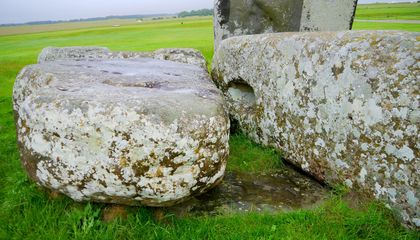
The long-standing mystery surrounding the origin of Stonehenge’s Altar Stone has taken a significant turn with the publication of new geological findings that dismiss a leading theory. For centuries, scholars have puzzled over the provenance of this distinctive six-ton sandstone slab, which rests flat and partially buried at the center of the prehistoric monument on Salisbury Plain. A 2024 study had suggested a dramatic link to northeast Scotland, implying the stone traveled more than four hundred miles by land or sea. However, a rigorous follow-up investigation published in the Journal of the Geological Society has overturned that conclusion, indicating that researchers were likely examining the wrong terrain.
Led by Duncan Pirrie, an emeritus geologist at the University of South Wales, the new study represents the most comprehensive geological analysis of the Altar Stone to date. The team combined direct examinations of the monument itself with analyses of samples held in museum collections to create a detailed geological fingerprint. This process involved evaluating the stone’s sedimentology, geochemistry, and mineralogy to establish a precise compositional profile. By building this clear picture of the slab’s characteristics, the researchers aimed to test leading theories about its origins against real-world data from potential source regions.
The investigation focused heavily on the Orcadian Basin in northeast Scotland, the area previously identified as a likely candidate. Nick Pearce, an emeritus geochemist at Aberystwyth University and co-author of the study, described the fieldwork as formidable, comparing the effort to finding a needle in a haystack. The team traveled across thousands of square kilometers of terrain, collecting approximately seventy samples from the region. These specimens were then transported back to laboratories for detailed testing to see if any matched the unique signature of the Altar Stone.
The laboratory evaluations yielded no matches among the seventy samples collected from Scotland. This negative result led the team to conclude that it is highly unlikely the Altar Stone originated in northeast Scotland. While the absence of a match might seem like a setback, the researchers emphasize that ruling out potential source areas is a critical step in geological detective work. By eliminating incorrect hypotheses, the study refines the search parameters and prevents further misdirection in the quest to identify the stone’s true birthplace.
The Altar Stone has been a subject of speculation since 1620, when landscape architect Inigo Jones suggested the partially buried slab might have served as an altar. Its composition differs significantly from other stones at the site. The massive sarsens that form the outer circle were sourced from the nearby Marlborough Downs, while the smaller bluestones were transported roughly one hundred forty miles from the Preseli Hills in southwest Wales. The Altar Stone’s unique nature has made it a focal point for understanding the logistical capabilities and motivations of Neolithic builders.
Earlier this year, scientists explored alternative theories involving glacial transport during the last Ice Age. Glaciologists modeled ancient ice sheets to determine whether glaciers could have moved Scottish boulders toward Dogger Bank, a now-submerged landmass in the North Sea. While ice flows could theoretically have pushed rocks near this area, such a scenario would require humans to retrieve the stone thousands of years before construction at Stonehenge began. The new geological findings further complicate these narratives by removing Scotland from the list of viable terrestrial sources.
With both northeast Scotland and southern Britain effectively ruled out as origins for the Altar Stone, the search is now pivoting toward other possibilities. Researchers suggest that alternative formations in northern England, other parts of Scotland, or even Ireland may hold the key to solving this puzzle. The stone’s journey remains one of the most intriguing aspects of Stonehenge’s construction history, offering a window into the movement of materials across ancient landscapes.
Identifying the true quarry is essential for archaeologists seeking to understand the people who built Stonehenge. Mike Pitts, an archaeologist not involved in the study, noted that pinpointing the source would help fit the Altar Stone into the broader context of Neolithic life. Knowing where the journey began would allow historians to view the landscape through the eyes of the builders, revealing more about their resources, routes, and societal organization. The search continues, but with a clearer map of what is not true.
The evolving scientific narrative surrounding the Altar Stone underscores the complexity of prehistoric engineering. Each new study adds layers of detail to our understanding of how these massive stones were moved and positioned. While the current findings do not provide a definitive answer, they eliminate a major hypothesis and redirect efforts toward more promising regions. The quest to trace the stone’s origin remains an active area of research, driven by the desire to unravel the full story of one of Britain’s most iconic monuments.
Sources behind this briefing
Go to the original reporting
- Smithsonian Magazine↗Where Did Stonehenge's Mysterious, Six-Ton Altar Stone Really Come From? Geologists Rule Out the Scottish Hypothesis as the Search Deepens