The short version
- Government estimates place participation at 400,000 while unions claim double that figure, marking a sustained period of civil unrest.
- Violence decreased compared to the prior week, though serious injuries occurred and nearly 1,000 arrests were made across multiple cities.
- Demonstrators cite deteriorating school conditions, heavy policing tactics, and economic hardship as primary drivers for continued weekend marches.
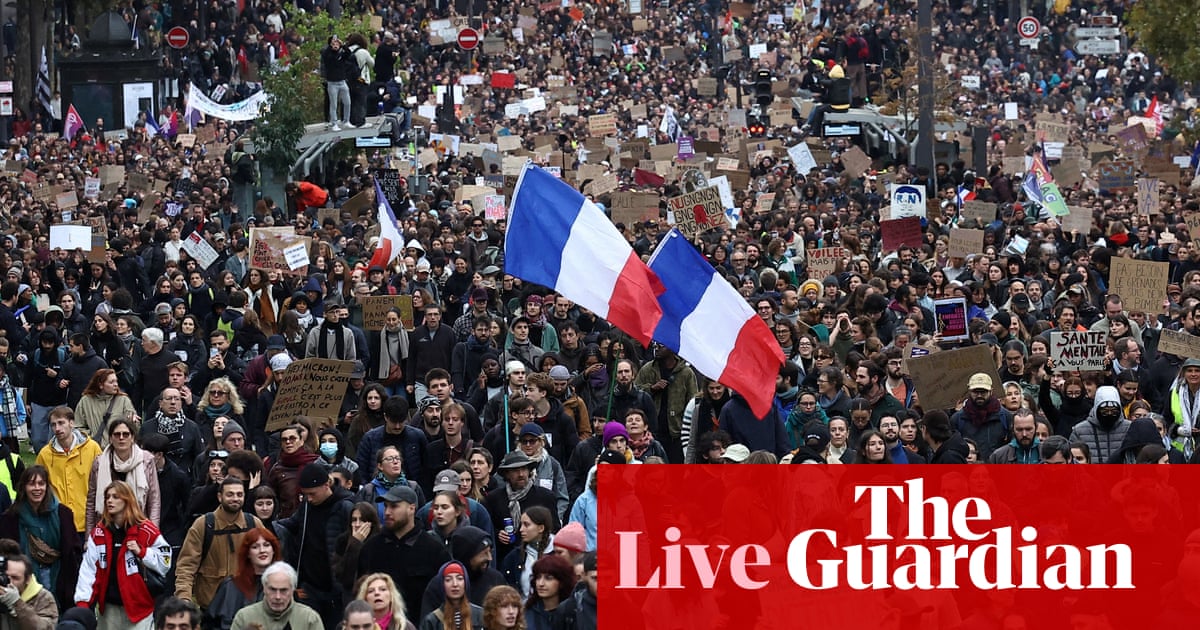
Hundreds of thousands of people took to the streets across France on Saturday, continuing a wave of civil unrest that has intensified political pressure on President Emmanuel Macron in his final months in office. The demonstrations, which spanned numerous cities, were largely peaceful in their main phases but concluded with localized violence in several areas. Government officials estimated that at least 400,000 individuals participated nationwide, while trade union representatives asserted the actual number was twice as high. This mobilization represents a significant escalation from earlier student-led actions into a broader societal movement involving teachers, parents, and various civic groups.
The protests were driven by a convergence of grievances, primarily centered on the deteriorating state of public education and rising living costs. High school students have been protesting since mid-September against severe staff shortages, crumbling infrastructure, and overcrowded classrooms lacking basic furniture. These initial student actions have expanded to include widespread anger over economic pressures and what many demonstrators describe as an authoritarian response from the state. Participants carried banners criticizing government policing strategies and demanding political solutions rather than forceful suppression of dissent.
In Paris, approximately 110,000 people marched along the eastern edge of the city, according to official counts. The atmosphere during the main procession was described as peaceful and even festive, with brass bands playing and families attending together. However, tensions flared at the conclusion of the march near Porte de Vincennes. Groups of masked individuals, who had not been part of the earlier demonstration, emerged and began throwing projectiles at law enforcement officers. Police responded with tear gas, water cannons, and stun grenades, leading to a chaotic scene that included burning bins and fireworks directed at security forces.
Violence was not confined to the capital. In cities such as Lyon, Lille, Montpellier, Nantes, and Toulouse, police deployed tear gas to prevent protesters from entering city centers. Clashes also occurred in Marseille, where bin fires were lit amid confrontations with authorities. Laurent Nunez, France’s interior minister, characterized the level of violence as extremely elevated but noted that the scale of vandalism and looting was significantly smaller than during the unrest of the previous week. He attributed the disturbances to ultra-left groups attempting to provoke clashes by throwing projectiles and fireworks at police officers.
Serious injuries were reported during the day’s events, underscoring the physical risks involved in the confrontations. Nunez confirmed that two individuals suffered severe harm, including a 20-year-old man in Toulouse who reportedly lost fingers due to an explosion. Another serious injury occurred in Clermont-Ferrand, though specific details regarding this case were not provided. These incidents add to growing concerns about the safety of both protesters and police, as investigations continue into previous cases where explosive weaponry used by law enforcement resulted in maiming and injuries among demonstrators.
The government’s strategy has drawn sharp criticism from participants who feel their democratic rights are under threat. Many attendees expressed frustration with the administration’s decision to ban non-union demonstrations deemed illegitimate and its practice of keeping protesters away from central urban areas. One communications worker noted that she had been teargassed during a peaceful demonstration the previous weekend and returned to defend the legal right to protest in the streets. Another student described the current political climate as increasingly authoritarian, suggesting that the state is actively trying to suppress democratic expression.
Law enforcement presence was substantial, with more than 70,000 police officers deployed across French cities. Shops were boarded up and many museums closed in anticipation of potential unrest. The interior ministry reported nearly 1,000 arrests during Saturday’s events, a figure that stands in contrast to the approximately 2,700 arrests made during the more violent protests of the previous week. That earlier day saw public buildings burned and hundreds of shops destroyed, marking one of the most severe episodes of unrest in recent years. The reduction in violence this weekend may indicate a shift in tactics or a temporary de-escalation, but the underlying tensions remain unresolved.
The movement shows signs of longevity, with key figures from previous anti-government protests joining the current demonstrations. Jérôme Rodrigues, a prominent figure from the gilets jaunes movement, stated that the government’s fear is evident in its efforts to push demonstrators away from places of power. He predicted that weekend marches would continue as long as the government fails to address the struggles of citizens unable to make ends meet. With police investigations ongoing and political pressure mounting, the coming weeks will likely see further testing of France’s social cohesion and institutional stability.
As the crisis deepens, the disconnect between the government and its citizens appears to be widening. Demonstrators from various backgrounds, including retirees and charity workers, have united in support of the students’ demands for better conditions. The presence of anti-fascist slogans in cities like Orléans highlights the complex ideological landscape of the protests. While the immediate violence has subsided compared to last week, the fundamental issues of public service investment, economic inequality, and civil liberties remain at the forefront of national discourse, setting the stage for continued confrontation.
Sources behind this briefing
Go to the original reporting
- The Guardian US↗Hundreds of thousands march in France as protests take place across Europe – Europe live
- The Guardian World↗Hundreds of thousands march across France in protests over schools and policing