The short version
- Jurors viewed a computer-generated recreation of the Paddington terrace to understand the prosecution's timeline of events.
- A firearms examiner testified that propellant patterns on a bedroom door indicate the victim was shot from close range.
- The defense maintains the shootings were accidental and occurred during separate struggles, while the prosecution alleges intentional murder.
The trial of Beau Lamarre-Condon, who faces charges for the deaths of Jesse Baird and Luke Davies, has entered a critical phase with the introduction of detailed forensic evidence. Jurors in the New South Wales Supreme Court were presented with a three-dimensional computer-generated video reconstructing the interior of a Paddington terrace house. This digital model was designed to illustrate the prosecution’s narrative regarding the movements of the accused on the night of February 19, 2024, when the two men were found dead in Baird’s home.
Lamarre-Condon, aged 31, has pleaded not guilty to two counts of murder and one charge of aggravated break and enter. The central dispute in the case revolves around the circumstances surrounding the gunshots. The prosecution contends that Lamarre-Condon used his police service weapon to intentionally kill Baird twice in the kitchen before shooting Davies through a bedroom door. In contrast, the defense argues that the fatalities were accidental, resulting from two distinct physical struggles in which Lamarre-Condon acted in self-defense.
Justice Natalie Adams presided over the presentation of the digital evidence, cautioning jurors about its limitations. She noted that the kitchen area depicted in the video was not shown to scale and that not all evidence relevant to the angle or distance of the shots had been fully introduced at this stage. The judge emphasized that while the reconstruction offers a visual guide to the crown’s theory, it does not capture every nuance of the physical evidence regarding the trajectory of the bullets.
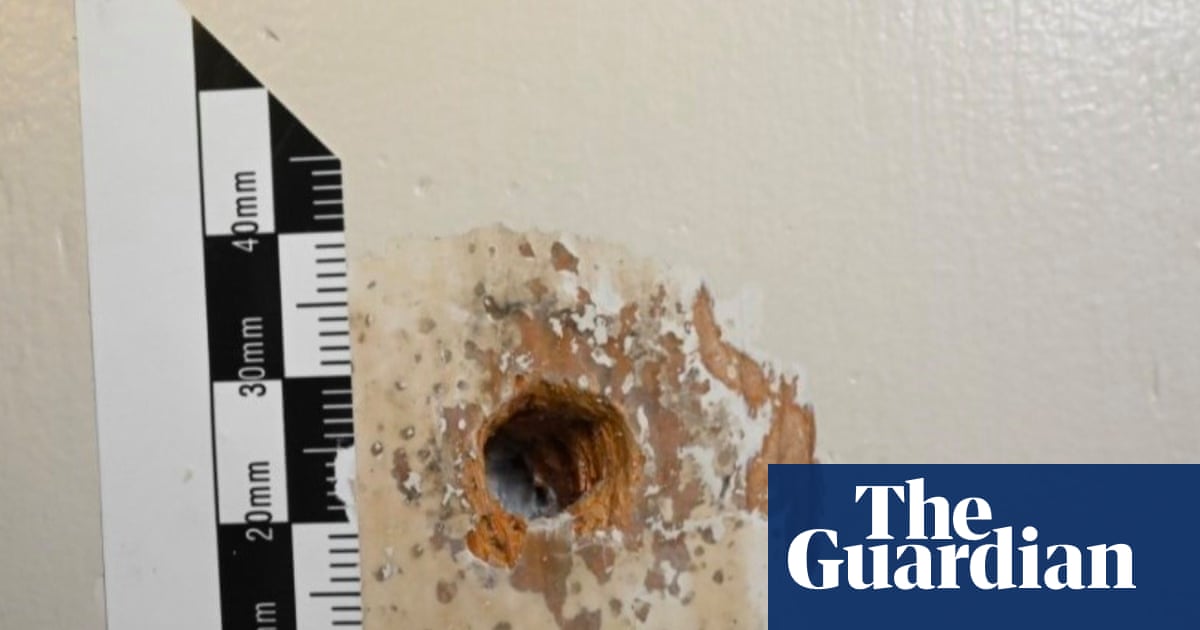
A key element of the testimony came from Lucas Van Der Walt, a firearms examiner for the New South Wales Police Force. He focused his analysis on a bullet hole found in a bedroom door, which the prosecution alleges was used to shoot Davies. Van Der Walt testified that he could determine the trajectory with greater certainty because the bullet passed through wood that was 35 millimeters thick. His examination included looking for signs of propellant residue, known as stippling, around the entry point.
Stippling occurs when unburned or partially burned gunpowder particles strike a surface near the muzzle of a firearm. Van Der Walt explained to the jury that the spread of these particles helps estimate the distance between the gun and the target. He stated that the pattern found on the painted door suggested the muzzle was only 10 to 20 centimeters away from Davies when the weapon was discharged. This proximity supports the prosecution’s claim of a close-range shooting rather than a distant accidental discharge.
To substantiate his findings, Van Der Walt described test firings conducted by police using the same type of gun and ammunition allegedly used in the crime. The door from Baird’s bedroom was removed for testing, and the resulting bullet holes were compared to the original evidence. The expert told the court that the spread pattern of propellant particles impacting the paint and wood in the test shots was very similar to what was observed at the scene. This comparison aims to validate the estimated distance of the shooter.
The examination also addressed discrepancies in the physical evidence, such as the absence of additional bullet marks or recovered bullets in the room where Davies died. Van Der Walt suggested that the missing bullet may have struck an object like a pillow or jacket and been subsequently removed and discarded by cleaners who thoroughly processed the scene. He noted that if a bullet slowed down enough to only lightly impact a surface, it might leave behind a scuff mark indistinguishable from normal wear and tear.
The defense’s theory relies on the assertion that the shootings were not premeditated but rather the result of chaotic encounters. By arguing that Baird was shot from further away than the prosecution claims, the defense seeks to undermine the narrative of intentional execution. The upcoming proceedings will likely focus on reconciling these conflicting accounts with the physical evidence presented, including the ballistics data and the digital reconstruction of the crime scene.
As the trial continues, the jury must weigh the technical testimony against the broader context of the events. The detailed analysis of propellant patterns and bullet trajectories provides a scientific framework for understanding the mechanics of the shootings. However, determining intent remains a complex task that depends on how these forensic details align with witness testimonies and other evidence yet to be fully explored in court.
The case highlights the challenges of interpreting digital reconstructions and ballistics evidence in high-stakes criminal trials. While the 3D video offers a compelling visual narrative, judges and experts alike remind jurors that such tools are aids rather than definitive proof. The outcome will depend on how effectively each side can link the physical traces left at the scene to their respective theories of accidental struggle versus deliberate murder.
Sources behind this briefing
Go to the original reporting
- The Guardian World↗Beau Lamarre-Condon trial shown crime scene reconstruction as ballistics expert traces bullet trajectories