The short version
- A study analyzing fingerprints on terra-cotta warriors indicates a diverse workforce including women and juveniles.
- Researchers used Bayesian modeling to overcome limitations in traditional fingerprint classification methods.
- Findings align with historical records of female and child labor in Qin dynasty state production.
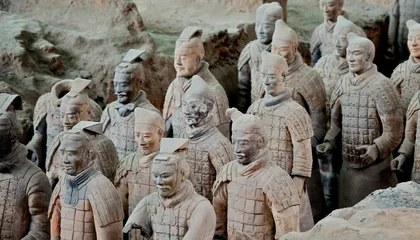
The creation of China’s terra-cotta army, a vast collection of life-sized sculptures buried with the first emperor Qin Shi Huang, has long been attributed to adult male artisans. However, new research published in the Journal of Cultural Heritage suggests that this traditional view may be incomplete. A team led by Xiaoxi Li from the Emperor Qin Shi Huang’s Mausoleum Site Museum analyzed fingerprints preserved on the clay figures and found biological evidence pointing to a more diverse labor force that included adult women and juveniles.
The terra-cotta warriors, rediscovered in 1974 by farmers digging a well in northwest China, number approximately 8,000. These figures are renowned for their individuality; no two soldiers are identical. Art historians have previously noted that while the torsos were modeled by hand, heads and hands were cast from molds. The final stages involved carving fine details into layers of clay, firing the sculptures, painting them, and equipping them with real weapons. This meticulous process required significant manual labor, but the specific demographics of the workers remained largely inferred rather than proven.
To investigate the workforce composition, researchers identified 79 well-preserved fingerprints on 36 warriors. They applied a Bayesian mixture model, a statistical method developed in 2023, to analyze these impressions. This approach differs from traditional methods that classify individual prints based on ridge breadth and density. Instead, it evaluates the entire batch of data to estimate the probability distribution of ages and sexes within the group, accounting for variations that can skew individual assessments.
The analysis revealed that 45 percent of the fingerprints likely belonged to adult women, while 33 percent appeared to come from adult men. The remaining 22 percent were attributed to juveniles, defined in the study as individuals under the age of 15. This age threshold aligns with Qin dynasty records indicating that 15 was the minimum age for criminal responsibility and forced labor or military service. These findings provide the first biological evidence supporting the presence of women and children in the production process.
Traditional fingerprint analysis has limitations, particularly when distinguishing between adult women and teenage boys, whose ridge patterns can be virtually identical. Conventional methods also often fail to account for interpopulation variation and the shrinkage of ceramics during firing. The Bayesian model addresses these issues by testing various possible mixes of demographics against the measurements and retaining those that fit best. This allows researchers to return ranges of probability rather than definitive classifications for each print.
Despite the compelling nature of the data, the researchers caution against drawing sweeping conclusions. The sample size was relatively small, drawn from only one of the three army pits. It is also possible that a single individual left fingerprints on multiple sculptures. Furthermore, inexperienced workers, who likely included women and children, may have been more prone to leaving behind fingerprints than trained artisans, who might have smoothed out such traces during finishing work.
The study’s findings resonate with existing historical records. Inscriptions on Qin dynasty lacquerware found in Hubei Province include phrases translating to “adult woman,” “young woman,” and “young boy.” These texts indicate that women and children participated in state-supervised production activities. The alignment between the biological evidence from the terra-cotta figures and these written records strengthens the argument for a diverse workforce.
The terra-cotta army was not intended as a realistic portrait gallery but as a retinue to serve the emperor in the afterlife. The goal of the sculptors was to recreate reality through replication, ensuring each figure possessed unique characteristics. The involvement of women and children in this monumental project challenges assumptions about gender roles and labor practices in ancient China. It suggests that state-sponsored production may have relied on a broader segment of the population than previously thought.
Further research could expand the sample size to include fingerprints from other pits, potentially providing a more comprehensive picture of the workforce. The use of advanced statistical modeling in archaeology offers new tools for understanding historical labor dynamics. As more data becomes available, historians may refine their understanding of how these iconic sculptures were created and who contributed to their construction.
The implications of this study extend beyond the terra-cotta army. It highlights the importance of reevaluating traditional assumptions about ancient societies using modern scientific methods. By integrating biological evidence with historical records, researchers can gain deeper insights into the social structures and labor systems of past civilizations. This approach may lead to new discoveries in other archaeological contexts where workforce demographics have been similarly overlooked.
Sources behind this briefing
Go to the original reporting
- Smithsonian Magazine↗Did Women and Children Collaborate With Male Artisans to Create China's Terra-Cotta Army? Fingerprints Left on the 2,000-Year-Old Clay Warriors May Hold the Answer