The short version
- Romanian authorities rescued five crew members from a chemical tanker struck by a drone, while seven others remain missing.
- Similar incidents involving commercial vessels have occurred in the exclusive economic zones of Romania and Bulgaria over the past week.
- NATO officials are coordinating with regional allies to strengthen counter-drone capabilities and adjust defense postures along the eastern flank.
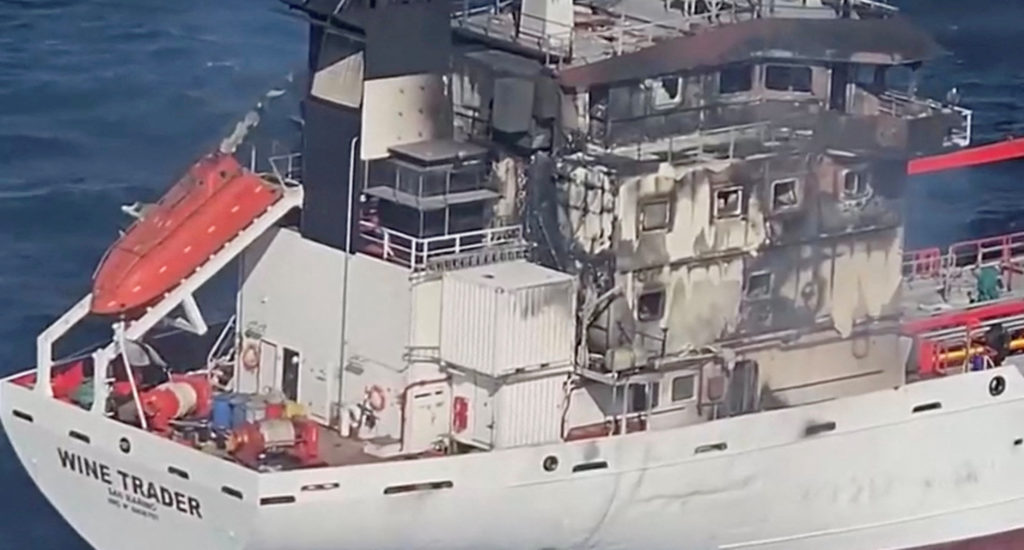
Romanian authorities initiated search and rescue operations off the Black Sea coast on Thursday following a drone strike that ignited a fire on a chemical tanker. The incident marks the latest in a growing series of attacks on commercial shipping in the region, intensifying fears that the conflict in Ukraine is expanding beyond its immediate borders. Five crew members were pulled from the water after the San Marino-flagged vessel Wine Trader was hit approximately 13 nautical miles southeast of the port town of Sulina. Seven individuals remain unaccounted for as rescue teams continue their efforts.
Romanian President Nicusor Dan confirmed in Brussels that the cargo ship had been targeted by a drone, noting that another vessel suffered a similar fate in a separate incident the previous night. While he did not specify the origin of the drones, he warned that the Romanian state would respond to these provocations. The Wine Trader was traveling from Tunisia to Romania when it was struck. Initial medical assessments indicated that one rescued crew member sustained scalp burns and another experienced mild smoke inhalation, while three others appeared unharmed.
The attack on the Wine Trader follows a disturbing pattern of maritime incidents in the Black Sea. On Wednesday evening, a fire broke out on the Comoros-flagged Yara J, a chemical and oil tanker en route from Turkey to Sulina. This incident occurred within Romanian territorial waters. Although the crew was reported safe, Romania’s acting defense minister, Radu Miruta, stated that an investigation is underway. He noted that while air targets were monitored near Ukraine’s Snake Island overnight, no drone was detected on military radars heading directly toward the Yara J.
Tensions have escalated significantly over the past week with multiple strikes in the exclusive economic zones of both Romania and Bulgaria, members of NATO and the European Union. On Tuesday, drone attacks targeted two ships off the Bulgarian coast, prompting emergency operations for eleven crew members from the Guinea-Bissau-flagged HS Dignity who remain missing. Another vessel, the Maltese-flagged Chelsea 3, operated by Ukraine, had its deck and hull hit by three aerial drones. All fifteen crew members were evacuated, with five receiving treatment for minor injuries.
Bulgarian Prime Minister Rumen Radev suggested that Russia was likely responsible for the Tuesday attacks, which came just a week after sea and aerial drones struck two other commercial vessels in Bulgaria’s exclusive economic zone. In those earlier incidents, a Togo-flagged ship sank, and a Bulgarian ferry evacuated the eighteen-member crew of a damaged Palau-flagged vessel. The frequency and nature of these attacks have raised serious concerns about maritime safety and the potential for broader regional instability.
The pattern of violence extends further back to October 5, when a Turkish-owned cargo ship carrying corn caught fire following a drone attack off Romania’s coast. The vessel subsequently sank in the Black Sea, resulting in two deaths and the rescue of eleven crew members. These events have underscored the vulnerability of commercial shipping lanes to modern asymmetric warfare tactics, particularly the use of unmanned aerial systems that can operate with relative impunity across contested waters.
In response to the escalating threats, NATO Secretary-General Mark Rutte met with Romanian President Dan and Bulgarian Prime Minister Radev to discuss security measures in the Black Sea. Rutte emphasized that the alliance has strengthened its posture along the eastern flank, including an increase in counter-drone capabilities. He affirmed that NATO will continue to work closely with its allies in the region, adjusting deterrence and defense strategies as necessary to address these emerging challenges.
The incidents highlight a significant shift in the dynamics of the war in Ukraine, with spillover effects impacting neutral commercial traffic and neighboring countries. While official attributions remain cautious, the timing and location of the strikes suggest a deliberate strategy to disrupt supply lines and test regional defenses. As investigations continue, the focus remains on ensuring the safety of maritime routes and preventing further escalation that could draw NATO members more directly into the conflict.
Authorities in both Romania and Bulgaria are coordinating their responses to these attacks, balancing the need for robust defense with diplomatic caution. The rescue operations and subsequent inquiries are ongoing, with no definitive conclusions yet reached regarding the perpetrators or the full extent of the damage. The situation remains fluid, with international observers closely monitoring developments in the Black Sea as a potential flashpoint for broader geopolitical tension.
Sources behind this briefing
Go to the original reporting
- PBS NewsHour↗Drone strike on ship in Romanian waters raises fear that war in Ukraine is spreading