The short version
- A digital facial reconstruction has been created for a man who died in Scotland between 140 and 165 C.E., based on DNA, isotopic analysis, and skeletal examination.
- The individual likely migrated from southern Britain to the Lothian region, joining three other decapitated men of diverse geographic origins found at the same site.
- Physical evidence suggests he lived a physically demanding life but suffered from a right-arm condition that may have prevented him from serving as a Roman soldier.
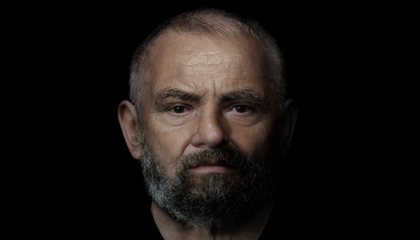
A new digital reconstruction allows the public to visualize the face of a man who died nearly two millennia ago in what is now Musselburgh, Scotland. The individual, who lived during the height of Roman occupation in Britain, was among four men discovered in 2010 whose heads had been separated from their bodies after death. National Museums Scotland has combined osteoarchaeological data with ancient DNA and isotopic analysis to produce this portrait, which will be displayed alongside his skull in an upcoming exhibition titled 'Roman Scotland: Life on the Edge of Empire.'
The reconstruction depicts a man in his early fifties with brown eyes, dark hair that was graying, and facial lines indicating age. Forensic artist Chris Rynn utilized genetic markers to determine skin, eye, and hair color, while also generating several plausible hairstyles consistent with the DNA results. These variations include a thinning widow’s peak with a bushy, gray-flecked beard or a fuller head of curly dark hair. The goal was not to create a definitive likeness but rather a scientifically grounded approximation that his contemporaries might have recognized.
Skeletal analysis reveals that the man endured a physically rigorous existence marked by significant trauma. His remains show healed fractures to the nose and ribs, suggesting he survived serious injuries well before his death. A bone growth around his right elbow joint points to septic arthritis, a condition that would have severely limited mobility in that arm. Dental wear patterns indicate he adapted to this impairment by using his mouth to grasp objects, further underscoring the physical demands of his daily life.
Despite living near the Roman fort at Inveresk, evidence suggests he was not a soldier. The arthritis in his right hand would have made wielding a sword difficult, leading researchers to propose alternative roles. He may have worked in an administrative capacity, such as a clerk, or perhaps used his left hand for combat if he did serve in a military context. This distinction helps clarify the social standing of individuals buried with such unusual rites near imperial infrastructure.
The circumstances surrounding his burial remain enigmatic. The man was interred on his back with his feet and shoulders elevated above his torso, while his head was placed to his right side, facing inward. Cut marks on the bones indicate the decapitation occurred postmortem, likely at the base of the neck. No funerary goods were found in the grave, yet the skeleton itself is among the best-preserved specimens from the site. This specific arrangement differs from standard Roman burial practices and hints at complex cultural or ritual motivations.
Isotopic analysis provides crucial context regarding his origins. Strontium levels in his teeth suggest he spent his childhood in southern Britain, hundreds of miles from where he eventually died. He was not alone in this migration pattern; two of the other decapitated men found at the site also appear to have originated in England. The third individual grew up in Scotland, while the fourth traced his roots to the Mediterranean region.
The diversity of origins among these four men challenges simple explanations for their shared burial treatment. Researchers note that because the individuals did not share a common geographic background, the decapitation ritual was likely not tied to a specific ethnic or regional identity. Instead, it may reflect a broader practice adopted by migrants settling in the Lothian area during the second century.
Scholars have proposed several theories for why these men were beheaded after death. One possibility is that the practice stemmed from early Celtic traditions that attributed supernatural power to severed heads. Another theory suggests the act served as a precautionary measure to prevent the dead from returning to life, or perhaps as a form of posthumous punishment. With over 500 similar decapitation burials identified across the United Kingdom, experts continue to debate whether these rites were uniform in meaning or varied by local custom.
The exhibition aims to humanize these historical figures by moving beyond skeletal data to present them as individuals with distinct appearances and life stories. Curators emphasize that while the exact reasons for the burial rituals remain uncertain, the scientific techniques used to reconstruct the man’s face offer a tangible connection to the past. The display invites visitors to consider the hopes, fears, and daily struggles of people who lived on the frontier of the Roman Empire.
As more ancient DNA and isotopic studies become available, researchers expect to refine their understanding of migration and social structure in Roman Britain. This case highlights how interdisciplinary collaboration can uncover details about identity and mobility that were previously inaccessible. The upcoming exhibition will serve as a focal point for these findings, presenting the reconstructed face as a window into the complex lives of those who inhabited the northern edge of the empire.
Sources behind this briefing
Go to the original reporting
- Smithsonian Magazine↗Archaeologists in Scotland Discovered the Skeleton of a Roman-Era Man Who Was Decapitated Nearly 2,000 Years Ago. Now, You Can See What He Might Have Looked Like During His Lifetime