The short version
- Excavators uncovered a skeleton oriented eastward, confirming the site as a Norse Christian church rather than a secular structure.
- The location near Brattahlíð suggests local elites competed for religious authority and revenue during the colony's peak.
- Researchers aim to date the structure more precisely to understand the timeline of the settlement's mysterious disappearance.
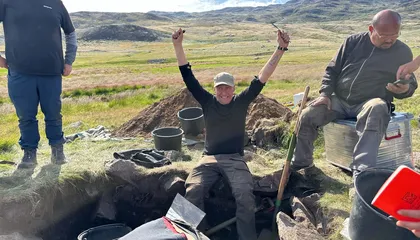
Archaeologists working in southern Greenland have identified definitive evidence of a Norse church, resolving a long-standing question about the function of a stone structure discovered decades ago. The confirmation came from the unearthing of a human skeleton buried with its head pointing east and arms at its sides, a positioning consistent with Christian burial practices in the early Middle Ages. This find serves as conclusive proof that the site was a place of worship, marking the first such discovery in the region in more than sixty years.
The excavation took place near the modern town of Narsarsuaq, approximately three miles from Brattahlíð. This estate served as the primary hub for the Norse colony and was the home of Erik the Red, who led settlers from Iceland to Greenland around 985 C.E. The colony thrived for centuries, supporting a population that peaked at roughly 3,000 individuals. These settlers established manor houses, hundreds of farms, and trade networks that exported furs, walrus ivory, and other Arctic goods to Europe.
Researchers first identified the potential church site in the early 2000s when they found a rectangular stone wall surrounding a smaller stone building. While the layout suggested a religious function, archaeologists required a cemetery to verify the structure's purpose. Initial digs yielded charcoal and fragments of decomposed bone, hinting at human activity but falling short of confirmation. It was not until recent excavations in August that the team recovered a complete skeleton, providing the necessary evidence to classify the building as a church.
Christian Edelfelt Koch Madsen, an archaeologist with the National Museum of Denmark and co-leader of the dig, described the skeleton as the 'smoking gun' that removes any doubt regarding the site's identity. Based on the construction materials, which include hewn stones, and the overall size of the building, researchers estimate it dates between 1100 and 1300 C.E. This timeframe aligns with the period when Norse settlers in Greenland were actively transitioning to Christianity, integrating European religious structures into their isolated society.
The discovery adds to a growing understanding of the social dynamics within the Norse colony. In total, six church remains have been identified around Brattahlíð. Researchers suspect these structures were built by wealthy local farmers or landlords who sought to compete for religious power and the associated revenue. Madsen noted that these competing churches demonstrate how settlers began vying for control over community leadership during the early Middle Ages, reflecting a complex hierarchy rather than a unified settlement.
The site may correspond to a 'Church Under the Sunny Mountains' mentioned in the Flateyjarbók, a medieval Icelandic manuscript. The location sits before a mountain range that receives significant sunlight due to its proximity to the North Pole and frequent high-pressure weather systems. However, researchers caution that many areas in Greenland share similar topographical features. The manuscript also references two other churches that could be located nearby, suggesting the area was densely populated with religious institutions.
The ultimate mystery surrounding the Norse presence in Greenland remains their disappearance in the early 15th century. Despite their initial success in building a prosperous society that imported stained glass and raised livestock, the colony vanished without a clear explanation. Konrad Smiarowski, an environmental archaeologist at the University Museum of Bergen and co-leader of the project, stated that this discovery is another piece of the puzzle. It may help clarify what happened to the colony and why it ultimately failed to sustain itself.
Looking ahead, the research team plans to analyze artifacts recovered during the recent dig. If they can secure additional funding, they intend to return to the site to narrow down the construction date of the church. This precise dating could provide critical insights into the timeline of religious adoption and social stratification in the colony. The findings contribute to a broader effort to understand how Norse society developed and eventually collapsed in one of the harshest environments on Earth.
Sources behind this briefing
Go to the original reporting
- Smithsonian Magazine↗Archaeologists Searching for Evidence of a Norse Church in Greenland Have Found 'the Smoking Gun' Near Erik the Red's Settlement