The short version
- Astronomers have identified a new celestial body, 2026 ED138, orbiting 46 times farther from the sun than Earth.
- The object takes approximately 281 years to complete one orbit and may be large enough to be round, a key criterion for dwarf planet status.
- Confirmation of its size is pending, as brightness alone cannot distinguish between a small reflective body and a larger duller one.
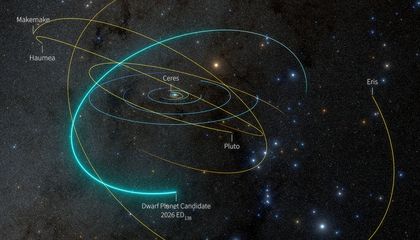
Astronomers have identified a mysterious object in the distant reaches of our solar system that could potentially be classified as a sixth dwarf planet. The celestial body, designated 2026 ED138, was discovered by Matthew Holman, a senior astrophysicist at the Smithsonian Astrophysical Observatory, while analyzing data from the Vera C. Rubin Observatory in Chile. Holman and his colleague Kevin Napier had been using a custom computer program to identify small objects in the solar system when they noticed an anomaly that appeared significantly larger than typical discoveries.
Initial caution is standard in this field, as astronomers frequently encounter false positives where bright objects turn out to be unremarkable upon closer inspection. However, Holman and his team verified the object's existence by locating it in historical photographic data spanning the past decade and even tracing it back to plates from 1937 stored at Harvard. This archival evidence allowed them to map its orbital path with increasing confidence, confirming that the object is real and consistently appears at predicted locations.
The newly identified body orbits the sun at a distance of 46 times that between Earth and the sun. It completes one full orbit every 281.1 years, placing it far beyond Pluto in the outer solar system. The central scientific question now revolves around its physical size. To be classified as a dwarf planet, an object must be massive enough for its gravity to pull it into a nearly round shape, but not large enough to clear its orbital neighborhood of debris. Current estimates suggest ED138 could range from 370 to 930 miles in diameter, which would place it within the size parameters of known dwarf planets.
Determining the exact size of ED138 remains challenging because astronomers cannot rely solely on brightness measurements. A smaller object covered in highly reflective ice could appear just as bright as a much larger, darker body. Consequently, further observations are required to confirm whether the object is indeed round and thus qualifies for dwarf planet status. If confirmed, it would join the ranks of Pluto, Eris, Haumea, Makemake, and Ceres as one of only five other officially recognized dwarf planets in our solar system.
Paul Byrne, a planetary scientist at Washington University in St. Louis who was not involved in the discovery, described the finding as incredibly exciting. He noted that it heralds a new era for solar system and planetary science, highlighting the potential for further discoveries in the distant regions of our cosmic neighborhood. The ability to trace such objects back nearly a century demonstrates the value of archival data in modern astronomical research.
The discovery process involved sifting through thousands of data points from the Rubin Observatory, which has been instrumental in identifying small solar system bodies. Holman and Napier had already spotted more than 2,000 small objects before ED138 caught their attention due to its unusual brightness and apparent size. The verification process underscored the importance of cross-referencing new data with historical records to establish orbital characteristics accurately.
While the object's existence is confirmed, its classification remains provisional until precise size measurements are obtained. The distinction between a large asteroid and a dwarf planet hinges on hydrostatic equilibrium—the state where an object's self-gravity overcomes rigid body forces to assume a round shape. ED138's estimated diameter suggests it likely meets this criterion, but definitive proof requires additional observational data.
The implications of this discovery extend beyond adding a new member to the solar system's catalog. It provides insights into the formation and evolution of distant celestial bodies and may help scientists understand the distribution of mass in the outer solar system. The object's long orbital period and vast distance from the sun make it a subject of significant interest for researchers studying the Kuiper Belt and beyond.
Future observations will focus on refining the size estimates and determining the surface composition of ED138. These details will help clarify whether the object is covered in ice, rock, or other materials, which can influence its brightness and reflectivity. The scientific community awaits these findings with anticipation, as they could reshape our understanding of the solar system's outer boundaries.
This discovery highlights the ongoing capabilities of modern observatories combined with historical data analysis. As technology advances, astronomers are better equipped to explore the farthest reaches of our solar system, uncovering hidden objects that have remained undetected for decades. The potential confirmation of a sixth dwarf planet marks a significant milestone in contemporary astronomy.
Sources behind this briefing
Go to the original reporting
- Smithsonian Magazine↗Astronomers Found a Mysterious Object Orbiting Far Beyond Pluto. It Could Be a New Dwarf Planet Hidden in Our Solar System
- SciTechDaily↗The Solar System May Have a 6th Dwarf Planet – and It’s Been Hiding in Plain Sight
- The Watchers - Watching the world evolve and transform↗Archival observations trace Rubin dwarf-planet candidate 2026 ED138 across 89 years