The short version
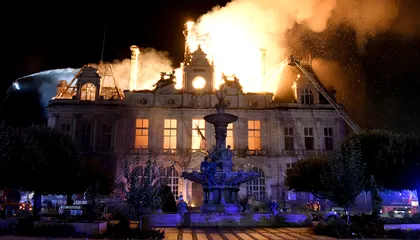
- Masked individuals set fire to the Limoges city hall on Saturday, causing extensive damage to the facade, spire, and roof.
- Authorities have classified the incident as arson, linking it to a broader wave of antigovernment demonstrations sweeping across France.
- Local leaders are requesting substantial federal funding for reconstruction, citing the successful restoration model used for Paris's Notre-Dame Cathedral.
A historic municipal building in central France suffered catastrophic damage this weekend after masked individuals breached the premises and ignited fires that consumed much of the structure. The Limoges city hall, a celebrated example of late 19th-century architecture, saw its facade, spire, and roof collapse or sustain severe destruction. French officials immediately characterized the incident as a deliberate act of arson rather than an accident, marking a significant escalation in the recent wave of antigovernment protests that have unsettled the nation.
The building holds deep cultural significance for the region. It opened its doors on Bastille Day in 1883 and was designated a historic monument in 1975 due to its ornate metal belfry and architectural merit. The exterior featured mosaic portraits of four notable former residents, including an enamel painter, a French chancellor, a revolutionary orator, and a Napoleonic marshal. These artistic elements, along with the structural integrity of the building, have been largely lost in the blaze.
Regional authorities described the destruction as a catastrophe for cultural heritage. Maurice Barate, a top official, stated on national television that the historic front section was almost entirely destroyed. He condemned the act as the work of hooligans and emphasized the deliberate nature of the attack. The physical devastation has drawn immediate comparisons to the 2019 fire at Notre-Dame Cathedral in Paris, though the causes differ significantly. While Notre-Dame burned likely due to accidental circumstances during renovations, the Limoges incident was a targeted assault.
The emotional resonance of the event is profound for local residents who view the city hall as a cornerstone of civic life. Many had used the venue for personal milestones such as weddings and baptisms. Witnesses expressed outrage and grief, with some noting that photographs are now the only remaining record of the building's former glory. The visual similarity to the Notre-Dame tragedy has intensified public sorrow, even though the contexts of the two fires are distinct.
In response to the destruction, local leadership is calling for substantial financial intervention from the national government. Guillaume Guérin, the mayor of Limoges, explicitly referenced the reconstruction effort for Notre-Dame, which saw donors raise nearly $1 billion and resulted in a reopened cathedral by late 2024. He urged federal authorities to provide similar capacity for rebuilding, describing the need for a significant influx of funds to restore the city's landmark.
Emergency crews remain on site to monitor the structural stability of the ruins. The primary concern is preventing further collapse and ensuring safety in the surrounding area. Residents have gathered at a distance to pay respects to the damaged building, highlighting its role as a community hub. The incident underscores the vulnerability of historic sites during periods of civil unrest and raises broader questions about security measures for protected monuments.
The timing of the attack coincides with heightened political tension in France. Antigovernment protests have gripped the country in recent days, creating an environment where public infrastructure is at risk. Authorities are investigating the identities of those responsible for breaching the building and setting the fires. The classification of the event as arson suggests a coordinated effort rather than spontaneous vandalism, adding complexity to the ongoing security challenges faced by local governments.
Reconstruction efforts will likely face logistical and financial hurdles. While the precedent of Notre-Dame offers a model for large-scale heritage restoration, the deliberate nature of this damage may complicate insurance claims and public funding allocations. The city must now balance immediate safety concerns with long-term preservation goals. The loss represents not just a structural failure but a blow to local identity and historical continuity.
As investigations continue, the focus remains on stabilizing the site and determining the full extent of the losses. The incident serves as a stark reminder of the fragility of cultural assets in times of social upheaval. Local officials are expected to present detailed plans for restoration in the coming weeks, relying on both public support and government assistance to rebuild what was lost.
The broader implications extend beyond Limoges. Other historic sites across France may need to reassess their security protocols in light of this attack. The incident highlights the intersection of political protest and cultural preservation, a challenge that requires careful navigation by authorities. The community now faces the difficult task of healing while preparing for a lengthy reconstruction process.
Sources behind this briefing
Go to the original reporting
- Smithsonian Magazine↗The Burning of This French City Hall Was a 'Catastrophe for Heritage,' Tragically Reminiscent of the Notre-Dame Fire