The short version
- Miles Russell argues that linguistic and numismatic evidence points to Verica being female rather than male.
- Skeptics question the reliability of stylized coin imagery and note that classical texts refer to the ruler using masculine terms.
- The debate highlights broader shifts in understanding Iron Age social structures, including potential matrilocal inheritance patterns.
A prominent British archaeologist is challenging the traditional narrative surrounding one of the most pivotal figures in the Roman conquest of Britain. Miles Russell, a researcher at Bournemouth University, proposes that Verica, historically identified as an ousted king who appealed to Emperor Claudius for military assistance, was actually a queen. This reinterpretation suggests that long-standing assumptions about gender roles in late Iron Age leadership may reflect modern biases rather than historical reality.
The significance of Verica lies in the role this leader played in precipitating the Roman invasion of 43 C.E. Following the death of the powerful tribal chieftain Cunobelinus and the rise of his son Caratacus, political instability swept through southern Britain. Verica, who led the Atrebates tribe across territories that now include Berkshire, Hampshire, and West Sussex, was displaced from power. Seeking refuge and support, this ruler crossed the English Channel to Rome, providing Claudius with a pretext to launch an invasion that would transform the island into an imperial province for nearly four centuries.
Russell’s argument rests on several lines of evidence, beginning with linguistics. In Iron Age Britain, personal names ending in the suffix “-a” were predominantly associated with women, a pattern seen in other known female rulers such as Boudica and Cartimandua. Conversely, male names typically ended in “os” or “us.” While Russell acknowledges this is not an absolute rule, he notes it applies to approximately 95 percent of recorded Iron Age British names, making the feminine ending of Verica’s name statistically significant.
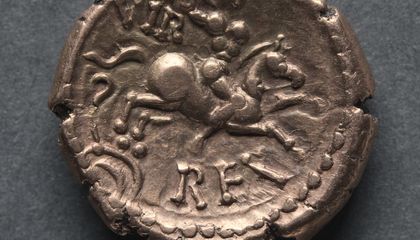
Numismatic evidence further supports the possibility of a female ruler. Coins minted under Verica’s authority depict slender, bare-breasted equestrian figures that Russell describes as appearing irrefutably female. This stands in contrast to contemporary coinage issued by male leaders like Cunobelinus, which often featured overtly masculine warrior imagery. Additionally, some of Verica’s coins bear the Latin abbreviation “COM F.” Traditionally interpreted as Commios filius, meaning son of Commios, Russell suggests this could equally denote Commios filia, or daughter of Commios, a leader who had allied with Julius Caesar during earlier conflicts in Gaul.
The title “rex” appearing on these coins has also been reexamined. While commonly translated as king, Russell argues that in this context, it may serve as a non-gender-specific designation indicating that the ruler held full authorization from the Roman emperor. This interpretation aligns with recent archaeological findings regarding social structures in southern Britain. A 2025 study co-authored by Russell indicated that Iron Age communities were likely matrilocal, meaning women remained in their ancestral homes while men moved, suggesting that land and status may have been inherited through the female line.
If Verica was indeed a woman, it could shed new light on the tone of Roman historical accounts. Chroniclers such as Cassius Dio often portrayed Emperor Claudius as easily manipulated or “henpecked.” Russell suggests that depicting the invasion as prompted by a female barbarian leader fits this narrative pattern, allowing Roman writers to frame the campaign as the result of whisperings from a femme fatale rather than a strategic imperial decision. This perspective challenges the view of the invasion as solely driven by male political maneuvering.
However, the proposal has met with skepticism from other experts in the field. Katharina Rebay-Salisbury, an archaeologist at the University of Vienna, questions the reliability of the numismatic evidence. She notes that the stylized nature of Iron Age coin imagery makes it difficult to definitively distinguish between male and female bodies, casting doubt on the claim that the figures are irrefutably female.
Roger Tomlin, a specialist in Roman epigraphy at the University of Oxford, raises additional concerns. He points out that Cassius Dio explicitly referred to the ruler as “Bericus,” a masculine form, and disputes the assertion that the title “rex” was used for female rulers. These counterarguments highlight the limitations of the available evidence and the challenges of reinterpreting historical records through a modern lens.
Despite the criticism, Russell views the controversy as a positive development for the field. He argues that the long-standing one-sided narrative has needed revision and that scholarly debate is essential for uncovering more accurate histories. The discussion surrounding Verica underscores broader efforts to reassess ancient societies, moving beyond patriarchal assumptions to consider the complex roles women may have played in leadership and politics during the Iron Age.
The implications of this research extend beyond the identity of a single ruler. They touch on how historical narratives are constructed and perpetuated, often reflecting the biases of later interpreters rather than the realities of the past. As archaeologists continue to analyze material culture and textual records, figures like Verica serve as focal points for reevaluating our understanding of ancient British society and its interactions with the Roman Empire.
Sources behind this briefing
Go to the original reporting
- Smithsonian Magazine↗Was the British King Who Urged the Romans to Invade Actually a Queen? One Archaeologist Thinks So